


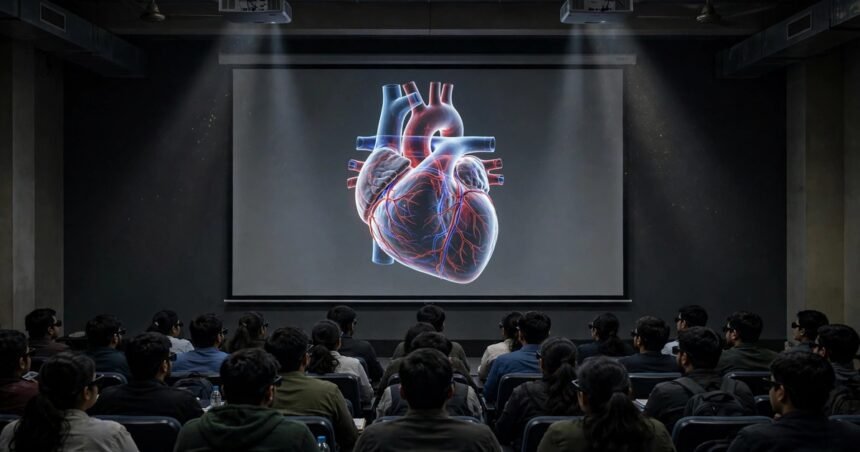
The technology that made Malayalam cinema’s pioneering 3D film My Dear Kuttichathan leap off the screen is now helping surgeons in Thiruvananthapuram look inside the human body. StereoSurge, a platform built by the young Thiruvananthapuram startup Feraura Pvt Ltd, turns routine CT and MRI scans into high-definition stereoscopic 3D models — so doctors can map a procedure in depth before ever entering the operating theatre, and a whole classroom of medical students can study the same beating heart, tumour or tangle of blood vessels together, in three dimensions.
StereoSurge began as a research project between the Sree Chitra Tirunal Institute for Medical Sciences and Technology (SCTIMST) and the Government Engineering College, Barton Hill. Three students of the college’s 2025 information technology batch — Anand S, Radev Krishna M R and Devadathan A — carried it forward after graduation, incubating at SCTIMST-TIMed, the institute’s technology business incubator, and founding Feraura to commercialise it. In January 2026, on Makar Sankranti, the three signed a formal technology transfer agreement between Feraura, SCTIMST and Barton Hill, and StereoSurge entered its next phase.
Two projectors, one silver screen, 200 pairs of eyes
The setup is elegant in its simplicity. Two projectors simultaneously throw images onto a specialised silver screen, using the same polarisation technology that powers 3D cinema. Viewers wearing 3D glasses in a darkened room perceive real depth and spatial relationships between anatomical structures — where a tumour sits against its blood vessels, how a heart chamber curves, which tissue lies in front of which. The whole system is a customised projection unit, a computer, specialised software, a silver screen and 3D glasses.
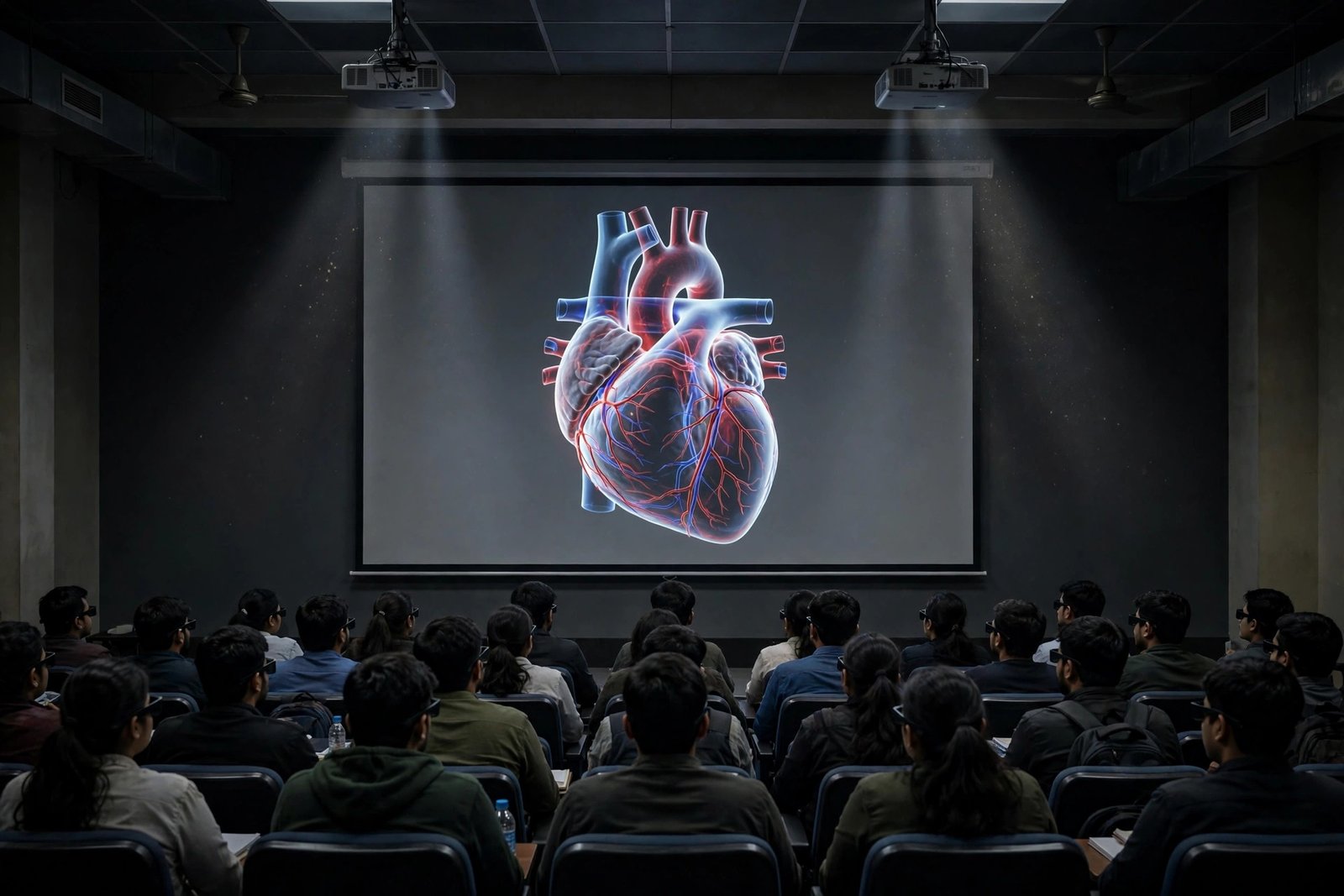
An illustration of a StereoSurge session: a 3D anatomical model projected for a classroom of medical students wearing 3D glasses. (AI-generated illustration)
Where a conventional visualisation system shows reconstructed anatomy on a flat screen, StereoSurge can hold around 200 viewers at once — an entire medical college classroom learning from the same three-dimensional image. Students can rotate structures a full 360 degrees, explore different regions and use colour options to pick out specific tissues and anatomical components, examining actual patient scans in three dimensions instead of reconstructing the body in their heads from a series of flat images.
More Read

Already inside two hospitals
The technology has already moved from the lab into institutional settings. A dedicated StereoSurge 3D Spatial Medicine Lab has been established at Thiruvananthapuram Government Medical College Hospital, and another unit is available at SCTIMST Hospital. For medical students, the platform adds a third dimension to anatomy education, alongside textbooks and cadaver dissection — and a complex heart surgery, once converted into a 3D model, can be stored and revisited to teach future batches of students, preserving rare cases and unusual anatomies as living teaching material.
The same depth that teaches students also sharpens research. Changes in brain volume associated with conditions such as Alzheimer’s disease can be studied through successive MRI scans and three-dimensional visualisations, and in the case of a brain tumour, doctors can examine its relationship with surrounding blood vessels and tissues, rotating the model to explore its spatial extent in far greater detail than a flat scan allows.
Built for the colleges that cannot buy a crore
What makes StereoSurge quietly radical is its price point. Expensive anatomical-visualisation systems such as Anatomage can cost more than Rs 1 crore, putting immersive 3D learning beyond the reach of many Indian institutions. StereoSurge, built on commodity projectors, a silver screen and software developed under the guidance of SCTIMST’s imaging specialists — with a joint patent application filed by SCTIMST and Barton Hill — aims to make that same depth of understanding affordable and accessible.
From a student project in Thiruvananthapuram to a dedicated lab in a government medical college, Feraura’s StereoSurge shows what happens when India’s finest medical institute and a government engineering college build together: a cinema trick, reimagined as a teaching and planning tool, that lets India’s next generation of doctors see the human body the way it actually is — in three dimensions, in depth, and all at once.
Keep reading: From Chip Packets to Sunglasses: Inside Without, the Pune Startup Recycling the Unrecyclable · Hunting Mosquitoes From the Sky: Inside Prime UAV’s AI Drones Taking On Malaria and Dengue · More Chemicals, Materials & Life Sciences stories
Like stories like this? Add Exceptional Technology as a preferred source on Google to see more of our reporting in your search results and Discover feed.







