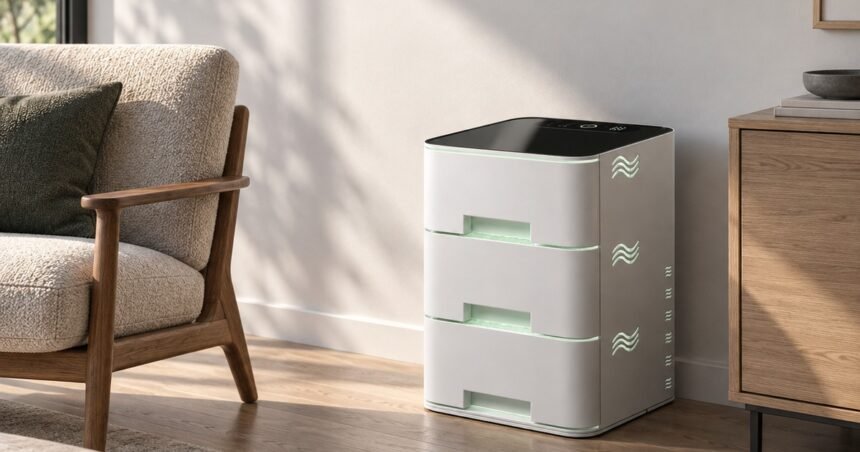
Every November, the same ritual plays out across Indian cities: the smog rolls in, the windows shut, and the air inside the house slowly turns stale. The purifier in the corner hums away at the dust — but the carbon dioxide keeps climbing with every breath, because no filter can touch it. In Gurugram, a company called Greenwater Scientific decided the answer was not a better filter at all. It was something alive.
Greenwater Scientific is an Indian biotechnology company building micro-algae technology for indoor air care. Co-founded by Dhruv Mehta and Sumir Mehta, the company combines research originating at the University of California San Diego with engineering and manufacturing in Manesar, Haryana — and its flagship product, the greenwaterHOME Air Synthesizer, puts a living photobioreactor next to the sofa. The device went on sale across India this November at ₹63,720, and the company calls it the world’s first indoor Air Synthesizer.
A living machine, not a filter
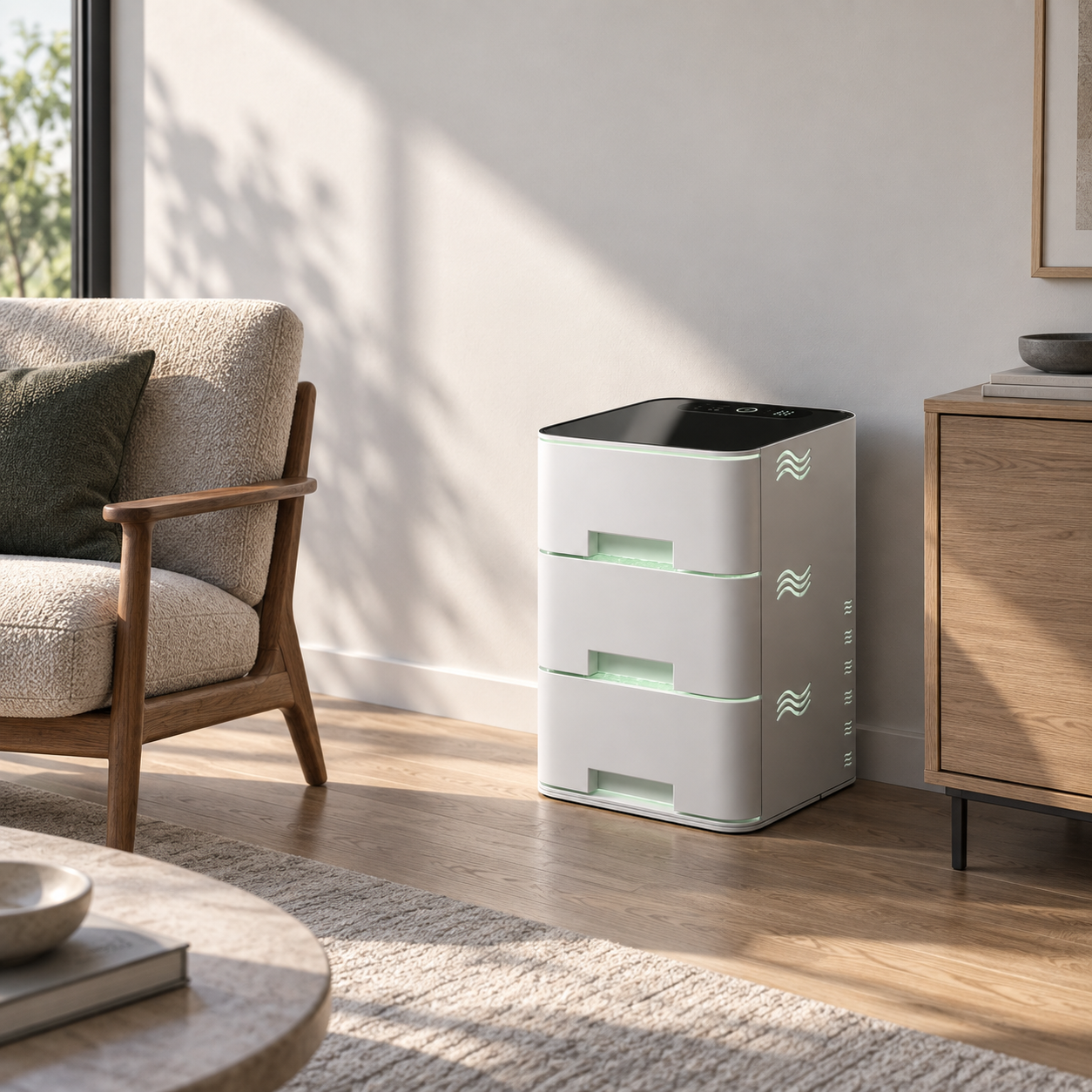
The idea behind the Air Synthesizer is beautifully simple. Roughly three-quarters of the oxygen on Earth is produced by phytoplankton and microalgae drifting in the ocean — single cells packed with chlorophyll that photosynthesise over their whole surface and keep dividing. Greenwater Scientific grows its cultures in a photobioreactor lab at its Gurugram headquarters, then ships them inside a compact unit built for the living room: a fan pulls room air through water holding the living microalgae, the carbon dioxide dissolves, the algae take it up, and oxygen rises back out into the room.
The company says the device makes 46 litres of oxygen a day, as measured by an NABL-accredited laboratory — about what 80 houseplants would produce, since an ordinary houseplant makes roughly 0.4 litres a day. Alongside the algae, the unit carries three-stage filtration for the air coming in from outside: a pre-filter, an H13-grade HEPA filter made of microfibre glass, and an activated carbon fibre filter with a honeycomb mesh that traps fine dust, smoke and volatile organic compounds such as benzene.
Tested in a sealed room
The numbers behind the device come from a sealed-room test the company ran from 14 November to 12 December 2025: an insulated 8×8×8 ft room filled with more than 3,000 ppm of carbon dioxide, measured every 15 minutes. With the Air Synthesizer running, the company says carbon dioxide fell by an average of 32% an hour and dropped below 1,000 ppm in about three hours; without it, levels stayed above 3,000 ppm. An NABL-accredited laboratory measured reductions of 95.1% in PM2.5, 95.7% in PM10 and 77.9% in benzene under test conditions.
Built for the living room
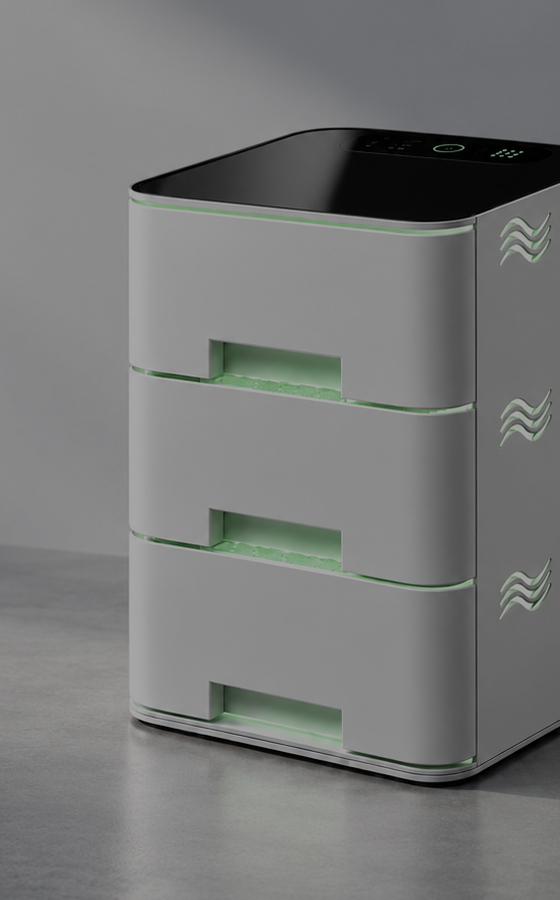
Greenwater Scientific designed the Air Synthesizer to be furniture first and machine second. It doubles as a side table, with a flat top for a coffee mug or a photo frame, and through its clear panel you can watch the culture shift from pale to deep green as it grows over the weeks — the darker it gets, the more carbon dioxide the algae are taking in. The company offers free installation by its field engineers, and a year of algae replacement — six refills, one every two months — delivered free for the first year. The device is also available on no-cost EMI from ₹4,779 a month.
More Read

The science behind it has travelled far: Greenwater Scientific has participated in the Blackstone LaunchPad Accelerator, received US Congressional recognition, and won the Grand Prize at UC San Diego’s Triton Innovation Challenge. It all began, the company says, when Dhruv Mehta watched a documentary explaining how much more efficient algae and phytoplankton are at photosynthesis than trees — and asked why we have always been taught to grow more plants to fight air pollution, when nature already has a far more effective resource. Three years of research and development later, that question sits in Indian living rooms, quietly turning carbon dioxide into fresh air — one glowing green bay at a time.
Keep reading: The One-Minute Brain Scan: Inside CEREBO, the Ahmedabad Device Spotting Brain Bleeds Before Symptoms Appear · Turning Methane Into Protein: Inside String Bio, the Bengaluru Company Brewing Food From Greenhouse Gas · More Chemicals, Materials & Life Sciences stories
Like stories like this? Add Exceptional Technology as a preferred source on Google to see more of our reporting in your search results and Discover feed.