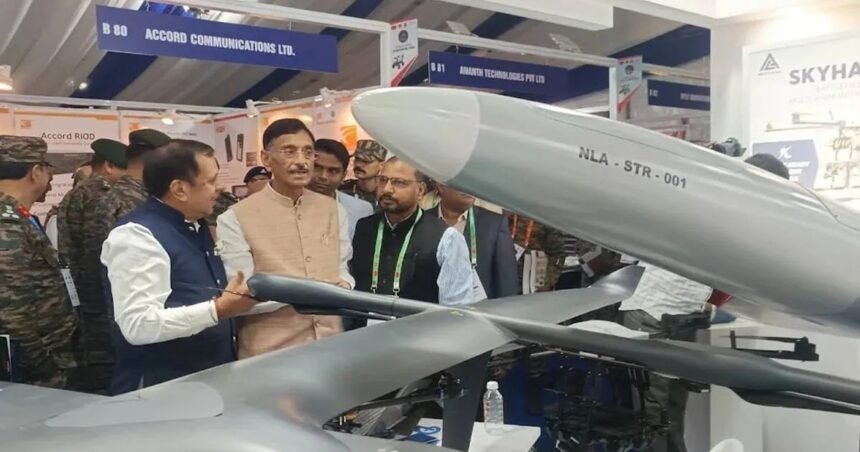
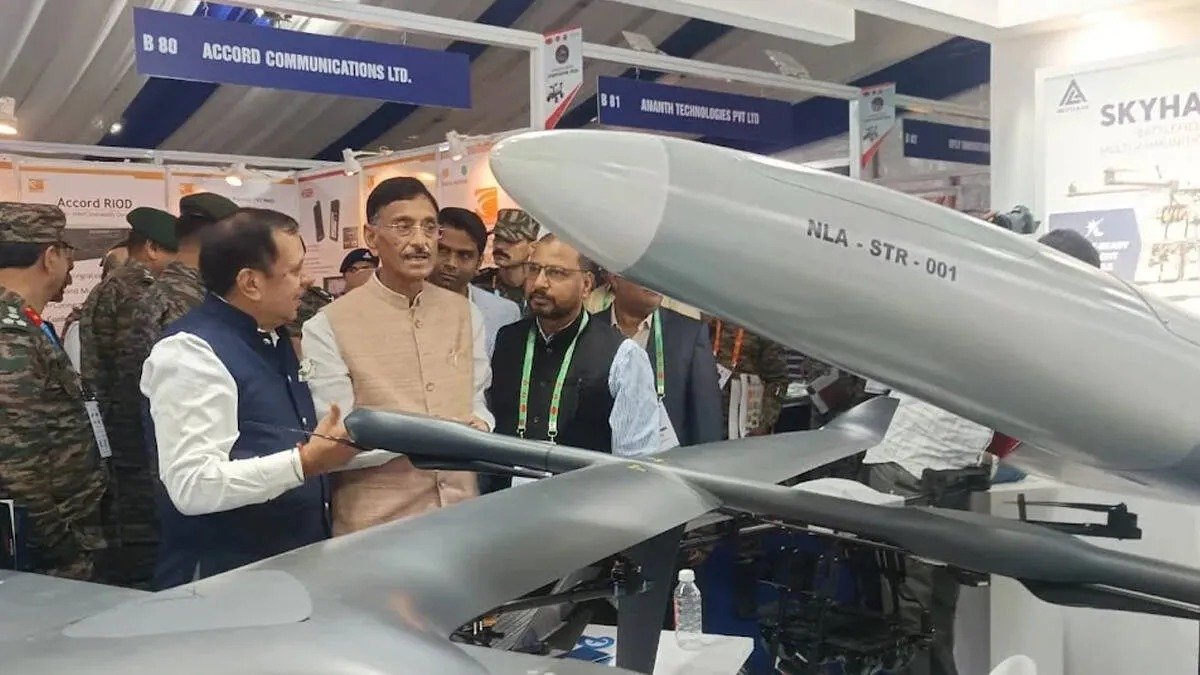
On a display stand at a defence expo, a grey dart of an aircraft marked NLA-STR-001 draws a crowd of uniformed officers. It has no propeller, no visible pilot, and a shape built for one thing: speed. This is STRYKER, and the Bengaluru startup behind it, NextLeap Aeronautics, says it cruises at more than 550 km/h while carrying a 30–50 kg warhead — several times faster than the propeller-driven loitering munitions that dominate today’s battlefields.
Speed is the whole point. A propeller-driven loitering munition cruises at a fraction of STRYKER’s pace, giving air defences time to react. A jet-powered aircraft arriving at 550 km/h closes that window dramatically, and the company positions STRYKER as a lower-cost alternative to cruise missiles for precision strikes on high-value targets such as radar installations, airbases and command centres.
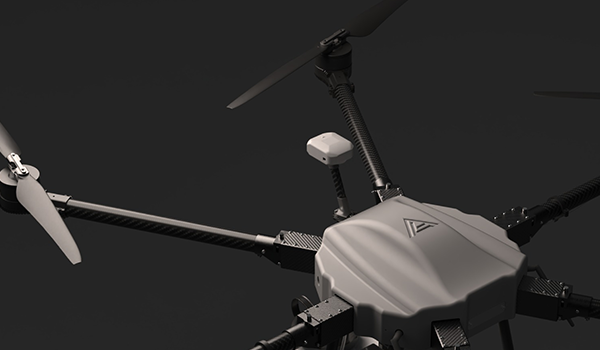
NextLeap was founded in 2019 by Alvin Anthony, Thaariq Ahmad and Gajendra Kashyap, and it is a DGCA-approved UAV manufacturer. The company began far from the battlefield: its flagship Leap A10 is a 10-litre agricultural spraying drone, and the company says it has deployed more than 350 drones across India, with a manufacturing capacity of 150 medium-class drones a month. Along the way it built a fibre-optic FPV drone for the Indian Army, the Black Drongo nano-UAV weighing under 250 grams, and Aistha, a backpackable surveillance UAV that flies for two hours over 20 kilometres.
The leap from farm drones to jet-powered strike aircraft rests on propulsion, and that is where NextLeap’s newest milestone sits. On 1 October 2026, the company announced it had completed a static test of the indigenous jet engine being developed for STRYKER, built in collaboration with Bengaluru gas-turbine specialist Dheya Engineering Technologies. The airframe is NextLeap’s own; the engine comes from the partnership with Dheya, whose DET-500 turbojet the company describes as producing around 50 kg of thrust. The company also says it delivered STRYKER aerial target airframes to an Indian defence agency in 2026 — the platform is already flying in target-drone form while the strike version works toward flight trials.
STRYKER is not a single aircraft but a family taking shape. The company is developing the Stryker-120E, an electric fixed-wing variant with a stated 120 km range, and the jet-powered Stryker-JP300, designed for a 300 km range, with a flight-test campaign expected by December 2026. Around them sits Sentinel, an autonomous docking station built for round-the-clock aerial surveillance, and two more platforms in development: SKYHAMMER, a heavy-payload autonomous strike drone, and ISTAR, a hydrogen-powered platform for intelligence, surveillance, target acquisition and reconnaissance.
What NextLeap has built is a rare thing in Indian private industry: a jet-powered unmanned strike aircraft designed, built and now ground-tested at home, with the small gas-turbine engine — the hardest part of the whole machine — developed alongside another Indian startup. The farm drones paid for the engineering. The jet engine proves it. The flight tests come next.
More Read

Keep reading: Medicines at 14,500 Feet: Inside TSAW Drones, the Delhi-NCR Company Flying India’s Medical Lifeline · The Autopilot Is the Brain: Inside Zuppa, the Chennai Company Building India’s Own Drones for the Front Line · More Aerospace & Defense stories
Like stories like this? Add Exceptional Technology as a preferred source on Google to see more of our reporting in your search results and Discover feed.