


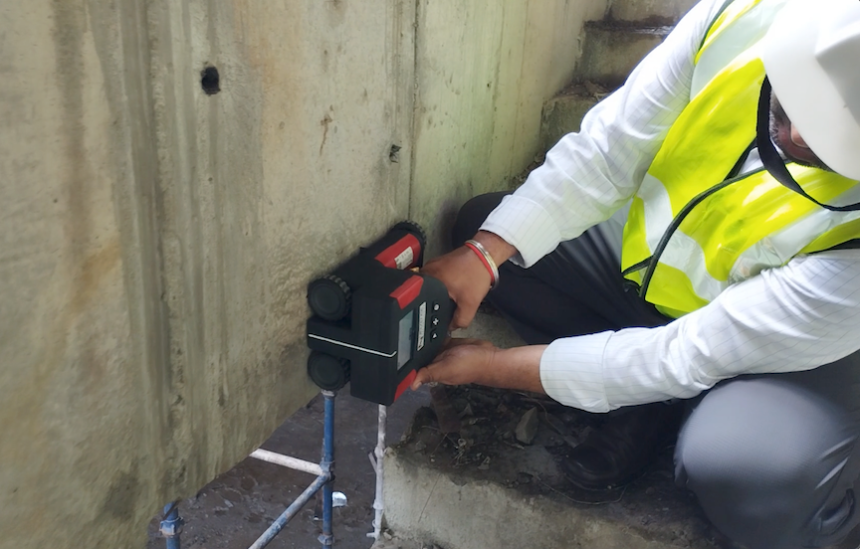
Image credit: Nirixense official photograph of the ReX 100 rebar scanner at work on site.
Every bridge, dam and tower in India carries a quiet secret inside its concrete: the steel that holds it together can corrode, shift and weaken for years without a single visible crack on the surface. By the time the damage shows, the repair is expensive — and sometimes it is already too late. Nirixense Technologies, a deep-tech company spun out of IIT Bombay in Mumbai, builds the sensors that listen to what concrete cannot say, catching the trouble early while it is still small and fixable.
A check-up that never stops
Nirixense’s flagship system is NiriX SHM, a wireless structural health monitoring network designed to watch over massive structures around the clock. Instead of a single device, it is a network of modular, battery-powered sensing units that the company says can be fitted to highway bridges, dams, retaining walls, buildings and even historical monuments.
The network works in three complementary layers. Dynamic Smart Nodes carry three-axis accelerometers and precision strain gauges that capture the vibration signatures and stress loads as heavy traffic rolls across a bridge. Deformation Smart Nodes use high-accuracy inclinometers and displacement sensors to track permanent shifts, tilting and settling. Environmental Smart Nodes measure the temperature swings that make concrete expand by day and contract by night, so the system can tell real structural movement apart from ordinary thermal breathing. Together, the nodes turn raw structural data into predictive maintenance insights, and the company says the system is designed to comply with guidelines set by the National Highways Authority of India.
Seeing the steel inside the concrete
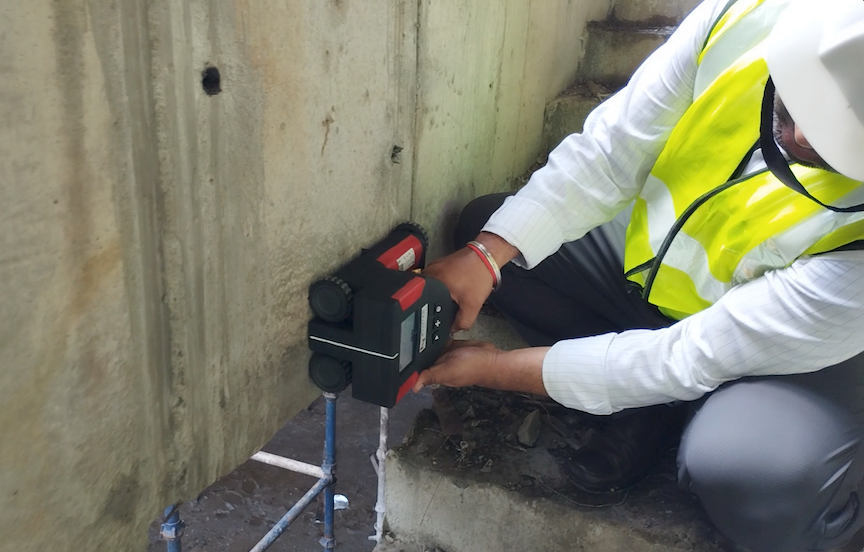
For the hands-on inspection side of the job, Nirixense built the ReX 100, a handheld rebar scanner made entirely in India. The device uses pulsed eddy current technology with the company’s TriDynamic intelligence and real-time edge AI to locate steel reinforcement bars inside reinforced concrete — without drilling a single hole.
The company says the ReX 100 can detect rebar cover up to 120 mm deep, measure cover and rebar position to within ±10 mm, and calibrate bar diameters up to 25 mm. It weighs just 1.2 kg including its swappable rechargeable battery, which runs for up to six hours of typical use, and it generates 2D and 3D profiles of the reinforcement in its companion app. For engineers checking an ageing bridge pier or a building before a retrofit, that means knowing exactly where the steel is — and whether it is corroding — before anyone picks up a drill.
More Read

Born in an IIT Bombay lab
Nirixense grew out of years of research at IIT Bombay’s AIMS Labs, where Professors Sauvik Banerjee of the Department of Civil Engineering and Siddharth Tallur of the Department of Electrical Engineering worked on structural health monitoring and non-destructive testing. Both are co-founders and directors of the company, which is based at the Rahul Bajaj Technology Innovation Centre on the IIT Bombay campus.
The research behind the products is protected by Indian patents licensed from IIT Bombay, including granted patent 566412 for a non-invasive handheld detector for characterising metal objects in concrete, alongside further patent applications covering rebar spacing estimation and corrosion detection. It is a textbook deep-tech journey: fundamental research, patented in India, engineered into products that work on real construction sites.
India is building and maintaining infrastructure at a scale few countries can match, and most of it is made of reinforced concrete. Nirixense’s bet is simple and powerful: structures that can report their own health, inspected by tools that can see inside them, will stand safer and last longer. The concrete may stay silent — but now, somebody is listening.
Keep reading: Sold Out in Days: Inside Rotoris, the Gurugram Watch House Building India’s Global Luxury Brand · The Pan With No Coating to Peel: Inside Ember’s SuperPan, India’s TitaniumSteel Answer to Non-Stick · More Manufacturing & Engineering stories
Like stories like this? Add Exceptional Technology as a preferred source on Google to see more of our reporting in your search results and Discover feed.







