Getting a small satellite into orbit is still one of the hardest tickets to buy in modern industry. Operators either wait for a rideshare slot on somebody else’s rocket, going wherever that rocket is going, or pay for a dedicated launch that very few companies can supply. In Ahmedabad, a young team of engineers has decided the answer is a rocket that comes home — and comes home fast enough to fly again the same week.
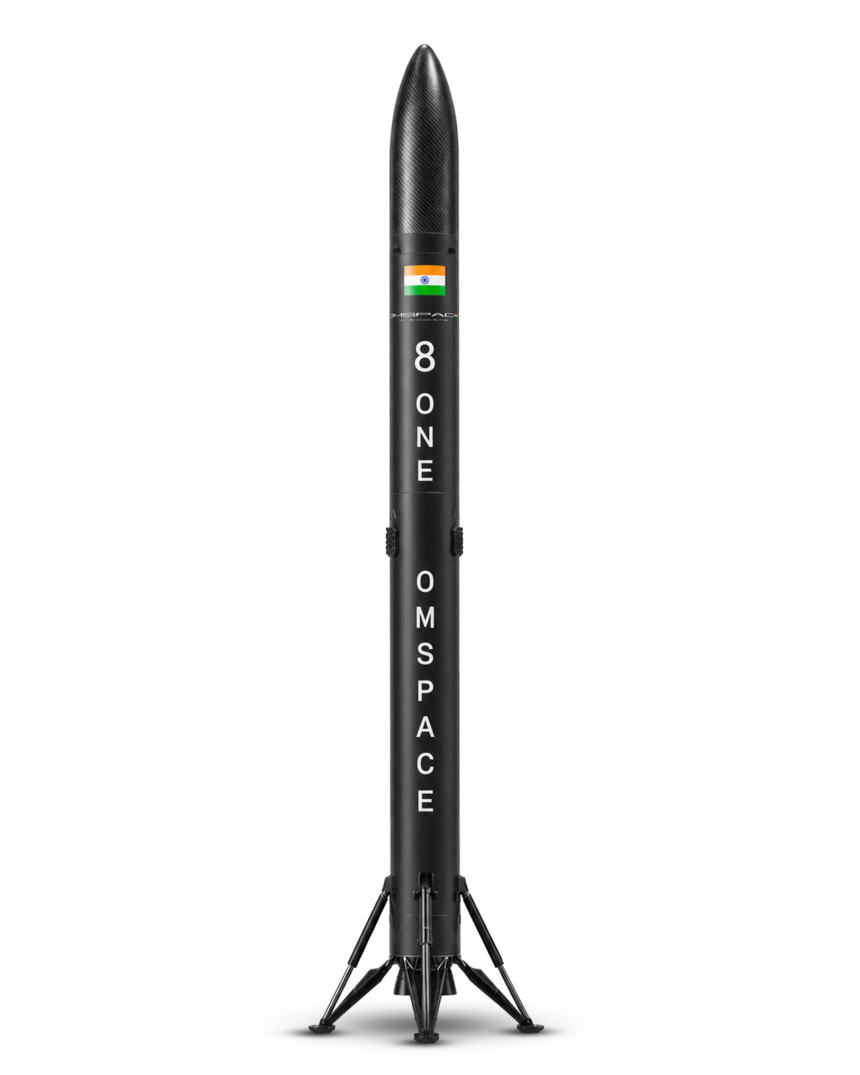
The company is OmSpace Rocket and Exploration, founded in 2020 by Ravindra Raj Binod Mistri with Maulik Mota and Stutika Padamshali, and its flagship programme is Infinity One, a modular reusable launch vehicle built for nano and small satellites. The company’s stated target is 500 kilograms of payload to low-Earth orbit at altitudes of up to 800 kilometres — the rideshare-starved end of the market — and its ultimate engineering goal is as audacious as its hardware: a complete re-launch within 24 hours.
This week brought the programme’s latest milestone. OmSpace has successfully tested the landing-leg mechanism of Infinity One — the system designed to hold up the vehicle’s first stage as it touches down after a mission, so the most expensive part of the rocket can be recovered, inspected and flown again. Landing legs are among the most demanding pieces of a reusable rocket: they must deploy at exactly the right moment, absorb the shock of touchdown and keep the vehicle stable, all while working in concert with the guidance, navigation and control systems.
The propulsion at the heart of the vehicle is what sets the programme apart. OmSpace says it is developing India’s first electric-pump-fed rocket engine — a design that drives the propellant pumps with electric motors and batteries instead of a gas turbine, trading some raw performance for simplicity and clean, predictable control. The manufacturing is largely in-house at the company’s 30,000 sq. ft. R&D facility in Ahmedabad’s GIDC industrial zone: a composites facility, additive manufacturing, five-axis CNC machinery and filament winding — the fibre-winding process used to build composite pressure vessels and rocket bodies. In 2025 the team also test-fired a 100% made-in-India 3D-printed ignitor for its cryogenic engine after more than 300 test runs, a milestone the company lists as a genuine technical breakthrough.

OmSpace has been proving hardware in steps rather than promises. In March 2026 the startup launched a single-stage sub-orbital sounding rocket from Bavaliyari village near the Dholera space hub — officially Gujarat’s first private launch of a rocket developed entirely on Gujarat soil, authorised by IN-SPACe and carried out with the coordination of the Airports Authority of India, the DGCA and the Indian Coast Guard. The rocket climbed to about 3 kilometres and returned safely under a dual-parachute recovery system, and the company plans another sounding test flight later this year.
The company has been assembling its institutional backing in parallel: incubation at CrAdLE at EDII, DPIIT and Startup India recognition, membership of the International Astronautical Federation, participation in the International Astronautical Congress 2026 in Turkey, and about $3 million in pre-seed funding raised in July 2025. Alongside the engineering it runs Youngspace, an aerospace education programme that the company says has run more than 200 workshops for over 55,000 participants across India and the UAE.
More Read

In a global launch market racing toward reusability, OmSpace’s bet is that the winning small launcher will be the one that lands, refuels and goes again — built, tested and recovered in India.
Keep reading: The Rocket That Lands Itself: Inside Space Philic, the Kanpur Startup Building a Reusable Rocket on Bio-Fuel · The Pit Crew for Drones: Inside AlgoFET, the Bengaluru Startup Building Autonomous Drone Ground Stations · More Aerospace & Defense stories
Like stories like this? Add Exceptional Technology as a preferred source on Google to see more of our reporting in your search results and Discover feed.