Getting a small satellite into orbit remains one of the most expensive commutes in modern industry. Rockets are built, flown once and discarded — and the cost of that single flight decides which startups, universities and defence programmes ever get their hardware into space. In Kanpur, a small team of engineers has decided the answer is a rocket that comes home, and burns cleaner on the way up.
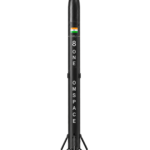
The company is Space Philic, founded by Indra Narayan Chaudhary, and its flagship programme is RUPAK, a 28-metre reusable launch vehicle designed to carry up to 250 kilograms to low-Earth orbit. The rocket pairs a carbon-fibre booster with retractable landing legs, so the most expensive part of the vehicle can return to Earth, land and fly again — the reusability playbook that transformed global launch economics, engineered in India.
The company’s published specifications make the ambition concrete. RUPAK is 28 metres long and 1.2 metres in diameter, with a combined thrust of 288 kN. The carbon-fibre construction keeps the structure light, and the company says the landing legs give the booster the ability to attempt powered landings and rapid reuse.
The heart of the vehicle is Shakti, a 32 kN bi-propellant rocket engine Space Philic is developing in-house. Shakti uses an electric-pump cycle: electric motors drive the propellant pumps, which the company says removes the need for complex turbomachinery while giving clean, predictable control during flight. The engine is built with selective laser melting — metal 3D printing — which cuts part count and mass and skips many of the traditional fabrication steps that make rocket engines expensive. Nine Shakti engines will power RUPAK’s first stage, the company says, giving the vehicle built-in redundancy.
The propulsion chemistry is what sets the programme apart. Space Philic is developing its engines around bio-derived, ethanol-based propellants, betting that greener chemistry can make launches both cheaper and cleaner. Inc42 reports the company has already tested a Shakti prototype on GP-300, an ethanol-based propellant — real hardware firing on the company’s own green propellant as it scales toward the full launch system. The official engine breakdown highlights the engineering details: a 3D-printed regenerative combustion chamber, separate electric fuel and oxidizer pumps, a thrust-vector-control actuator, and a niobium-alloy, radiatively cooled nozzle for the vacuum-optimized variant.
Beyond satellite launches, Space Philic is designing RUPAK’s upper stage around three payload platforms: a 250 kg commercial platform for small and micro-spacecraft, a Long Endurance Laboratory for in-orbit experiments and technology validation, and a Fully-Integrated Defence platform the company says can deploy payloads within a 24-hour window — rapid-response access to orbit for national-security missions.
More Read
The company works out of Kanpur with support from the Startup India ecosystem and incubation backing including SIIC at IIT Kanpur, and closed an undisclosed funding round in September 2026 as it grows from engine testing toward the full vehicle. In a private launch sector racing to prove reusability, Space Philic’s bet is that the winning rocket will be the one that lands — and the one that burns the cleanest.
Keep reading: The Pit Crew for Drones: Inside AlgoFET, the Bengaluru Startup Building Autonomous Drone Ground Stations · The Flying Truck: Inside LogiXair’s L560, the Autonomous VTOL Built to Haul 300 kg Across 600 km · More Aerospace & Defense stories
Like stories like this? Add Exceptional Technology as a preferred source on Google to see more of our reporting in your search results and Discover feed.