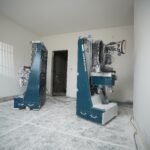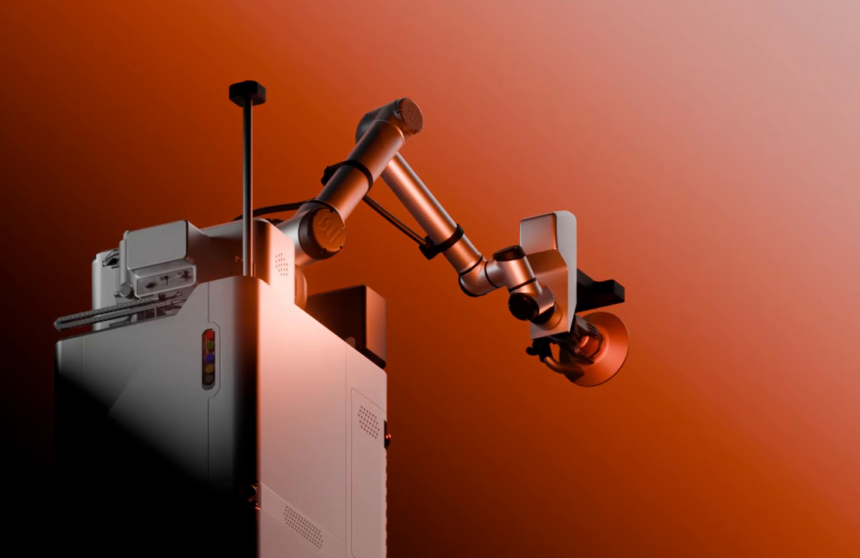
Image credit: Origin
A sheet of drywall goes up in minutes. The finishing — the joint compound, the sanding, the priming, the endless coats — is what actually stretches a construction schedule. On a large project it is repetitive, dusty, physically punishing work, and skilled finishers are getting harder to find everywhere from Manhattan to Munich. A startup founded in January 2025 decided to hand the trowel to a machine instead — and within ten months had its robots working on real job sites in New York.
The company is Origin, a physical-AI startup based in San Francisco and Bengaluru, founded by Yogesh Ghaturle, Ashish Daga and Tushar Makkar. Ghaturle previously founded Perpule, the cloud point-of-sale company acquired by Amazon in 2021; Makkar led AI teams at Eightfold AI; and Daga built precision automation hardware at digital pathology company Morphle Labs. Their flagship machine, the OG-1, is an autonomous wall-finishing robot: it applies joint compound, sands and primes walls to a professional finish without a human hand on the tool.
One robot, every wall
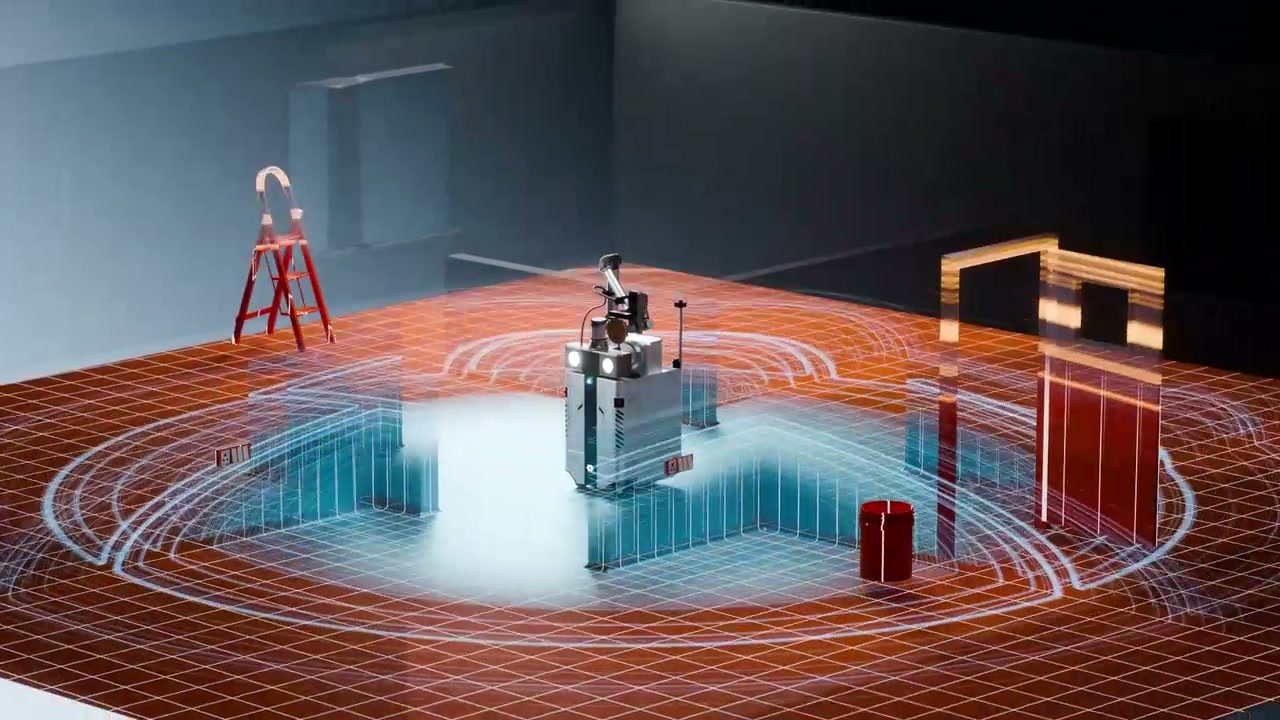
OG-1 rides on a three-wheeled platform designed to fit through standard doorways, then extends its reach up to 14 feet to tackle high walls and ceilings. A 360-degree vision system lets it work alongside construction crews while other trades continue around it, with no cordoned-off zone. For contact-heavy work like sanding, the robot uses real-time force control to hold consistent pressure against the wall — the kind of consistency a human arm loses by the end of a shift. Construction crews handle site mapping and material replenishment; the finishing itself, the company says, happens with no human intervention.
The brain: a construction action model
What makes OG-1 more than a remote-controlled sander is the software the company calls its Construction Action Model — a foundation model built specifically for construction, with three parts: a reasoning system that plans and orchestrates complex subtasks in a construction workflow, an action policy that navigates autonomously, chooses where to work, decides how to use each tool and assesses the quality of its own work, and a controller that translates those decisions into precise, feedback-driven physical motion. The model is trained on high-fidelity simulation and deployment data from live job sites, and Forbes reports the robot recognises 200 different objects commonly found on a construction site.
“Over the last century, construction has only mechanised or automated heavy exterior work. But much of the skilled work inside the building, which accounts for more than 65 per cent of the construction timelines, is still done by hand,” Ghaturle said. “We started Origin to bring physical AI to interior trades.”
More Read
Built for the job site, not the lab
The milestone that separates Origin from the lab-demo crowd is deployment: the company says it rolled its first robots onto New York construction sites within ten months of founding, and its site counters 100,000+ square feet finished and 5,000 hours of work delivered. The machines currently work across commercial spaces, multifamily housing, data centres, hotels and warehouses — and the company claims they finish walls three times faster than a human crew, saving customers a claimed 20% on labour costs from day one.
Origin sells outcomes, not robots: contractors subscribe to a robots-as-a-service model paying a reported $25,000–$40,000 a month, with current deals averaging $2–2.5 million. “Too many construction robots perform well in a lab and fail within a week on a live job site. Origin built for the job site from the start, and it shows in the results: the robot works, crews trust it and the company can manufacture it at volume,” said Vivin Hegde, founding partner of Zacua Ventures.
What comes next
Origin emerged from stealth on 15 October 2026 with $20 million in total funding co-led by Accel and Zacua Ventures, with participation from Ronnie Screwvala’s Unilazer Ventures, Schema Ventures, Z21 and angel investors associated with Anduril, Skild AI, 1X and Tesla. Screwvala called it “deep-tech hardware, engineered in India, solving a problem for builders around the world.” The capital is earmarked for building a fleet of 150 robots by the end of 2027 and large-scale pilots with two of the largest drywall-finishing contractors in the US, plus pilots planned in Germany, Sweden, France and Saudi Arabia. Next year the same hardware platform is slated to learn taping, drywall installation, stud installation and drilling — one robot, progressively more trades.
Drywall finishing will never be glamorous. But a robot that reaches the ceiling without scaffolding, holds consistent pressure across a thousand square feet, and shows up for the next trade — from a team that went from founding to live deployment in ten months — is exactly the kind of unglamorous engineering that construction’s labour crunch has been waiting for. An India launch, the company says, is still a few years away.