


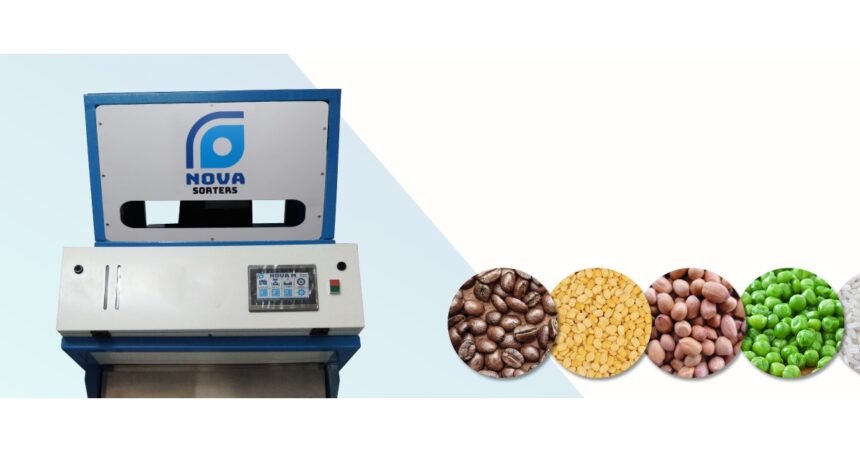
Walk into a cashew processing unit in India and you will likely find rows of workers bent over trays, picking through kernels by hand, pulling out the scorched tip, the spotted kernel, the fragment of shell, one nut at a time. It is slow, tiring work, and the quality of the final pack rests on the sharpness of the human eye. A Hyderabad company called Nova Sorters has built a machine that does the looking instead, and it looks at every single kernel, several times over, in the blink of an eye.
An electronic eye for the processing line
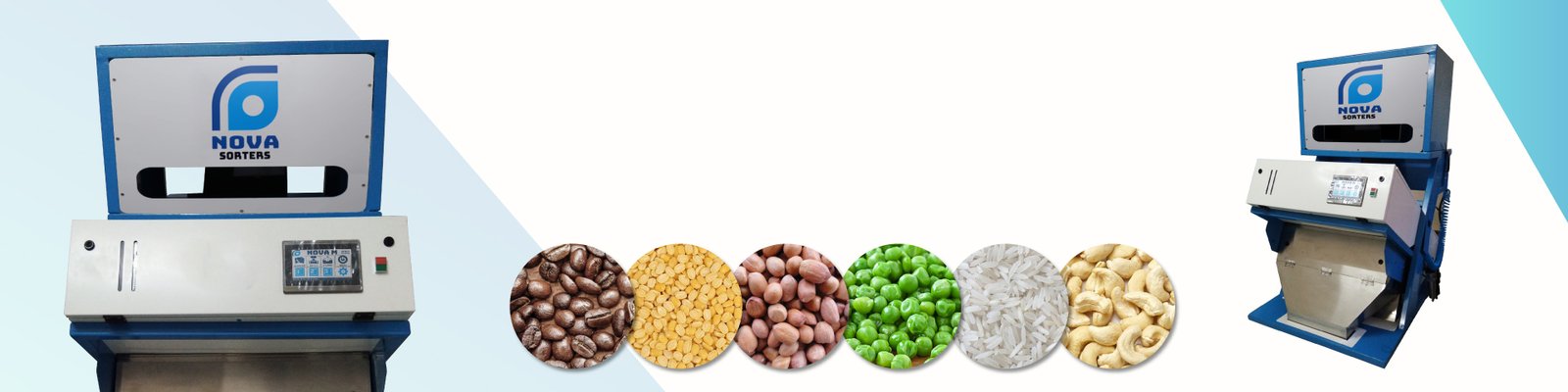
A machine-vision colour sorter works like an electronic pair of eyes for a processing line. As kernels stream past the inspection area, cameras and carefully controlled lighting examine each one, and the system compares what it sees against predefined quality settings. At the rejection point, precisely timed jets of air divert anything that does not make the grade into a separate outlet. For cashew processors, the company says, the technology replaces repetitive manual inspection with a consistency no tired pair of eyes can match, batch after batch.
But the company is quick to point out that sorting is not only about removing defects. It is also about keeping as much good product as possible. A system that throws away good kernels along with bad ones costs the processor money with every tonne it runs, so Nova Sorters designs its machines to weigh both sides of the result: the quality of what is accepted, and the amount of good product that is never wrongly rejected.
Built for cashew, not adapted to it
Cashew sorting is harder than it looks. Good kernels vary naturally in shade, while a defect can be a subtle pink, brown or dark-yellow patch covering only a small part of an otherwise perfect kernel. Dust, heat and humidity in a real factory add their own complications, and the machine has to keep performing in those conditions, not only in a laboratory. Nova Sorters has used those realities to guide its engineering, refining its systems around the needs of cashew processors and the floors they work on.
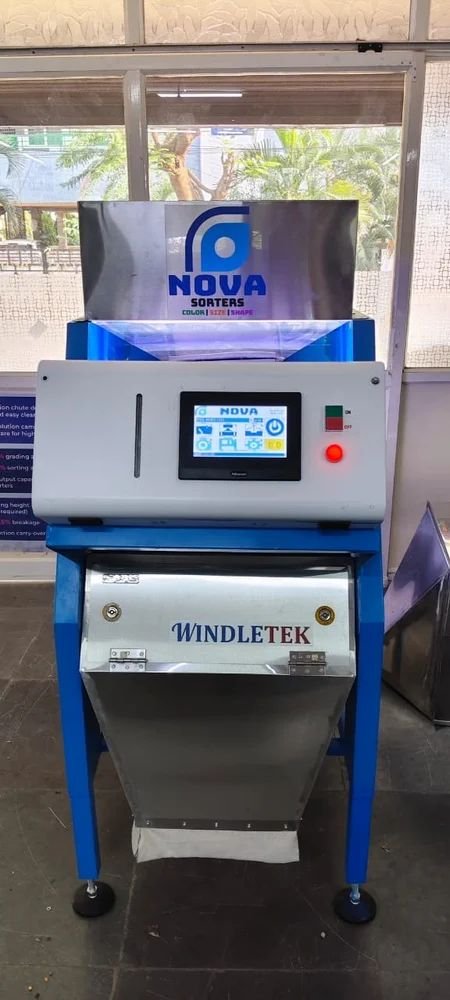
The range is built around those needs. The company’s Nova Plus Series and NW cashew colour sorters handle visual quality inspection, shell sorters take care of separation after shelling, and sizing machines divide kernels into consistent size grades. The Nova Plus Series runs at up to a tonne an hour, with models from 200 to 600 kg an hour, and the company says its machines can sort whole cashew kernels right down to baby bits in the same equipment. Custom high-resolution RGB and mono cameras pick out micro-defects, sizing and shape algorithms grade each kernel, and a dust-proof Wi-Fi HMI panel keeps the machine easy to run and service remotely.
Seeing shape, not just colour
The company’s most distinctive claim is about shape. Nova Sorters says it was the first in the world to launch shape inspection of nuts in gravity-flow food inspection machinery using machine learning, and the company puts its cashew grading accuracy at more than 95 percent thanks to that proprietary shape inspection technology. The idea is to move beyond simple colour settings toward defect recognition that works more like the judgement of an experienced human grader, only faster and more consistent. The company is continuing to develop that AI capability, aiming for machines that recognise irregularities the way a seasoned grader would, at line speed.
More Read

What changes on the factory floor
For processors, the payoff shows up in ordinary numbers. The company says one customer in Maharashtra cut labour costs by around half while raising output by 40 to 60 percent after installing its machines. That is the kind of result that spreads by word of mouth: the company says 90 percent of its sales now come from referrals from existing customers, and in the last three years it has built a presence across 10 states and union territories.
The company behind it
Nova Sorters is the brand of Windle Designs LLP, founded in Hyderabad in 2017 by Gunasekaran Seethapathi. From the start, the company chose to develop its core technology in-house rather than assemble imported components, with its team working across vision systems, electronic controls and mechanical design. Its Hyderabad facility brings design, manufacturing and testing together under one roof, so machines are refined and proven before they reach a customer. In 2026 the company was recognised as the Best Made in India Machine Vision Colour Sorter and Cashew Processing Machinery Company, India 2026. Its ambition now is to become a globally recognised Indian brand in food sorting technology, extending the same machine-vision expertise to other nuts and food products.
Why it matters
India is one of the world’s great cashew processing nations, and grading decides what a kernel is worth on the world market. For years the machines that did that grading at scale were imported, expensive to buy and slow to service. Nova Sorters shows a different path: an Indian-built machine, engineered for Indian factory conditions, that grades by colour, size and shape at up to a tonne an hour and is serviced from Hyderabad. It is a quiet piece of industrial engineering with a very visible result, a better kernel in every pack, sorted by a machine that never blinks.
Keep reading: The Machine That Grades Every Apple: Inside Intello Labs’ AI Packhouses · The Device That Smells Rot Before It Spreads: Inside Godaam Innovations, the Maharashtra Startup Saving India’s Onions · More Food Processing & Agri-Tech stories
Like stories like this? Add Exceptional Technology as a preferred source on Google to see more of our reporting in your search results and Discover feed.







