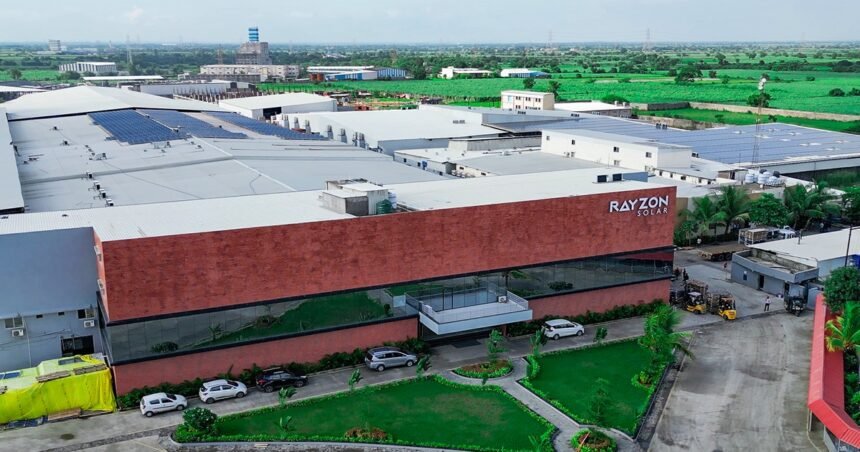
Image credit: Rayzon Solar — the company’s Surat manufacturing campus, where its new solar cell plant is coming up.
Every solar panel India installs starts with a cell, and for years most of those cells have arrived from abroad. In December 2026, that equation shifts a little further toward home: Surat-based Rayzon Solar is set to commence operations at its 5.1 GW TOPCon solar cell manufacturing facility, with initial deliveries expected in the first quarter of 2027. The company announced the timeline in a press release issued on the sidelines of the Bharat Renewable Energy Summit (BRE Summit) 2026.
From assembling modules to making the cell itself
Rayzon Solar is already one of India’s largest solar module manufacturers, with 11.31 GW of ALMM-listed module capacity across its advanced facilities in Surat, Gujarat. Until now, though, the company has bought the solar cells that go inside those modules. The new plant marks its entry into cell manufacturing — the step that turns it from a module assembler into a cell-to-module manufacturer, controlling far more of the quality chain in-house.
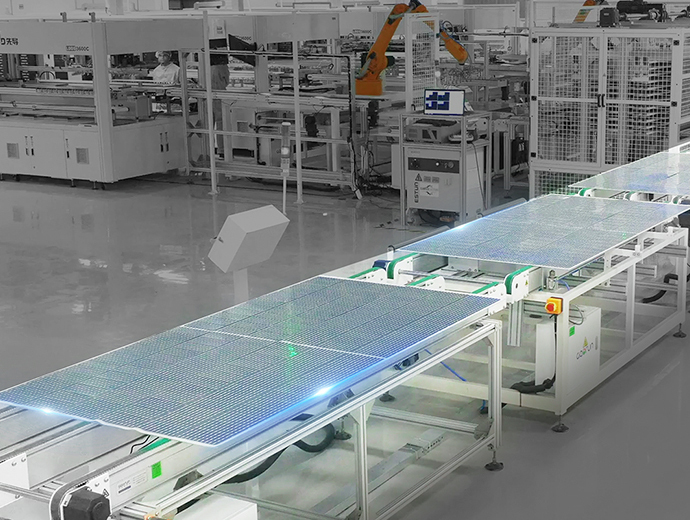
The technology at the heart of the plant is TOPCon — tunnel oxide passivated contact — the high-efficiency cell architecture that has become the workhorse of modern solar manufacturing. The company’s flagship L’LIOS N-Type TOPCon bifacial modules are built on it, and the new plant will feed that module platform with cells made under Rayzon’s own roof.
One more link in the chain, then the next
The cell plant is only the middle of Rayzon’s plan. The company is already working toward a 5.1 GW ingot casting and wafer slicing facility, targeted for development by 2028, and says it is engaging with multiple states to assess incentives and finalise a location. Ingots and wafers are the very first links of the solar value chain — the silicon blocks and slices from which cells are made — so adding them would take Rayzon from raw silicon toward finished panels almost end to end.
More Read

Alongside the cell plant, Rayzon has commissioned a 19,800 tonnes per annum aluminium extrusion and anodising unit dedicated to producing solar module frames, another piece of the supply chain brought in-house. The company says its research programme, which includes work on tandem-junction technology and nano-coatings for next-generation modules with targeted launches by 2028, has produced three patent filings over the past year, and it collaborates with the University of New South Wales on R&D.
Perovskite glass on top of TOPCon
Rayzon is also looking one technology generation ahead. In July 2026 it signed a five-year, 5 GW partnership with Caelux Corporation of the United States to layer Caelux’s energy-producing perovskite solar glass over its TOPCon modules, a combination the companies say will produce some of the highest power-density modules available. Commercial volumes are expected by 2028, with the modules eligible for India’s government-tendered utility market.
Founded in 2017 by Chirag Nakrani and Hardik Kothiya, Rayzon has grown from a small module line into one of India’s top solar manufacturers in under a decade. Co-founder Chirag Nakrani says the commissioning of the 5.1 GW TOPCon cell facility will mark an important milestone in the company’s journey toward deeper backward integration — and every gigawatt of cells made in Surat is a gigawatt India no longer has to import.
Keep reading: Power That Travels to the Patient: Inside OGO Energy’s Mobile Battery for Medical Vans · Twenty Minutes to a Full Charge: Inside EMO Energy’s NEXO, the Solar Energy Stack Powering India’s Delivery Fleets · More Energy & Power stories
Like stories like this? Add Exceptional Technology as a preferred source on Google to see more of our reporting in your search results and Discover feed.