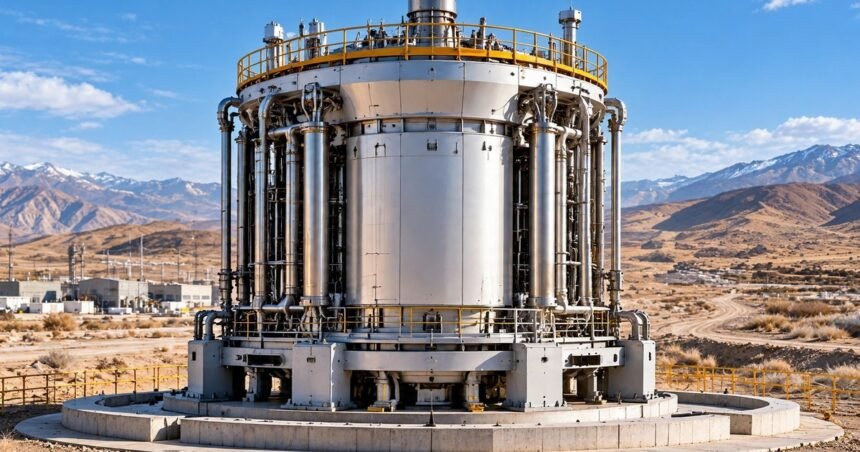
India has spent seventy years waiting for thorium to power the country. The metal is everywhere in Indian sand — the country holds roughly a quarter of the world’s thorium reserves — and almost none of the uranium that conventional reactors need. That imbalance is why Dr Homi Bhabha designed India’s nuclear programme in three stages, each one leading to the same destination: a country running on its own thorium. In April 2026, the 500 MWe Prototype Fast Breeder Reactor at Kalpakkam reached first criticality, carrying India into the programme’s second stage. Now a small Pune startup called IYNS TechSolutions wants to build the machine that takes it the rest of the way — SUK-M, a thorium-fuelled microreactor the company describes as India’s first indigenous design of its kind.
A reactor built like a product, not a project
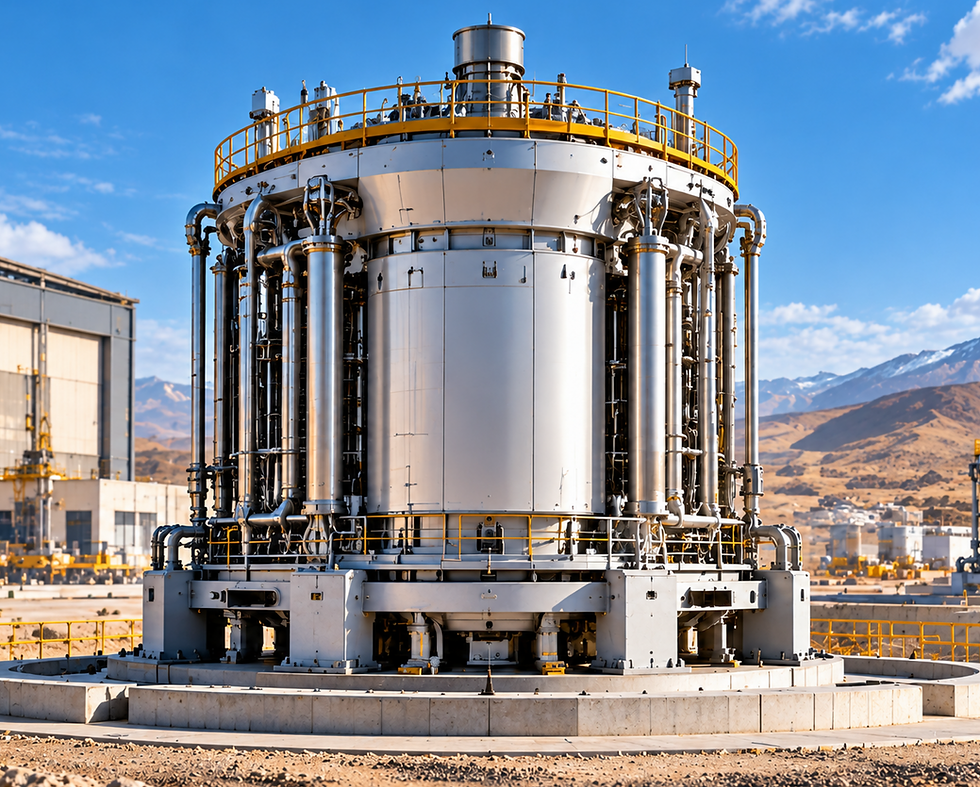
SUK-M — short for Swayamchalit Utkrantik Kendrakbhednam–Micro, or “Sookshma”, meaning subtle or minute — is a Generation IV molten-salt reactor, the company says. Each factory-built module is designed to produce about 10 megawatts of electricity or 30 megawatts of heat, and to travel to its site by road or rail, ready to be installed where the power is needed. The company says construction on site would take 18 to 24 months, and a module would run for 10 to 15 years between refuellings, on a footprint far smaller than a conventional plant.
That is the point of the design. Big reactors are bespoke construction projects that take a decade to build; SUK-M is meant to be manufactured, again and again, on a production line, and deployed in fleets wherever demand sits — industrial clusters, special economic zones, steel and cement plants, data centres, desalination plants, green-hydrogen units, and the island territories and remote border regions where diesel is shipped in today at great cost.
Safe by design
The reactor runs on molten salt at atmospheric pressure, the company says, with the salt carrying the fuel itself — so there is no high-pressure water system and no need for the pumps, backup generators and operator intervention that conventional reactors rely on to stay cool. The safety systems are passive, working on gravity and natural circulation, and the design is meant to shut itself down and cool itself if power is lost and nobody intervenes. Severe accidents, the company says, are eliminated by design rather than prevented by procedure.
The fuel is the other half of the story. SUK-M burns a proprietary uranium-thorium fuel cycle, drawing on India’s own thorium instead of imported uranium — and, unlike many advanced reactor designs abroad, it does not depend on HALEU, the enriched uranium whose supply is tightly controlled. For a country that has built its entire nuclear programme around thorium, that independence is the point.
The team behind it
IYNS TechSolutions was founded in April 2021 by Dr Nitendra Singh and Dr Samyak Munot, both PhDs from the Department of Atomic Energy’s Homi Bhabha National Institute. Singh brings more than fifteen years in nuclear safety, reactor design and climate policy, including work at ITER in France — the world’s largest fusion project — on the safety of tritium breeding blanket systems; he also founded the Indian Youth Nuclear Society, the community from which the company grew. Munot brings more than eight years in severe accident management and reactor simulation, including experimental campaigns and work published by the Department of Atomic Energy. Behind them sits an advisory board of India’s atomic-energy veterans.
More Read

Why now
The timing, the company says, is the policy door opening. The SHANTI Act of 2025 allows private participation in nuclear energy in India for the first time, and the government’s Nuclear Energy Mission targets 100 GW of nuclear power by 2047, including at least five indigenous small modular reactors by 2033. NITI Aayog projects India’s energy needs will grow two to two-and-a-half times by 2047, with peak demand reaching 708 GW — and steel, cement and chemicals need continuous process heat above 700°C that solar and wind cannot deliver around the clock.
The work is moving from paper to laboratory. The team has completed its initial computer simulations, and on 25 November 2026 it raised its first institutional funding — a pre-seed round led by Speciale Invest and co-led by Navam Capital, with BYT Capital and angel investors — to hire scientists and engineers in India and build a dedicated experimental facility. From there, the plan is to work with India’s nuclear regulator step by step towards licensing, with a prototype targeted for 2031. The company calls its mission “Indian Nuclear Programme 2.0”: the science India built over seventy years, carried into industry by a new generation.
That is what makes SUK-M worth watching. India has the thorium, the programme and now the policy; what it has not had is a company building the reactor itself. A small team in Pune is now doing exactly that — one factory-built module at a time, aimed at the day when the same reactor that powers a steel plant can also power an island, a data centre or a ship, and when the fuel in the ground beneath India’s beaches finally becomes the energy in its grid.
Keep reading: The Brain Inside Every Battery: Inside RC Labs, the Bengaluru Startup Building India’s Intelligent Battery Management Systems · The Battery Line Turning India’s Sunshine Into Stored Power: Inside Waaree ESS’s 5.15 GWh Gujarat Plant · More Energy & Power stories
Like stories like this? Add Exceptional Technology as a preferred source on Google to see more of our reporting in your search results and Discover feed.