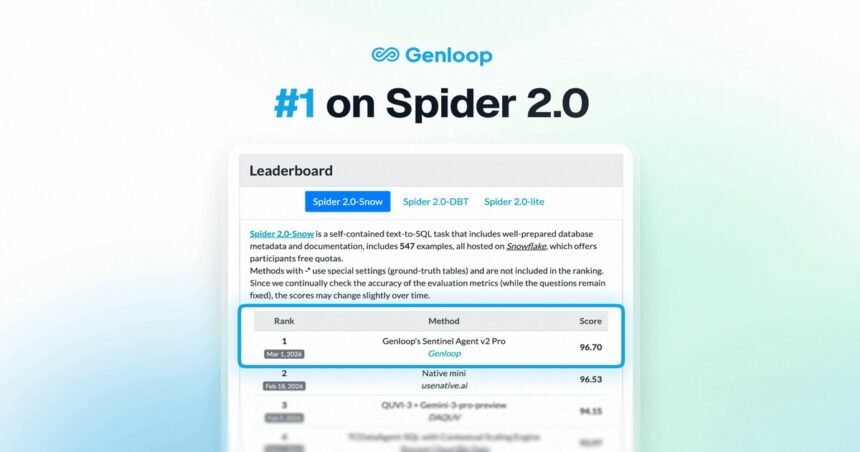
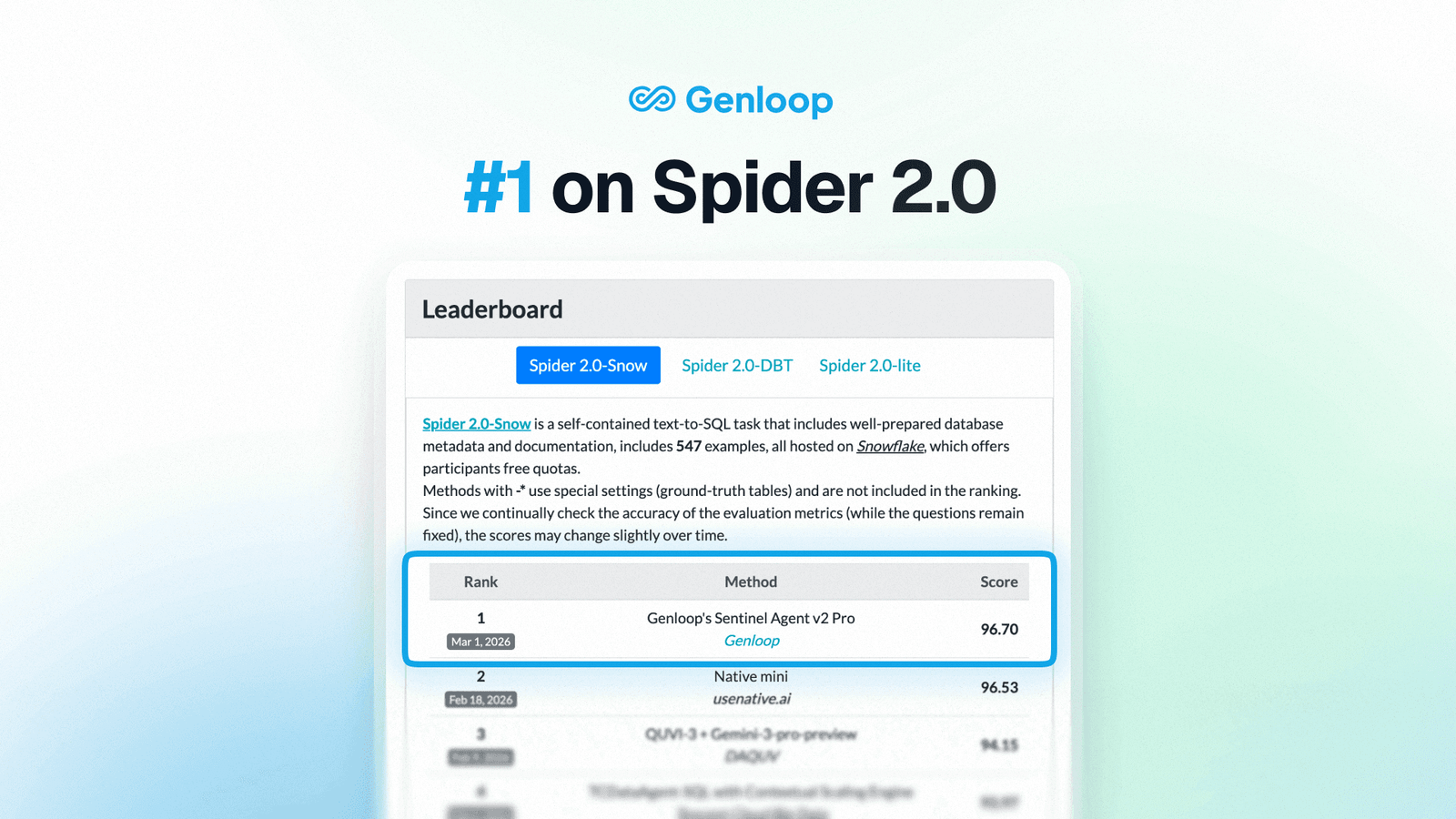
On 1 March 2026, a small team in Bengaluru put India at the top of one of the hardest leaderboards in enterprise AI. Genloop’s Sentinel Agent v2 Pro scored 96.70 on Spider 2.0-Snow — the global benchmark for turning plain-English questions into database queries — finishing ahead of systems from Tencent, AT&T, ByteDance and Snowflake. It is the same team now building three small language models for India itself, under the government’s IndiaAI Mission: one to reason, one to converse, and one to keep the country’s digital spaces safe — all of them thinking natively in 22 Indian languages.
The benchmark that doesn’t forgive shortcuts
Spider 2.0 is one of the most demanding data-reasoning benchmarks in the world, the company says. It pushes systems to reason across more than 150 real-world databases, 13,000 tables and 500,000 columns — messy metadata, inconsistent schemas and multi-step reasoning across siloed sources, the way data actually exists inside enterprises. The Snowflake track it tops is a self-contained text-to-SQL task of 547 examples, all hosted on Snowflake.
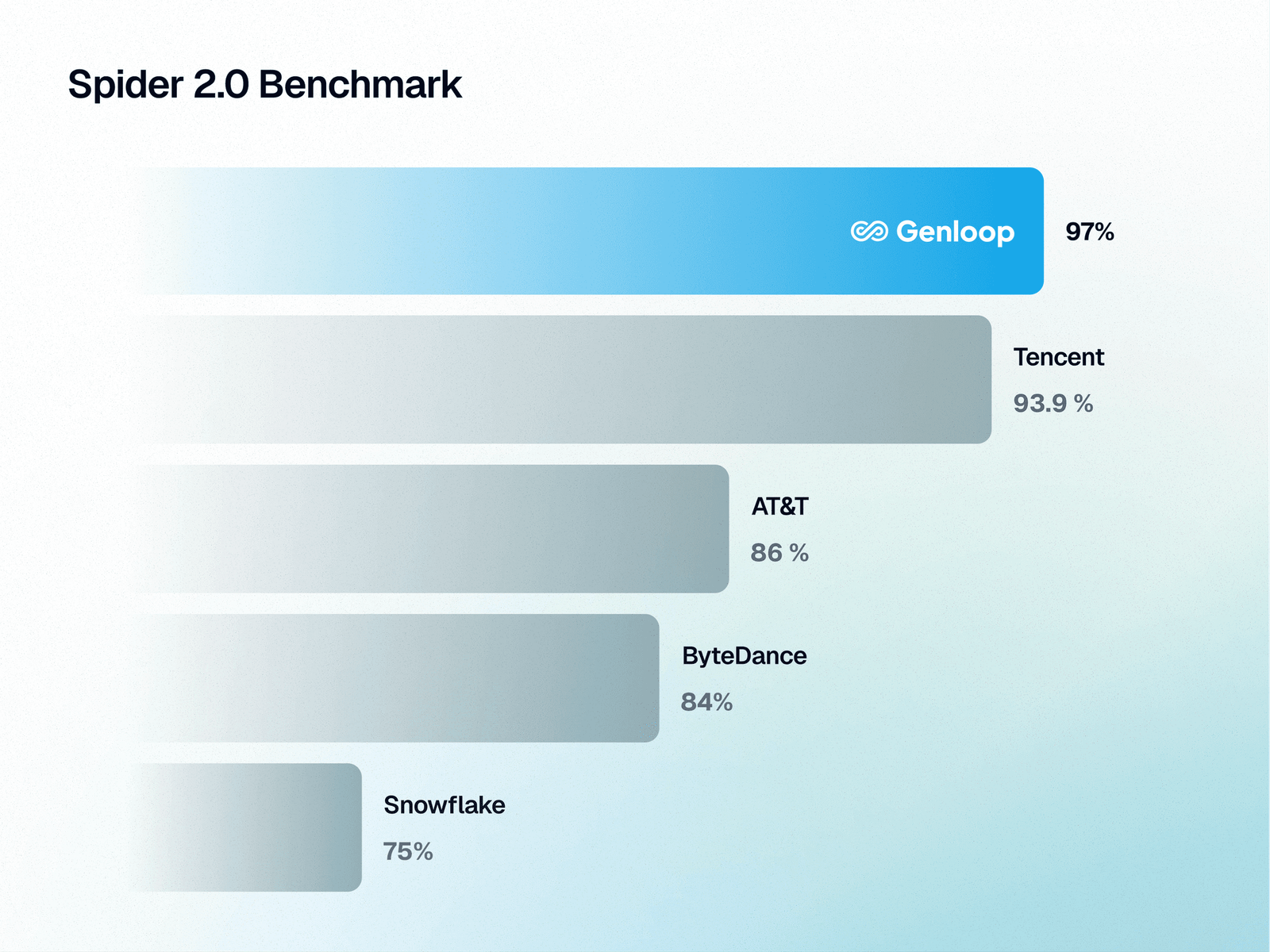
The gap behind Genloop tells the story. Tencent scored 93.9%, AT&T 86%, ByteDance 84% and Snowflake itself 75%. The teams attempting the benchmark include some of the largest technology companies on the planet, and the benchmark is designed so that shortcuts do not survive it. Genloop’s 96.70% is the highest score on the leaderboard.
Why Genloop wins: a memory of what the data means
The secret, the company says, is that Sentinel does not just translate questions into SQL. It builds a context graph of the customer’s data environment and reasons against that, instead of guessing at raw schema. Genloop calls this its Context Intelligence Layer: a governed layer that holds a business’s logic, metric definitions, join paths and team-specific context, so when the agent is asked what “revenue” means, it already knows — because that understanding has been encoded over time.
The research behind the approach is now in the open. Genloop’s paper, “Living Context Graphs: Continual Semantic Learning for Enterprise Data Reasoning”, was published at the CL4FMAgents workshop at NeurIPS 2026. Its headline result: a continually learned semantic layer over an existing warehouse lifts held-out text-to-SQL transfer from 13.7% to 36.3% with a frozen language model, while a use-earned concept graph cuts serving costs by 2.3 to 3.3 times at no accuracy loss. The paper’s authors include Genloop chief executive Ayush Gupta alongside Varun Agrawal, Ayush Srivastava, Eshan Gujar and Kaushal Kumar.
A data analyst for every team
The benchmark is the proof; the product is the point. Genloop describes its platform as a data analyst for every team: an intelligence layer that connects live to Snowflake, BigQuery and lakehouse sources, with no ETL and no copies, reasoning across all of them in a single query. Liveboards produce automated reports on live data, agents watch metrics and surface findings before anyone asks, and a living context graph captures what the data means, how the business investigates and who is asking — so the same question gets the same verified answer every time.
More Read

The platform is already in use or on pilot at companies including Lenskart, Emeritus, Waaree Energies and NetApp, the company says, after design partnerships in late 2025 and a formal enterprise launch in January 2026. It is a striking customer list for a startup founded in 2024 — and a sign that the same context-graph engineering that wins benchmarks is doing real work inside real businesses.
Three small models for 22 languages
The bigger mission sits alongside the enterprise business. Genloop is one of twelve organisations selected under the IndiaAI Mission to build India’s own foundation models, chosen in the mission’s second round in September 2025. It is building three small language models of around two billion parameters each: Yukti, the base model that reasons natively across all 22 scheduled Indian languages; Varta, the conversational model, instruction-tuned and optimised for edge deployment in healthcare, agriculture and governance; and Kavach, the content-moderation model.
Kavach is the most distinctive of the three. The company describes it as India’s first guardrail LLM: a sovereign content-safety layer designed to moderate in all 22 scheduled languages. Foreign moderation tools, Gupta points out, are built on English-dominated datasets and lack taxonomies for terrorism, communalism and cultural bias — categories that matter enormously in India’s information ecosystem. Kavach is built to understand them natively, distinguishing hate speech from legitimate political or religious expression in the languages Indians actually speak.
Small is the point. As Gupta puts it, a single call to a trillion-parameter model takes around eight iPhone batteries’ worth of energy, while a small language model can manage roughly a thousand calls on the same energy. A two-billion-parameter model needs far less memory, runs far more cheaply, and can be deployed where the work actually happens — in government systems, classrooms and startups, on laptops and phones, even without cloud connectivity.
The team behind it
Genloop was founded in 2024 in Bengaluru, and is led by chief executive Ayush Gupta. Its Indian entity, Genloop Intelligence Pvt. Ltd., carries the IndiaAI Mission work, with government support of &rupee;2.61 crore under the mission — &rupee;2.09 crore for compute and &rupee;0.52 crore for other costs, according to Lok Sabha records. The company’s enterprise platform, meanwhile, has grown from design partnerships into deployments at some of India’s best-known companies, all in under two years.
Why now
The timing is the sovereign-AI moment. The IndiaAI Mission has put public money and national compute behind a dozen Indian teams building models on Indian data, in Indian languages, for Indian conditions — and the first wave of those models is now arriving. Genloop’s answer to the question of what India should build is deliberately practical: not a model to beat the largest systems in the world, but models that understand Indian languages natively and are affordable to deploy anywhere.
As one advisor to the programme puts it, the vision is that whenever a government department, a classroom or a startup asks whether there is an Indian model it can use, the answer should be yes. Genloop is building the models — and the benchmark-topping engine underneath them — to make that answer true.
That is what makes Genloop worth watching. It has already shown it can out-reason the biggest names in enterprise AI on the world’s hardest test. Now it is turning the same engineering towards the harder problem: AI that speaks India’s languages, understands India’s context, and belongs to India.
Keep reading: Production That Never Pauses: Inside Botsync, the Robots Keeping Factory Lines Moving · 16,500 Levels in a Single Device: Inside MBrain AI, the Bengaluru Startup Building Brain-Inspired Chips from Molecules · More Industrial Automation & Technology stories
Like stories like this? Add Exceptional Technology as a preferred source on Google to see more of our reporting in your search results and Discover feed.