Every Indian knows the sound. The lights flicker, the fans slow, and then — from the basement, the rooftop, the compound wall — the diesel generator coughs itself awake and settles into its rattling roar. Hospitals, factories, malls, data centres, apartment towers: behind almost every building that cannot afford to go dark, a generator is burning diesel, minute after minute, just in case. A Pune company called Belding India thinks that roar is a problem a battery can solve — and it has built the machine to prove it.
Its answer is the Hybrid BESS, a battery energy storage system designed and developed in India that works alongside the diesel generators industries already own, cutting their diesel consumption by 40 to 80 percent, depending on the load. The system was unveiled at India Energy Storage Week 2026 in New Delhi, by Shripad Yesso Naik, Minister of State for New and Renewable Energy.
A battery that lets the generator rest
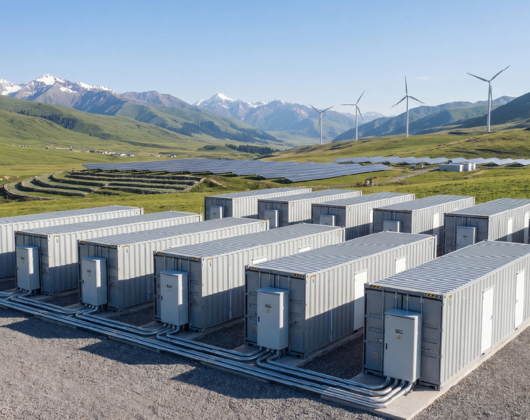
Most backup power in India is a compromise. A generator has to be sized for the worst moment — the peak load — and then spends most of its life running far below that, at low load, where diesel engines are at their least efficient and most polluting. Belding’s Hybrid BESS changes the arithmetic. The battery carries the load first, absorbs sudden spikes in demand, and hands over to the generator only when it is genuinely needed — and then at the load where the engine runs best.
The handover is seamless. When the grid fails, the battery delivers instant backup power while the diesel generator starts, so there is no gap, no flicker, no interruption for the equipment downstream. The system also steadies voltage and frequency, and it can fold solar power into the mix, charging from the sun when it shines and discharging when the site needs it most. The company says the result is lower fuel bills, lower maintenance, a longer life for the generator itself, and a lower total cost of ownership across the system’s life.
The 40-to-80 number
The headline figure is the diesel saving: 40 to 80 percent, depending on how the site uses power. For a hospital that cannot risk a single second of darkness, for a data centre where uptime is the whole business, for a factory running three shifts, that is fuel not bought, fumes not breathed, and money not burned. The company has designed the system for exactly those places — data centres, manufacturing plants, hospitals, airports, telecom towers, mining operations, oil and gas sites, defence installations, remote industrial locations and construction projects, where reliable backup power is not a luxury but the job itself.
Built in Pune, almost entirely in-house
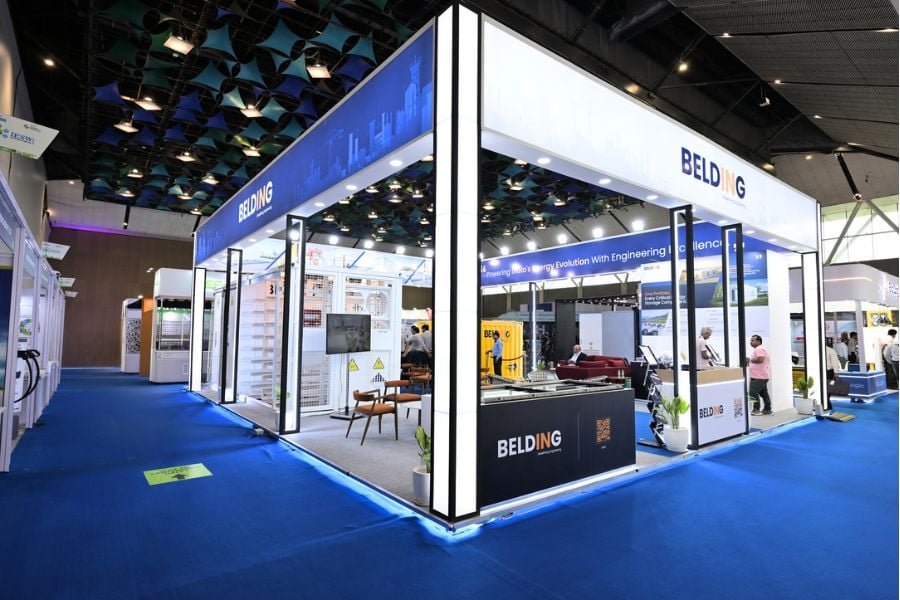
What makes the Hybrid BESS an Indian engineering story, and not just an Indian label on imported hardware, is how much of it Belding builds itself. The company runs a 3 GWh battery assembly line at its manufacturing facility in Pune, spread across 9 acres. Except for the battery cells themselves, the company says the entire value chain is managed in-house — battery pack assembly and module integration, cooling plates, fire protection systems, power conditioning and distribution equipment, the energy management system, and the design and fabrication of the containerised units themselves.
More Read

That depth of integration is what lets the company tailor each system to a customer’s site rather than selling a standard box. The market response since the launch has been encouraging, the company’s director Nikhil Bhuta told EPC World, with potential customers visiting the Pune facility to share their specific operating challenges — and three customers already working with Belding on prototypes as proof of concept, validating the solution in their own environments before larger deployments.
From foils to energy storage
Belding India’s own story is a reinvention. The company began in 1984 as Synthiko Foils, making aluminium packaging foils for the pharmaceutical and food industries, and it remains listed on the Bombay Stock Exchange. Today it is a holding company with five subsidiaries spanning energy storage, edge and modular data centres, precision engineering, defence technology and security screening — including Evolve IT Solutions, acquired outright, which builds indigenous X-ray baggage and cargo scanners.
The energy storage push is gathering pace. In June 2026 Belding formed a joint venture, Belding HD India, with HD Fabcon to take on large battery storage and renewable energy projects end to end, from design and manufacturing to installation and commissioning. In September 2026 it signed a partnership to take its modular data centre systems into the United States, Canada and Mexico. And its customer list for energy storage and data centre solutions already includes names like Pace Digitech, Amara Raja Batteries, Waaree, Reliance, Adani, Tata and Vertiv.
The ambition, as Bhuta puts it, is to position Belding India as a leading indigenous OEM for edge and modular data centre infrastructure and battery energy storage systems in India — and a trusted global delivery partner beyond it. The diesel generator is not disappearing from India’s rooftops and basements tomorrow. But if Belding’s bet is right, the generator of the future will spend most of its life resting quietly, while a Pune-built battery does the heavy lifting.
Keep reading: No Liquid, No Fire: Inside Inventus, the Chennai Startup Building India’s Solid-State Battery · Turning Electricity Into Metal: Inside Sthyr Energy’s Zinc-Air Battery That Stores Power for Months · More Energy & Power stories
Like stories like this? Add Exceptional Technology as a preferred source on Google to see more of our reporting in your search results and Discover feed.