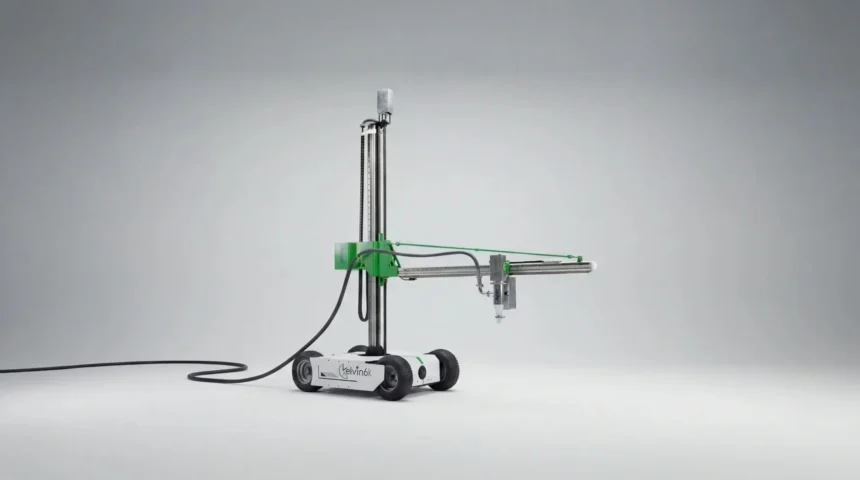
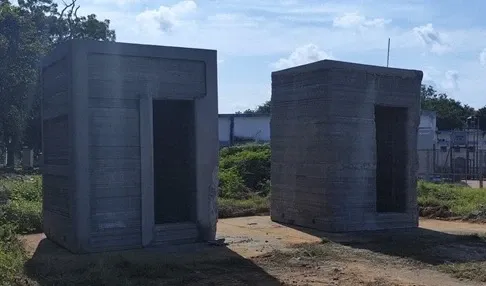
On an Indian Air Force station in Tambaram, a robot built a building. Not a model, not a prototype — a real guard room and sentry post, printed layer by layer on site by a Made-in-India robotic 3D printer. The project, executed by the Garrison Engineer (AF) Tambaram and unveiled by Air Commodore Ratish Kumar, was reported by Manufactur3D as India’s first commercial onsite 3D-printed building. Behind it stands Kelvin6k Technologies, a Chennai startup whose 3D-printing construction robots swap cement for industrial-waste geopolymer — and which, the company says, is already in early discussions with ISRO about printing beyond Earth.
The Air Force project that proved it
Construction 3D printing has been demoed in labs for years, but Kelvin6k’s breakthrough was doing it as a commercial, onsite job for a demanding client. In September 2024, the company and the Military Engineer Services (MES) Tambaram inaugurated the printed guard room and sentry post — built with a domestically developed SCARA robotic printer rather than imported hardware. For a technology often dismissed as a curiosity, a defence client stamping it with approval was the strongest possible validation — the same prove-it-with-robots playbook xLogic is running with its dark factory.
The company was founded by Dr. Pradeepkumar Sundarraj (CEO) and Dr. Ravi Kant Upadhyay, and holds a patent for its construction robotic printer, according to Manufactur3D. Kelvin6k’s stack covers the full chain: large-scale robotic printers, intelligent slicing software, and the cementitious and geopolymer materials themselves — for affordable housing, public and defence infrastructure, and precast construction. The startup even pitched on Shark Tank India Season 5.
Cement-free: the geopolymer bet
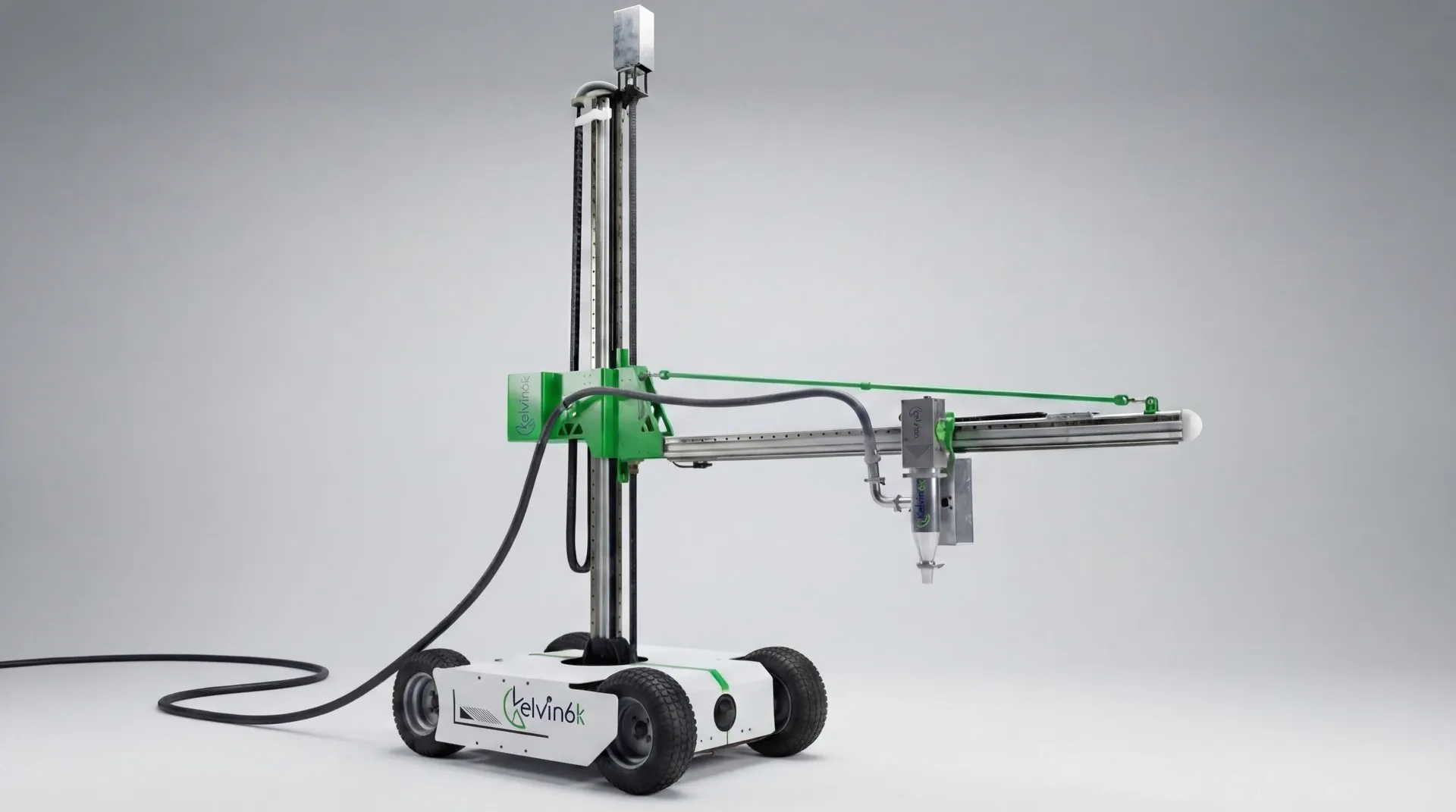
The most consequential part of Kelvin6k’s pitch isn’t the robot — it’s what comes out of the nozzle. Instead of Portland cement, the printers can use geopolymer concrete made from industrial waste. Cement production accounts for roughly 8% of global CO₂, so the carbon arithmetic of construction is enormous. Kelvin6k claims up to 90% lower emissions — a company claim to read alongside independent research: a 2026 Trinity College Dublin trial estimated around 70% embodied-carbon reduction versus Portland cement concrete.
The product lineup reflects a deliberate two-tier strategy. Aton, the flagship, offers a 16-metre print area for large structures, while portable ATOM has a 5.2-metre reach the company says fits in a utility vehicle — figures from company materials, not independently verified. The company also claims its systems cost a fraction of international competitors, and mentions Greater Chennai Corporation projects that no independent source confirms.
A robot that prints buildings with industrial waste instead of cement — the company claims up to 90% lower carbon emissions than conventional concrete.
The Moon shot
Then comes the claim that sounds like science fiction: the company says it is in early discussions with ISRO about off-Earth construction, with lunar printing as a 2030 horizon. This must be attributed strictly as a company claim — there is no independent confirmation. What is independently true is that ISRO has pursued lunar-habitat 3D printing research for years, so the idea sits within a real programme. Back on Earth, the nearer-term prize is affordable housing: a robot that prints a structure in days, with a fraction of the emissions and without imported hardware — provided the economics hold at scale, still to be proven beyond showcase projects.
Key takeaway
The takeaway: Kelvin6k moved construction 3D printing from lab demo to a paying defence client — and its real bet is cement-free geopolymer, not just the robot. The Moon talk is ambition; the Tambaram building is fact.
What comes next
What will decide Kelvin6k’s trajectory is practical: can geopolymer printing clear structural certifications for mass housing, can print speeds beat conventional cost per square foot, and will municipal clients beyond defence sign on? The company has the patent and the showcase project. What it needs now is repeat orders — proof that robot-built buildings can become routine — the same additive-manufacturing wave Astrobase is riding with its 3D-printed rocket engine.
What is Kelvin6k Technologies?
A Chennai-based startup founded by Dr. Pradeepkumar Sundarraj (CEO) and Dr. Ravi Kant Upadhyay that builds large-scale robotic 3D printers for construction, along with slicing software and cementitious/geopolymer materials. It holds a patent for its construction robotic printer, according to Manufactur3D.
What did Kelvin6k build for the Indian Air Force?
With the Military Engineer Services (MES) Tambaram, Kelvin6k delivered India’s first commercial onsite 3D-printed building — a guard room and sentry post on an IAF station — using a Made-in-India SCARA robotic printer, unveiled in September 2024.
What is geopolymer concrete and why does it matter?
Geopolymer concrete replaces Portland cement with binders made from industrial waste. Since cement production accounts for roughly 8% of global CO₂, the savings are large: Kelvin6k claims up to 90% lower emissions (company claim), while a 2026 Trinity College Dublin trial estimated around 70%.
Is Kelvin6k really working with ISRO on Moon printing?
The company says it is in early discussions with ISRO about off-Earth construction with a 2030 horizon — but there is no independent confirmation. What is confirmed is that ISRO independently researches 3D printing for lunar habitats, so the concept aligns with a real programme.
More Read

Sources & further reading
- Kelvin6k Technologies — official site — Robotic printers, slicing software and geopolymer materials; applications and company background
- Manufactur3D: Kelvin6K + MES Tambaram 3D-printed building — September 2024 report on India’s first commercial onsite 3D-printed building with the Air Force
- FacFox: India’s first onsite 3D-printed building — Coverage of the MES Tambaram project and founders on automating construction stages