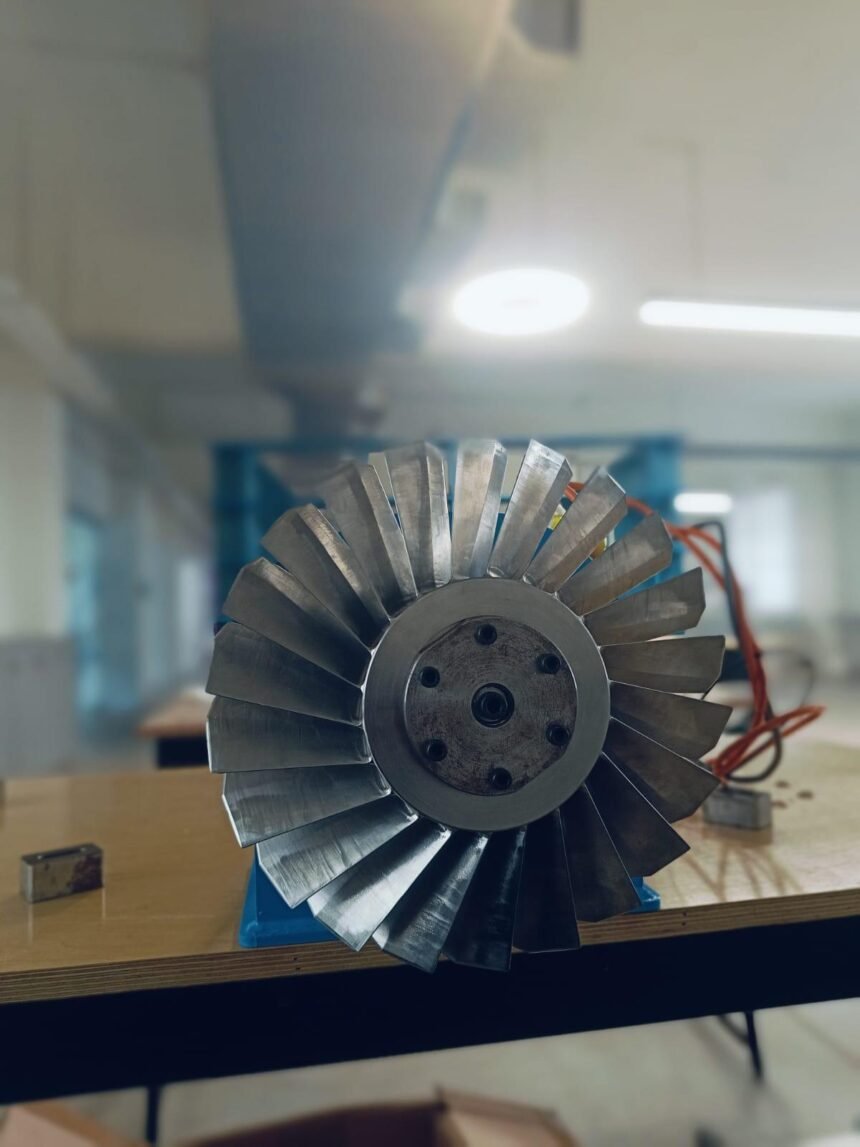
Every jet engine ever built has the same machine at its core: the axial-flow compressor, a ring of spinning blades that squeezes air to many times atmospheric pressure before fuel ignites it. The design was invented in 1901 by Charles Parsons, and for more than a century the world’s best propulsion engineers could only nudge it forward — today’s machines convert roughly 83–90% of the energy put into them into useful work, and for decades that ceiling refused to budge. A five-year-old Bengaluru startup says it has finally cracked the geometry that created the ceiling in the first place.
Spacerolls Aerospace Technologies Private Limited was incorporated on 10 August 2021 by Mohammed Rasheed Cheralil, a Malappuram-born aerospace engineer trained at SRM University, who spent years working back to first principles on a problem the industry had quietly stopped trying to solve. The company is DPIIT-recognised by Startup India, certified under the UDYAM MSME programme, a regional participant in the Boeing BUILD 2.0 boot camp, incubated at the Codissia Defence Innovation and Atal Incubation Centre in Coimbatore and at Chennai’s Crescent Innovation & Incubation Council, and a member of the iTNT deep-tech network.
The invention is ABMP — Axially Opposing, Base-Merged, Double-triangular Prismic blades. Rather than refining the classic aeroplane-wing airfoil that every conventional compressor blade is built on, Spacerolls rebuilt the flowpath itself: diamond-shaped aerofoils are integrated into the blade to optimise airflow dynamics through the machine. The company’s big insight is the blade tip — in every conventional machine the tip is the weak point, where air leaks and metal scrapes the casing. Spacerolls says ABMP is engineered so the tip itself does compression work, and so the air leaving the machine is uniform and distortion-free all the way from hub to tip, something the company says no conventional architecture has ever achieved.
The numbers the company reports from its testing are striking: isentropic efficiency of 98–99%, a leap past the roughly 90% ceiling the industry had been stuck beneath for decades; roughly 10 times greater stability in noise and vibration; and 10–20% lower noise. The company says the machine is lighter too, and places no net force or drag on the surrounding structure — a direct result, it says, of how orderly the airflow becomes as it moves through the machine.
The intellectual property is where the story gets serious. Spacerolls’ Indian patent application (202241043132) for the blading system has gone international — published family members are on record in Australia, Canada, Turkey, Mexico and Hong Kong. The company says it has filed for protection in more than 40 countries, that South Africa has already granted its patent, and that the World Intellectual Property Organization’s International Searching Authority issued a written opinion finding all ten claims novel, inventive and industrially applicable — the three tests any real invention must pass.
The technology is already moving toward real engines. In October 2026, Spacerolls announced a strategic collaboration with Vayuvya Defence, pairing its ABMP axial-flow compressor and open-fan architecture with Vayuvya’s engine-prototyping expertise and its 4 kN indigenous micro-jet engine, now in active testing — a joint push toward self-reliant Indian jet propulsion. Spacerolls also lists a memorandum of understanding with Nikon SLM Solutions of Germany and Singapore for joint R&D using selective laser melting, aimed at additively manufactured engine components. And ABMP is not the company’s only frontier: its product line extends to ABMP ramjet engines — with diamond-airfoil blades ahead of the inlet and a shockwave holder for stable combustion — and a stealth surveillance and strike unmanned aircraft with multispectral sensors and encrypted communications.
More Read

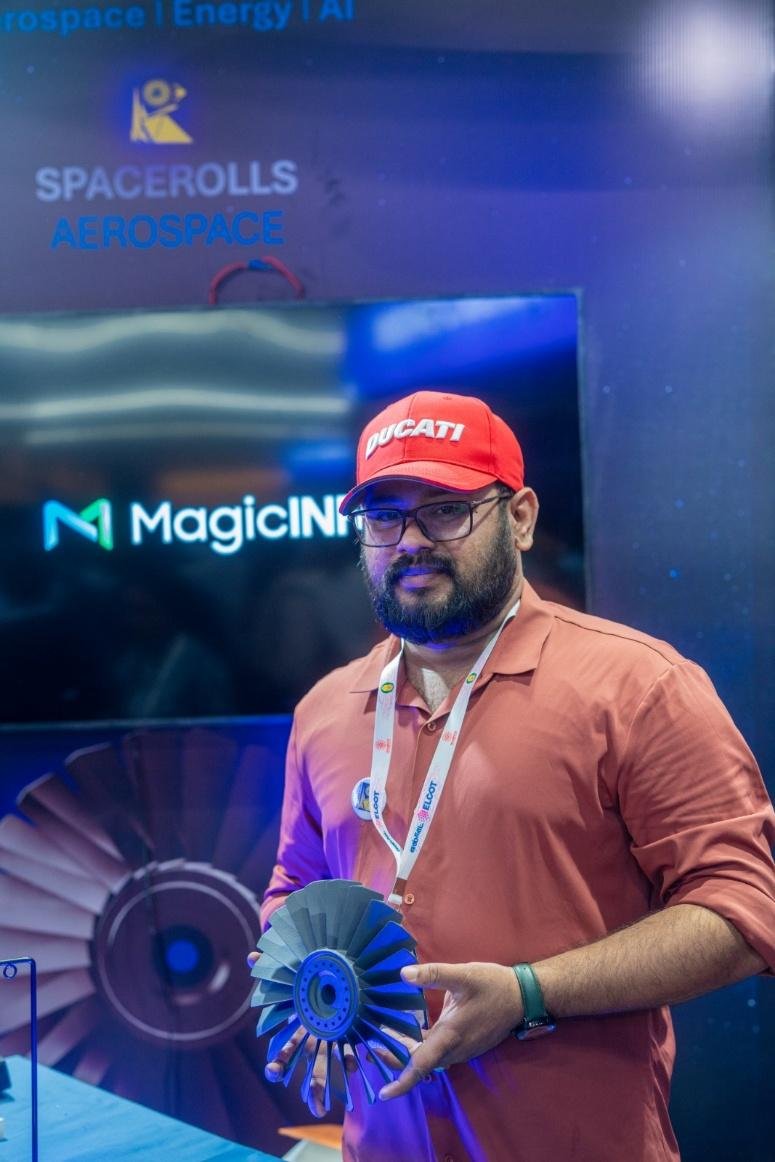
Spacerolls founder Mohammed Rasheed Cheralil with an ABMP blade prototype at an industry expo.
What Spacerolls is attempting is audacious in the best sense — taking a machine the world treated as a solved problem and rebuilding it from first principles, in India, for every industry that moves air. If the ABMP architecture validates at scale, the quiet fuel-burn penalty baked into aviation, power generation and industry for 120 years starts to look like a design choice the world finally outgrew — and the company that outgrew it will be the one from Bengaluru.
Keep reading: Nine Months to a Jet Engine: Inside Nabhdrishti, the Bengaluru Startup Building India’s Own Gas Turbines · You Build the Rocket, They Build the Engine: Inside Hathor Rockets, India’s Own Rocket-Engine Company · More Aerospace & Defense stories
Like stories like this? Add Exceptional Technology as a preferred source on Google to see more of our reporting in your search results and Discover feed.