Inspecting a corroded ship hull or a giant oil storage tank has always been slow, expensive and dangerous work. It means scaffolding, harnesses, confined spaces and long shutdowns, with people working at height or inside steel structures that were never designed to be comfortable. In Noida, a deeptech startup called Octobotics looked at that job and asked a simple question: why send a person at all, when a robot can climb the steel instead?
Octobotics was founded in 2020 by Ishan Bhatnagar and Gulshan Kumar, two marine engineers who had both served as First Engineers at sea, Bhatnagar with BW Group in Singapore and Kumar with DEME in Belgium. They knew inspection from the sharp end, and they built the company around a single idea: magnetic robots that cling to steel and see what the human eye cannot.
The robots travel on magnetic tracks that grip vertical and even overhead steel, so they can crawl up a ship’s hull, around a storage tank or along a pipeline without scaffolding. As they move, phased-array ultrasonic transducers send high-frequency sound waves into the metal and listen for the echo, mapping corrosion, thinning walls and weld defects hidden beneath the surface. On ship hulls, high-pressure water jets clear away biofouling first, so the sensors read clean steel. Everything the robot collects streams to the cloud, where AI-assisted analytics turn it into geo-mapped corrosion maps, defect findings and remaining-life analysis that maintenance teams can act on.
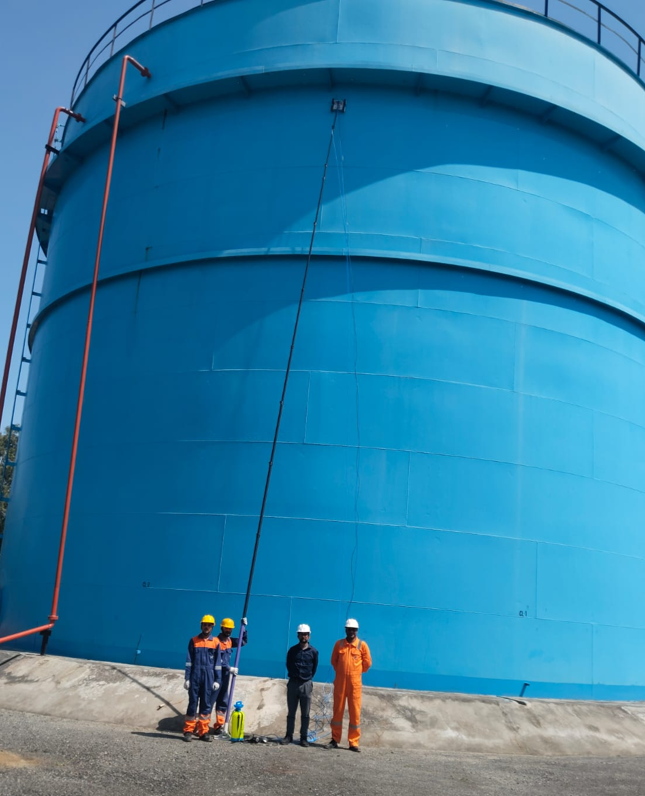
The company has built four platforms around that core. TrackSense is the magnetic crawler for corrosion mapping on tanks, pipes and vessels. ReachMaster is a telescopic system that takes ultrasonic thickness readings at height, so teams can inspect tall structures without building scaffolding at all. WeldSense inspects welds autonomously using ultrasonic, phased-array and time-of-flight diffraction methods. And PA Rail Scan brings phased-array inspection to railway tracks and welds. Together, the company says, they cover the hardest-to-reach assets in industry, from ballast tanks and hulls to boilers, pressure vessels and distillation columns.
The customer list is unusually strong for a company of its size. Octobotics counts the Indian Navy among its customers, alongside IOCL, BPCL and HPCL, plus Aarti Industries, GSFC and Saudi Arabia’s S-Chem. At IOCL’s Panipat Naphtha Cracker, the company says, its robots mapped a unit ultrasonically during a turnaround, the kind of high-pressure window where every extra day of inspection costs dearly. Rather than selling the hardware outright, Octobotics offers inspection as a subscription, handling deployment, data analysis and recommendations, so clients get the latest robots and software without buying the fleet themselves.
The numbers show a business already earning its keep. YourStory reported about Rs 2 crore in revenue in the company’s last financial year, and in February 2026 Octobotics raised about Rs 10 crore in a seed round led by Navam Capital, with BYT Capital participating. The company says its robots inspect up to 90% faster and at up to 60% lower cost than conventional methods, and that it has inspected more than 100 critical assets across more than 10 countries, with approvals from seven major classification societies.
More Read

What comes next is scale. The team is working towards IECEx and ATEX certification, the standards that let equipment operate safely in explosive atmospheres and open doors across oil and gas, and it plans to expand into Singapore and the Middle East, taking a made-in-India inspection stack into markets that have long imported this kind of technology. The vision is a simple one: the most dangerous inspection jobs in the world, done by robots that never get tired, never need a harness, and see straight through steel.
Keep reading: The Chips Behind the Chips: Inside Tessolve, the Bengaluru Company Engineering Silicon for the World’s Biggest Chipmakers · Built on His Mother’s Voice: Inside Maya Research, the Bengaluru Startup Outsinging Google in Voice AI · More Industrial Automation & Technology stories
Like stories like this? Add Exceptional Technology as a preferred source on Google to see more of our reporting in your search results and Discover feed.