Walk into almost any Indian factory that has been running for twenty years and you will see the same choreography. Parts travel from stores to the line on trolleys pushed by hand. Finished goods travel back the other way the same way. The trips repeat all day, every shift, and when workers are hard to find — or when a heavy load strains a back — the whole line feels it.
The robots that could take over that work have usually come with a catch. Imported autonomous vehicles are expensive, and older guided vehicles need the building itself to change first: magnetic strips or markers laid into the floor, fixed paths painted into the plant, and a shutdown while it all goes in. For a factory running three shifts, that shutdown alone can kill the business case.
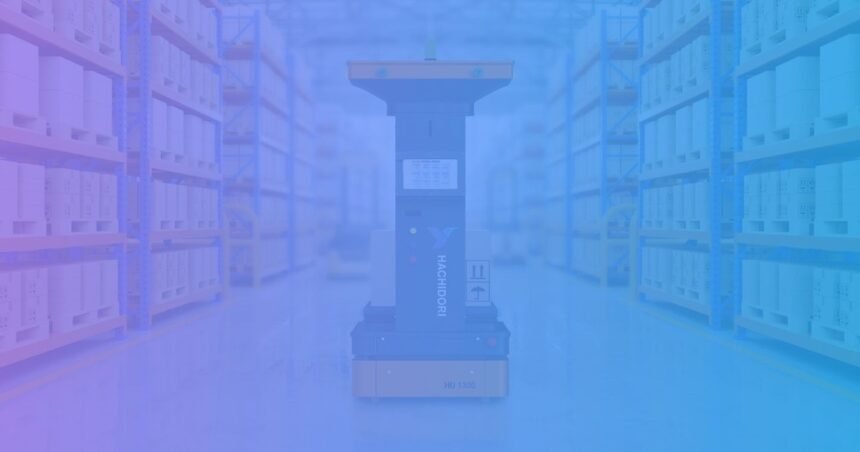
The company is Hachidori Robotics, a Bengaluru company founded in 2019, and its answer is to build a robot that needs none of that. Its autonomous mobile robots — AMRs — find their own way around a live factory floor, with no tracks, no magnets and no shutdown to install them.

The indoor GPS
An AMR differs from an older automated guided vehicle in one decisive way. A guided vehicle follows a fixed path built into the floor. An autonomous robot works out its own route using sensors and software, and changes it when something is in the way.
Hachidori’s system rests on its patented Wireless Natural Navigation technology, which the company calls WiNN — an indoor equivalent of GPS. Satellite positioning does not work inside a building, so the company installs wireless Beacons in the factory or warehouse that give its robot fleet coordinates to navigate by. The Beacons also double up for real-time location tracking of smart bins, pallets and trolleys.
On board, each robot carries 2D LiDAR, 3D depth cameras and sensor fusion that build a live picture of its surroundings, so it can reroute around an obstacle in real time and adapt instantly when a layout changes. There are no floor markers, no ceiling QR codes and no fixed guides to maintain. The company says a fleet can be fully operational in as little as four to eight weeks, with minimal disruption to ongoing operations — and that its machines cost about a third of imported autonomous vehicles.
More Read
One fleet for the whole floor
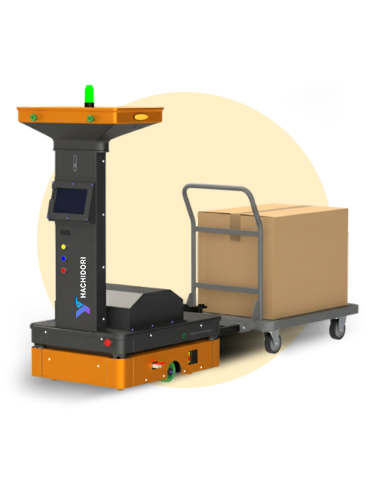
Hachidori builds eight specialist AMR variants, covering loads from under 50 kg to 4,000 kg, so one supplier can handle most of a plant’s internal movement. A tugger pulls a train of carts down a long aisle. A pallet jack lifts and shifts a single load. Unit load carriers, dock-and-conveyor robots and a bin-handling robot for automated storage and retrieval cover the rest — receiving dock to storage, storage to production line, finished goods to dispatch.
The robots run on LiFePO4 batteries, with a swappable-battery option for near-continuous, round-the-clock operation, and they plug into a plant’s warehouse management system with real-time fleet management. The company says its robots can raise material movement efficiency by up to three times.
Built for Indian floors
Hachidori sells into automotive, consumer goods, electronics, pharmaceutical and warehousing customers, and positions itself as a manufacturer that understands Indian conditions, where site layouts vary and change often. Its robots move heavy automotive components and finished vehicles inside assembly plants, bulk pallets in fast-moving consumer goods warehouses, and work-in-progress material through textile, garment, plastic, electronics and pharmaceutical units — including cold-storage operations, where they move pallets and integrate with warehouse management systems.
In food and beverage warehouses, the company says, its lifting robot — with a lift capacity of up to 1.5 tonnes — moves perishable and non-perishable consumables, while its dock-and-conveyor model works alongside automated storage and retrieval systems to transfer raw material in and finished goods out. The robots are designed and manufactured in India, at the company’s Bengaluru plant, and the company describes its AMRs as a 100% Made in India product.
The engineering behind that claim started early. Hachidori was incubated at the Society for Innovation and Development at the Indian Institute of Science, and its precise-location work was sharpened through Qualcomm’s QDIC programme, which helped the team build a stereo-vision subsystem on a Qualcomm Snapdragon processor for obstruction detection and avoidance. The company holds more than three patents on its indoor positioning and navigation work.
That steady, practical engineering shows in the team itself. From about 11 people in late 2021, Hachidori has grown to around 120 people, with offices across Karnataka, Maharashtra, Delhi and Tamil Nadu alongside its Bengaluru manufacturing plant. For a hardware company selling to conservative industrial buyers, that growth is one of the clearest signals that the robots are being bought and put to work.
Hachidori’s founders — Janakiram Annam, Ramanathan Venkataraman, Venkataraman Natarajan and Krishna Vaidyanathan — set out to give older Indian factories the automation that usually only reaches brand-new ones. No floor surgery, no shutdown, no imported price tag: just a robot that learns the floor it is given, and gets on with the trips nobody should have to push by hand anymore.
Keep reading: The Robot That Learns Like a Baby: Inside CynLr, the Bengaluru Startup Teaching Machines to Handle Anything · Glasses That Listen: Inside Torchit, the Ahmedabad Startup Turning Sight Into Sound · More Industrial Automation & Technology stories
Like stories like this? Add Exceptional Technology as a preferred source on Google to see more of our reporting in your search results and Discover feed.