Walking looks effortless — until it isn’t. For someone living with Parkinson’s disease, or recovering from a stroke, every step can become a negotiation: a foot that hesitates, a rhythm that breaks, a fall waiting in an ordinary hallway. For years, the only way to measure that struggle precisely was to travel to a specialist gait laboratory, walk across pressure-sensitive walkways under banks of cameras, and wait for experts to interpret the results. In Gandhinagar, a team from the Indian Institute of Technology Gandhinagar asked a simpler question: what if the laboratory could fit inside a shoe?
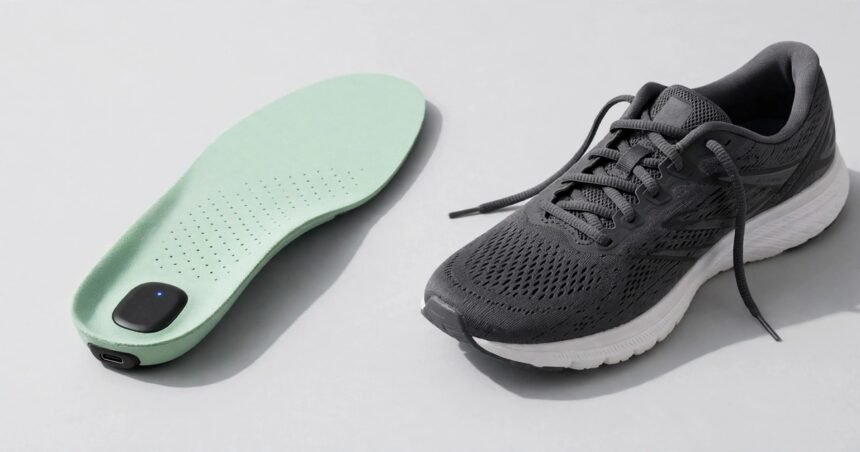
The answer is INSTROLE, the smart insole built by Oreejoy MedTech Pvt. Ltd., a startup incubated at IIT Gandhinagar. It is a lightweight insole packed with pressure sensors, signal processing and artificial intelligence, designed to read how a person walks in real time — not in a laboratory, but in everyday life, in their own shoes, on their own streets.
From a gait laboratory to a shoe insert
The idea grew out of more than a decade of research. Oreejoy was founded by Prof. Uttama Lahiri of IIT Gandhinagar’s Department of Electrical Engineering, together with Dr. Neelesh Sharma, and the work began with a close look at mobility disorders linked to Parkinson’s disease and stroke. Conventional gait analysis at the time relied on pressure-sensitive walkways or camera-based systems that could cost roughly ₹25 lakh to ₹65 lakh and needed specialised facilities — wonderful science, but far from most patients.
INSTROLE takes a different route. Its embedded sensors map pressure beneath the foot, recording how weight shifts, how the foot strikes the ground, and how movement changes over time. An edge device processes the measurements, which can be sent wirelessly to the cloud, and a companion app turns them into two views: a clear summary of walking and balance for the user, and a detailed gait pattern for clinicians. The company says the wearable approach can cut the cost of gait analysis by about 80 per cent compared with the laboratory systems it was designed to complement.
How INSTROLE reads a walk
Every walk tells a story, and INSTROLE is built to listen to all of it. As a person moves, the insole’s sensors capture the pressure story of each step — heel strike, roll-through, push-off — and the software analyses the pattern as it happens. Changes in symmetry, rhythm or weight distribution that a clinician might miss in a single clinic visit become visible over days and weeks of ordinary walking.
That continuity is the heart of the idea. A single laboratory session shows how someone walks on one good day in one strange room. A wearable insole shows how they walk at home, on uneven ground, when tired, and when recovering — the walking that actually shapes their life. For clinicians, that means assessments grounded in real behaviour; for patients, it means progress they can see, not just feel.
More Read
From Parkinson’s to post-stroke recovery
The platform’s first focus is personalised sensory cues to aid walking in people with Parkinson’s disease — gentle, tailored prompts that help steady a faltering rhythm. From there, the work has widened. Research involving around 300 participants across Rajkot, Ahmedabad, Gandhinagar and New Delhi has supported the startup’s programme, bringing together researchers, clinicians, students and technology developers, and the applications now extend to post-stroke rehabilitation, flat-foot assessment and osteoarthritis.
Behind the technology sits a deep institutional home. The institute’s Tinkerer’s Lab and Research Park provided facilities and support as the idea grew from research into a company, and Prof. Lahiri’s earlier work on technology-assisted gait rehabilitation — recognised with the Tata Innovation Fellowship for 2020-21 — laid the scientific groundwork for the wearable.
A Boeing BUILD win
The wider innovation world has started to notice. Oreejoy was named one of seven winners of the fifth edition of Boeing India’s University Innovation Leadership Development (BUILD) programme, selected from around 2,000 applications nationwide, with 28 teams reaching the national finals. Each winning team receives a ₹10 lakh grant to develop its idea further, and Boeing lists Oreejoy MedTech Pvt. Ltd. among the winners, incubated at IIEC Gandhinagar, with Prof. Uttama Lahiri and Dr. Neelesh Sharma named as the team.
It is a fitting milestone for a technology that began by asking how to bring a laboratory to the patient, rather than asking the patient to come to the laboratory. A shoe insert will never replace a clinician’s judgement — but a shoe insert that quietly reads every step, day after day, gives clinicians something they have rarely had before: the full story of a person’s walk, told by the walk itself.
Keep reading: A Drop of Blood, an Answer in Minutes: Inside Rheoheme, the IIT Bombay Startup Screening Anaemia and Sickle Cell Disease · The Device That Fixes Sleep While You Sleep: Inside DUSQ, India’s Closed-Loop Sleep Regulator · More Chemicals, Materials & Life Sciences stories
Like stories like this? Add Exceptional Technology as a preferred source on Google to see more of our reporting in your search results and Discover feed.