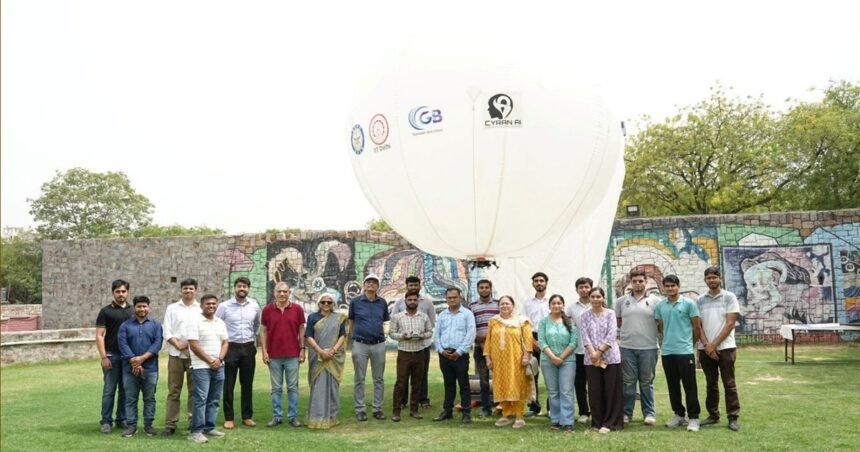
High above the lawns of IIT Delhi, a great white balloon hangs motionless in the sky, tethered to the ground by a single line. It does not buzz like a drone or streak past like an aircraft. It simply stays there, watching — hour after hour, through heat, wind and rain, its camera drinking in everything below. That quiet persistence is exactly the point. This is India’s own tactical aerostat, and it is built to outlast anything with rotors.
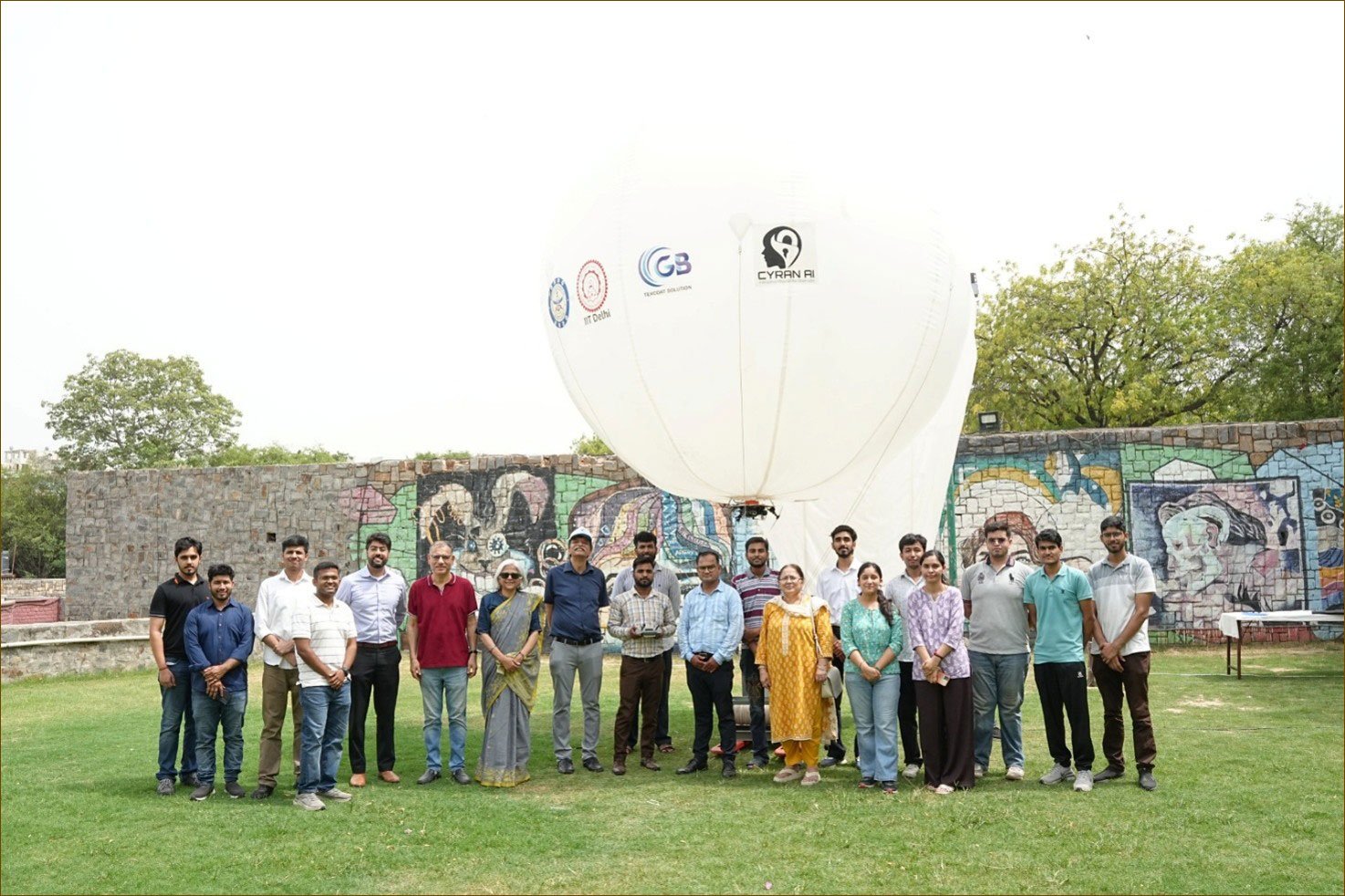
The system was demonstrated by IIT Delhi in July 2026: a tactical aerostat of about 24 cubic metres, flown to a height of 30 metres while carrying a payload of up to 10 kg for surveillance, security and remote communications, streaming live aerial data to the ground team. It is the visible tip of years of research into a technology India has historically had to import.
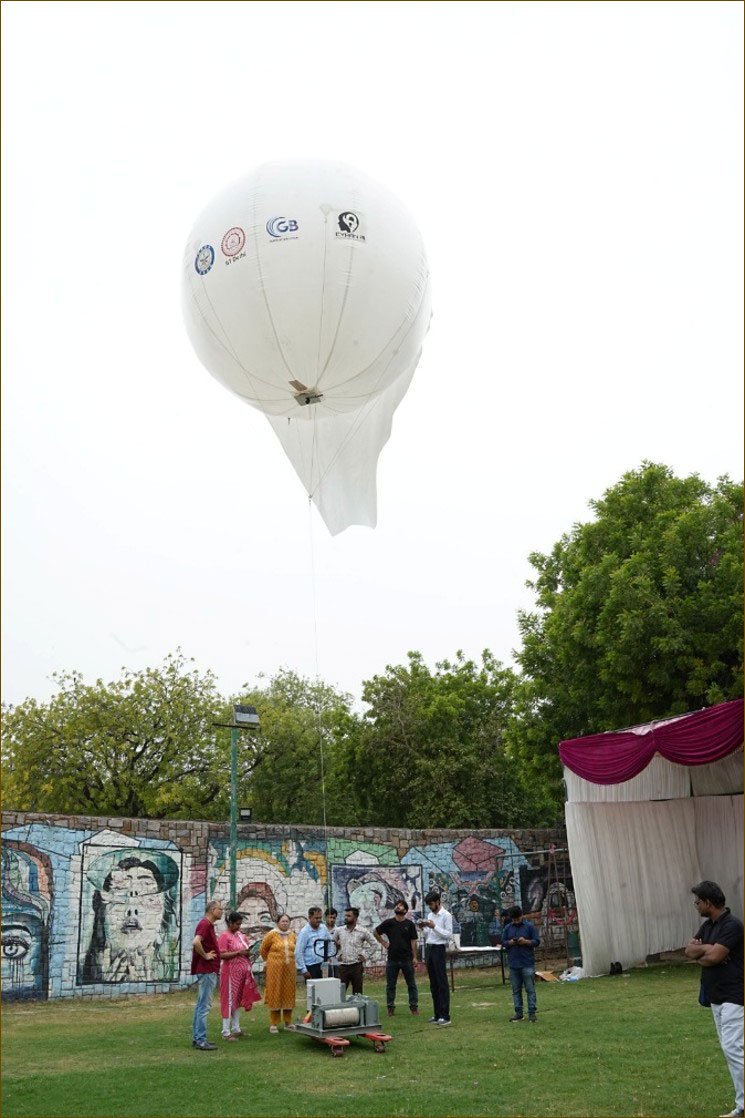
An aerostat is a lighter-than-air platform: helium does the lifting, so there is no motor burning energy just to stay up. Compared with drones, the institute says, aerostats offer significantly longer endurance, lower operating costs, continuous monitoring, higher payload capacity and greater reliability. Where a drone must land to recharge, an aerostat keeps its eye open — an ideal watchman for border surveillance, disaster management, infrastructure monitoring, environmental observation, traffic management and emergency response.
The breakthrough sits in the skin of the balloon. The technology comes out of the DRDO Industry Academia-Centre of Excellence (DIA-CoE) funded SITEX-I and SITEX-II research programmes at IIT Delhi, led by Prof. Mangala Joshi and Prof. B. S. Butola of the Department of Textile and Fibre Engineering. Their teams developed indigenous aerostat hull materials and engineering technologies, cutting dependence on imported strategic materials and laying the foundation for India’s own lighter-than-air systems.
Turning that research into a flying machine fell to GB Texcoat Solution Pvt. Ltd., a FITT-IIT Delhi-incubated deep-tech startup. The company developed and fabricated the complete aerostat system using its proprietary high-performance coated textile materials, designed for superior helium retention, lightweight construction, durability and all-weather operation, day or night.
And the eye itself is getting smarter. During the demonstration the aerostat carried a high-definition surveillance payload, while CYRAN AI, an IIT Delhi faculty-led deep-tech startup, ran advanced Edge AI algorithms on the live aerial imagery in real time — intelligent object detection, classification, activity recognition and automated alerts, computed at the edge rather than beamed away for processing.
More Read
The platform is designed to carry surveillance and communication payloads at altitudes of up to 20 km, the institute says, which would put a single aerostat’s gaze over an enormous sweep of land. Beyond defence preparedness, the same persistent eye can serve disaster response, public safety, critical infrastructure monitoring, agriculture, environmental management and smart-city applications.
From imported balloons to a homegrown system built on Indian textiles, Indian engineering and Indian AI — the aerostat is a quiet kind of self-reliance, floating patiently above the field, watching over everything below.
Keep reading: The Friend From Space: Inside Vyommitra, ISRO’s Robot Astronaut Flying India’s First Uncrewed Gaganyaan Mission · The Flying Truck That Needs No Runway: Inside BluJ Aerospace, the Hyderabad Startup Building India’s Heavy-Lift eVTOL Platform · More Aerospace & Defense stories
Like stories like this? Add Exceptional Technology as a preferred source on Google to see more of our reporting in your search results and Discover feed.