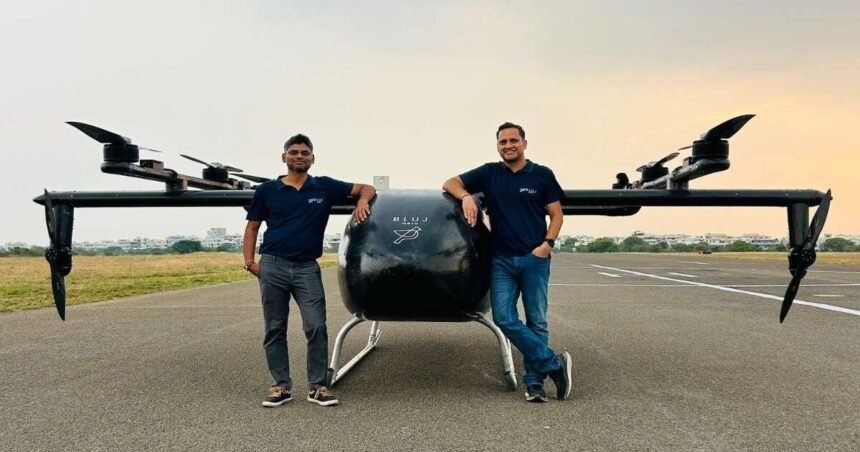
Some of India’s most important cargo never travels on a road at all — it waits for a helicopter, a boat, or a long drive to a substation in the hills, a border post, or an offshore platform. In Hyderabad, a small team of aerospace engineers decided that the missing link was an aircraft built for exactly that job: big enough to matter, electric, and able to land where no runway exists.
BluJ Aerospace, founded in 2022 by Amar Sri Vatsavaya and Utham Kumar Dharmapuri, spent four years in research and development before unveiling its answer in May 2026. The Gen #2 is the first commercial-grade aircraft built on the company’s VANTIS platform — short for Vertically Integrated Architecture for Next Generation Intelligent Aerial Systems — a single shared architecture spanning the airframe, propulsion, controls and autonomy systems, so that every future BluJ aircraft inherits subsystems already proven in flight.
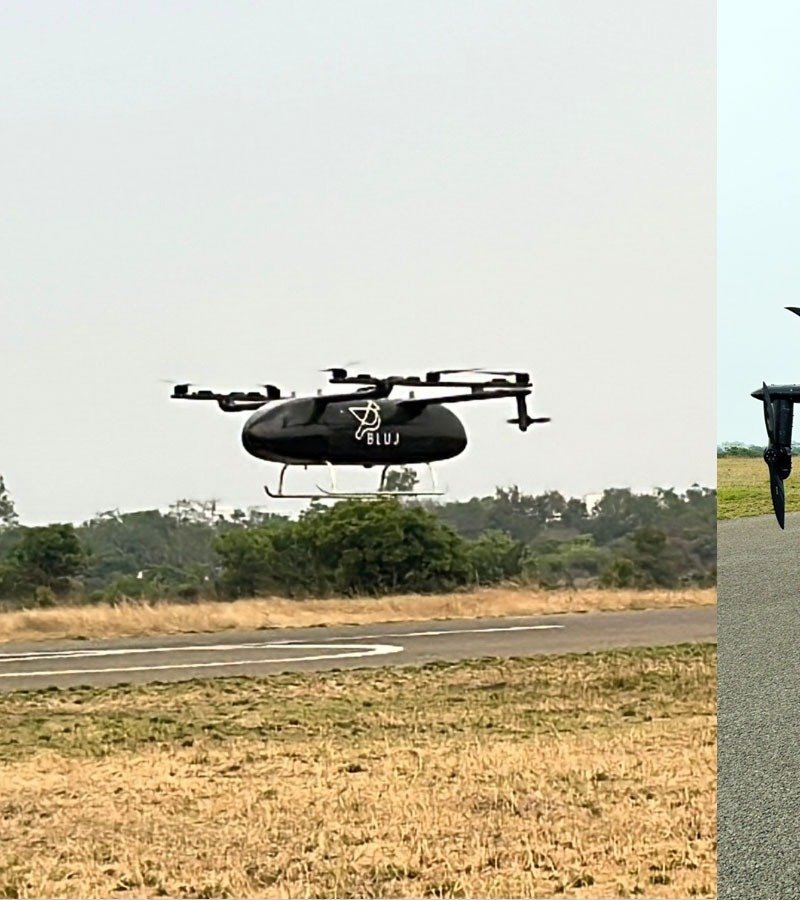
The numbers tell the story of a working aircraft, not a concept. Gen #2 is fully battery-powered, uses a lift-plus-cruise configuration, and is designed for an active payload target of more than 200 kg within a 500 kg maximum take-off weight. It follows Gen #1, the company’s technology demonstrator, which the company says achieved India’s first public flight demonstration of a 500 kg-class electric vertical take-off and landing aircraft. The company says Gen #2 is 40 percent lighter than its predecessor, the result of that long optimisation effort, and it is now in active flight testing, being used for early customer pilots, payload testing and real-world logistics mission evaluations.
The commercial pipeline already reaches across the sectors where a heavy-lift flying truck earns its keep: infrastructure logistics, express cargo, energy, airports and defence. The company says it has completed a successful pilot deployment with a leading power-sector public sector undertaking for infrastructure logistics, and it has active partnerships with a defence public sector undertaking and Indian defence companies. Backed by Endiya Partners and Ideaspring Capital, with Skyroot co-founder Pawan Kumar Chandana as an advisor, BluJ operates from a 40,000-square-foot facility in Hyderabad with a team of more than 50 engineers and aerospace specialists, holds an issued design patent on its eVTOL architecture, and has filed a utility patent on its airframe design.
Self-reliance runs through the build. The company says around 50 percent of the platform is built in-house today, with a target of 75 percent within two years — its own battery packs, electronic boards, motor controllers and propellers, built so that critical components need not be sourced from China. That in-house depth is what makes the platform idea real: the same VANTIS foundation is designed to scale to one-tonne-payload heavy logistics aircraft, and onward to hydrogen-electric long-range passenger variants.
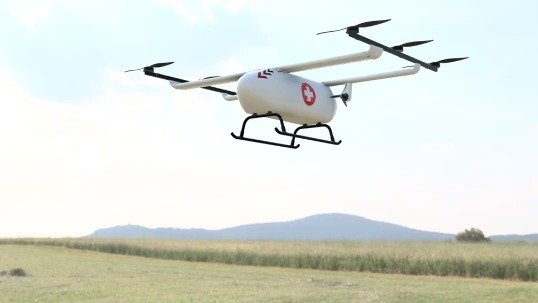
The hydrogen chapter is already underway. The company says it has developed a ground version of its hydrogen-electric propulsion system, including an in-house Type IV composite hydrogen tank, and is progressing towards a flight version, with hydrogen-electric long-range variants targeted for 2027–2028 in collaboration with Bharat Petroleum Corporation Limited and Cochin International Airport Limited on hydrogen ecosystem development. Its flagship hydrogen-electric cargo aircraft, REACH, is designed to complement mid-mile logistics and bring same-day delivery to underserved regions — the company talks of routes like Bengaluru–Mysuru, Chennai–Pondicherry, Mumbai–Pune and Hyderabad–Warangal, flown in under 30 minutes, without a traditional airport at either end.
More Read

Commercial deployment of the battery-powered cargo aircraft is targeted for 2027, with a Series A round of $10–15 million sought to carry it there. From a demonstrator that proved a 500 kg electric aircraft could fly in India, to a commercial-grade machine now proving itself on real logistics missions, BluJ is building the platform first and the aircraft second — and that is exactly why its next aircraft, and the one after that, should arrive faster than its first.
Keep reading: Break the Surface: Inside Aspera Industries’ Eureka, the Autonomous Seaplane Turning Water Into Runways · Unjammable by Design: Inside Pisarv, the Indore Startup Giving the Army Drones That Can’t Be Hijacked · More Aerospace & Defense stories
Like stories like this? Add Exceptional Technology as a preferred source on Google to see more of our reporting in your search results and Discover feed.