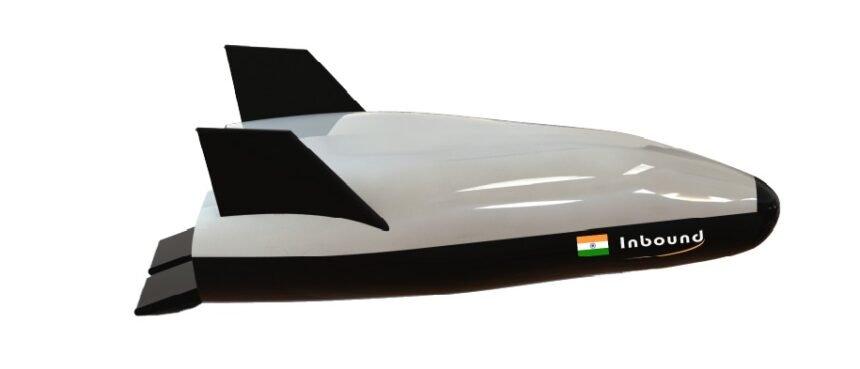
Right now, an experiment that needs weightlessness can wait years for a slot aboard a space station — and when it finally flies, it comes home in a capsule that splashes down wherever its parachutes take it. A Chennai startup is building a very different kind of return ticket: a reusable spaceplane that glides home and lands on a runway, with its precious cargo intact.
Inbound Aerospace, incubated at IIT Madras, is developing an autonomous, unmanned, free-flying recoverable spacecraft for exactly that job. Founded by Aravind I B, Vishal Reddy and former Indian Navy aviator Captain Abhijit Bhutey (Retd), the company is building a vehicle that launches to low-Earth orbit aboard available launch vehicles, operates there on its own propulsion for months at a time, and then brings everything it carried safely back to Earth.
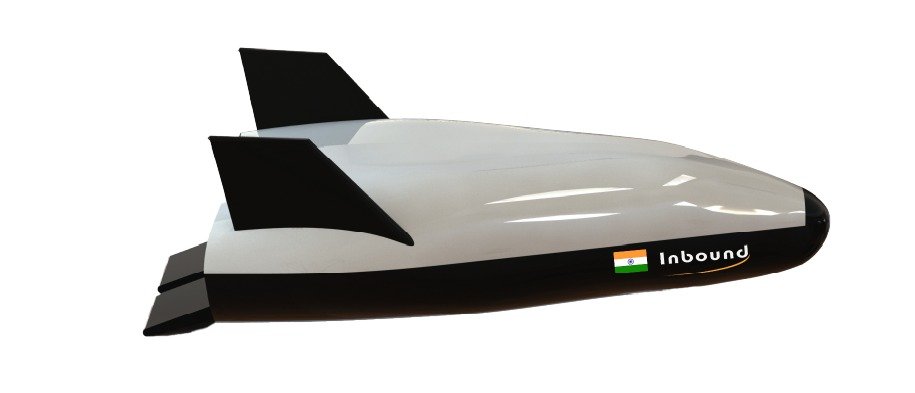 Inbound Aerospace’s reusable lifting-body spaceplane. (Image: Inbound Aerospace)
The shape of the vehicle is the breakthrough. Instead of a conventional capsule, Inbound is building a lifting body — a fuselage shaped so the vehicle itself generates aerodynamic lift during atmospheric flight, even without large wings. The company says that gives it far more control on the way home than a ballistic capsule, with a gentler ride for fragile payloads and a precise runway landing at the end of the flight, rather than a broad ocean or desert recovery zone.
That return leg is what unlocks the science. In weightlessness, liquids, crystals and biological systems behave in ways they never do on Earth — protein crystals grow purer, fibre optics can be drawn flawlessly, and new materials take shapes gravity would never allow. The company says its spacecraft will carry experiments and manufacturing equipment into orbit, let them run for around three months, and return the finished results to its customers. Its target applications span pharmaceuticals and biotechnology, advanced materials and semiconductors, ultra-high-bandwidth fibre optics, scaffold-free 3D bioprinting and protein-based artificial retinas, alongside in-orbit technology demonstrations and satellite qualification.
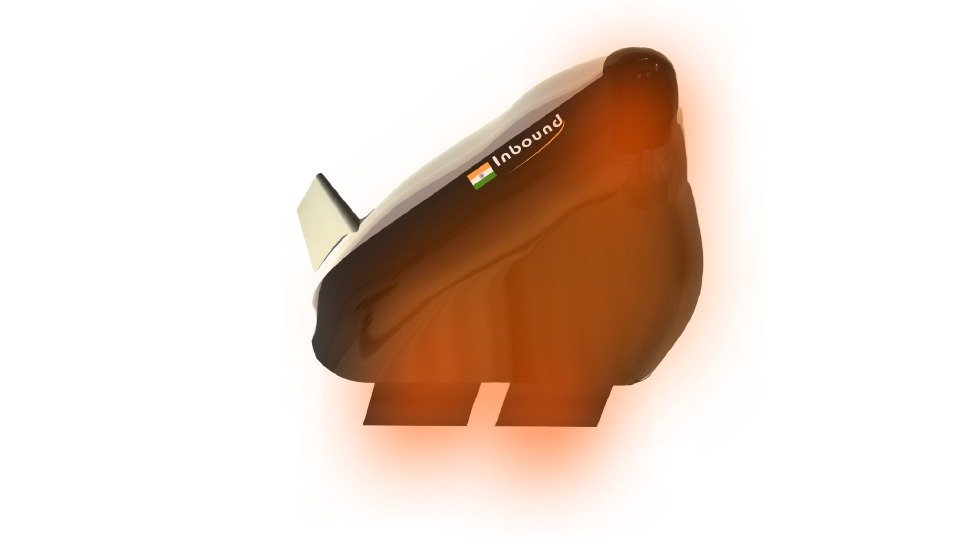 Surviving re-entry is the hard part — and the heart of Inbound’s engineering. (Image: Inbound Aerospace)
More Read
Getting the landing right starts long before orbit. Unlike the circular parachutes that reliably slow a capsule but cannot steer it, Inbound’s spacecraft uses a rectangular, steerable parachute — much like the canopies skydivers use — designed to guide the vehicle to a designated landing point. The company showcased that precision aerial delivery and safety-chute system alongside its re-entry vehicle concept at Bengaluru Space Expo 2026, and it sees the same pinpoint-landing technology finding uses in defence logistics, disaster response and remote delivery.
The test programme is already moving. The company says it has completed a 1-kilometre drop test validating its parachute technology, with further tests planned at 3, 8 and 30 kilometres, and the spacecraft itself has reached Technology Readiness Level 4. Its maiden prototype launch is targeted for 2028, with launch vehicle options under evaluation including SpaceX’s Falcon 9, Skyroot’s Vikram and Japanese rockets.
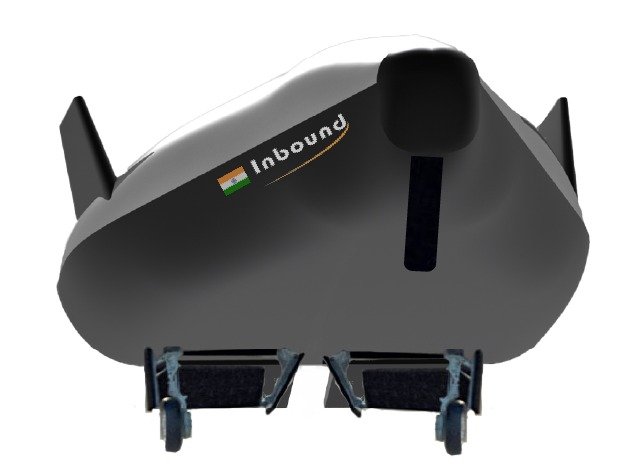 Built for the runway: Inbound’s spaceplane is designed to land precisely, not splash down. (Image: Inbound Aerospace)
To prove the full return journey, Inbound has signed a five-year agreement with Australia’s Space Angel Group, announced at Bengaluru Space Expo 2026, covering flight testing, drop tests, high-altitude and near-space trials, recovery operations, spaceport support and mission planning. The company says Australia will serve as an interim landing site for the next two to three years while India builds out its own re-entry ecosystem, giving its test programme the wide, empty corridors a returning spacecraft needs.
The backing is building too. Inbound raised more than $1 million in a pre-seed round in July 2025 led by Speciale Invest, with Piper Serica participating, and the company says it is preparing a seed round of $11–25 million, primarily to secure a launch vehicle for its 2028 test mission and fund further research and development. Longer term, the company expects revenues of around $3–4 million per launch as orbital research and manufacturing grow into a regular traffic flow.
India’s private space story has so far been told mostly in launches — rockets climbing away from Earth. Inbound Aerospace is building the other half of that story: the journey home. From Chennai, a small team is engineering a spacecraft that treats orbit not as a one-way trip, but as a round trip — and a runway landing as the normal way to end a mission in space.
Keep reading: The Eye That Never Blinks: Inside GB Texcoat’s Made-in-India Tactical Aerostat · The Friend From Space: Inside Vyommitra, ISRO’s Robot Astronaut Flying India’s First Uncrewed Gaganyaan Mission · More Aerospace & Defense stories
Like stories like this? Add Exceptional Technology as a preferred source on Google to see more of our reporting in your search results and Discover feed.