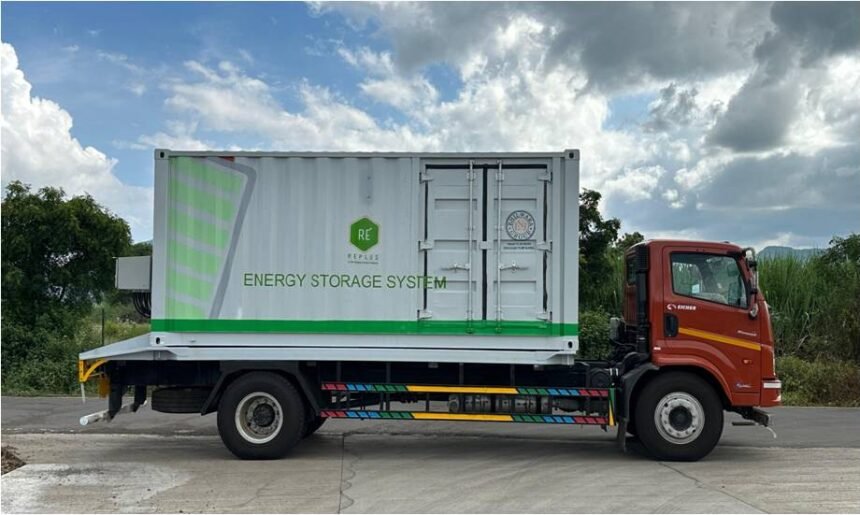
Every evening, India faces the same quiet test. The sun sets, solar farms across the country stop generating, and homes, factories and telecom towers still need power. The cheapest clean electricity in the world is useless if it cannot be kept until it is needed — and that is exactly the gap a Pune company has spent years engineering its way into. Its answer is a steel container, twenty feet long, that holds enough electricity to carry a neighbourhood through the night.
The company is REPLUS Engitech, a Pune-based battery and energy-storage manufacturer that is part of HEG Advanced Materials and the LNJ Bhilwara Group. Its flagship product, the RE5K, is a liquid-cooled battery energy storage system (BESS) that packs 5.01 megawatt-hours into a single container — a unit the company describes as India’s first 5.01 MWh liquid-cooled BESS container, launched at the Renewable Energy India Expo in 2025.
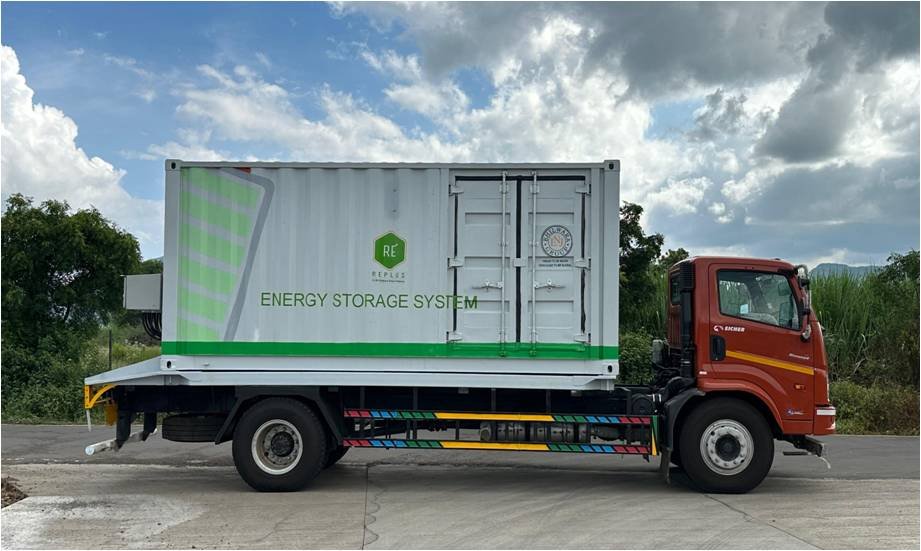
REPLUS’s containerised energy storage system. (Image: REPLUS)
The engineering inside the box is built around a simple idea: big batteries only work if they stay cool, safe and predictable for decades. The RE5K uses intelligent liquid cooling that keeps cell temperatures uniform even up to 55°C, so the system holds its performance through Indian summers. Safety is layered twice over — a dual-stage fire suppression system combining condensed aerosol and water mist — inside a corrosion-resistant, ruggedised container designed for outdoor sites. The company rates the system for a 20-year service life with a 10,000-cycle design built on long-life 314 Ah cells, and says it meets international safety and performance standards. A modular architecture and an advanced energy management system let operators scale from a single container to multi-container sites, and dispatch stored power exactly when the grid or the factory needs it most.
The news that makes this story current is scale. REPLUS is now in initial trial production of the 5.01 MWh container at its Pune facility, and the company told pv magazine on 28 October 2026 that mass production begins in March 2027, with commercial deliveries following in April 2027. The Pune plant itself is being commissioned by December 2026 with an annual production capacity of 6 GWh — six times the 1 GWh line the company runs today. A higher-capacity 6.25 MWh version of the container is already in development for commercial, industrial, renewable-integration and microgrid customers.
More Read

The RE5K is only the flagship of a range that stretches from grid scale down to the home. For commercial and industrial customers, the company is developing a 261 kWh rack-based solution. For telecom towers, it offers a 48 V, 100 Ah battery designed for a ten-year life that works with standard Delta, Vertiv and Exicom power units. For households, a 12 V, 100 Ah battery is designed as a direct drop-in replacement for conventional lead-acid batteries — the company says customers can remove the old battery and install the new one without modifying their existing inverter setup. On wheels, REPLUS builds a 32.23 kWh electric-vehicle pack rated at 307 V and 105 Ah, weighing about 230 kg and rated for more than 3,500 cycles at 80% depth of discharge, plus a 10.75 kWh three-wheeler pack in a sealed IP67 case. The company also developed India’s first AIS-certified battery pack for light commercial vehicles, and says more than 500 of its EV battery packs are already proving themselves on the road.
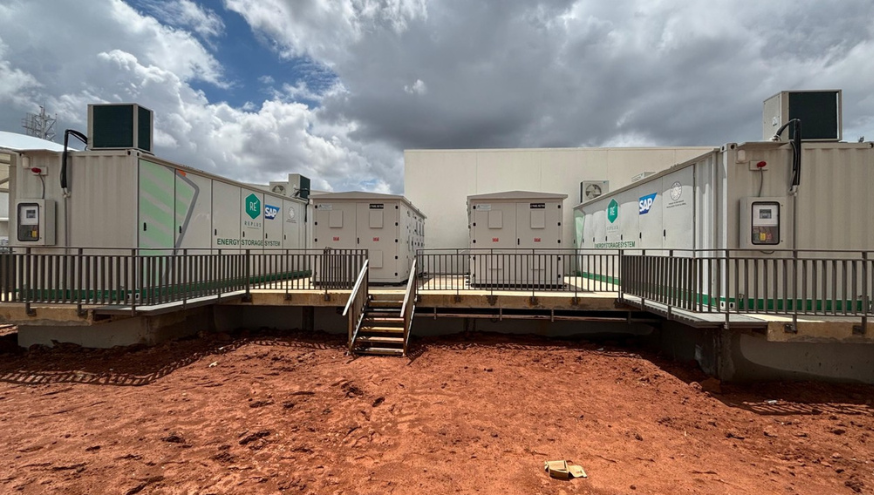
A REPLUS battery energy storage installation in the field. (Image: REPLUS)
What ties the range together is how much of it is engineered in-house. REPLUS designs its own battery management systems and energy management systems, runs AI-enabled pack manufacturing for stationary storage, telecom, hybrid systems and e-mobility, and operates its own container-level testing. The company says it has already deployed 100 MWh of storage projects across the country. The commercial world is responding: in September 2026, REPLUS secured a Rs 217.56 crore order from Indus Towers to supply lithium-ion battery banks, with execution scheduled by March 2027. The company was also named Leading BESS Manufacturer at the IESA Excellence Awards 2026, and has received Rs 43 crore under the government’s Research, Development and Innovation scheme to advance its storage technology.
The economics behind the container are the reason its chief business officer for energy storage, Suhas Sutar, expects adoption to accelerate among industrial customers. Solar power at commercial and industrial scale, he told pv magazine, can already be procured at Rs 3.50–4 per kWh; add the cost of storing it in batteries and the delivered energy still lands around Rs 7–8 per kWh — cheaper than grid electricity in several states. A factory can bank its own daytime solar and spend it during the expensive evening peak, turning a cost centre into a controlled asset.
The wider group is thinking further up the supply chain too. TACC, another HEG Advanced Materials subsidiary, plans to manufacture graphite powder for lithium-ion cells equivalent to the needs of 20 GWh of cell production, while the group is exploring a circular model in which end-of-life batteries move through authorised recycling channels and recovered materials return to manufacturing.
REPLUS’s story is a reminder that India’s energy transition is not only about building more solar panels and wind turbines. It is about building the boxes that let clean power wait until it is wanted — designed, tested and manufactured in Pune, sized from a single home battery to a container that can steady a factory, a microgrid or a stretch of the grid itself. With mass production months away and a 6 GWh plant coming online, the container from Pune is about to become a familiar sight wherever India stores its sunshine.
Keep reading: From Straw to Fuel: Inside STEER World’s netiBIO, the Bengaluru Machine Turning Crop Waste Into Clean Gas · Five Megawatt-Hours in a Box: Inside Trontek’s EKOM, India’s Homegrown Answer to Grid-Scale Storage · More Energy & Power stories
Like stories like this? Add Exceptional Technology as a preferred source on Google to see more of our reporting in your search results and Discover feed.