Every harvest, India’s fields produce a mountain of a problem. Paddy straw, Napier grass and other crop residues pile up by the tonne — too fibrous to digest easily, too bulky to ignore, and too often set alight in the field when there is nowhere better for them to go. Yet locked inside that tough, stringy biomass is clean fuel, waiting for a machine clever enough to unlock it. A Bengaluru company has built exactly that machine, and India’s green-energy establishment has just honoured it.
That company is STEER World, founded in Bengaluru in 1993 and grown into a global leader in materials transformation technology, built on pioneering work in twin-screw extrusion and continuous manufacturing. Its bioenergy division, netiBIO, has now won the CBG Equipment Manufacturer award at the 6th India Green Energy Awards 2026. STEER World’s Global CEO and Executive Director, Nitin Gupta, received the award from Shripad Yesso Naik, Union Minister of State for Power and New & Renewable Energy, at a ceremony held on 14 October 2026 at Atal Akshaya Urja Bhawan in New Delhi.
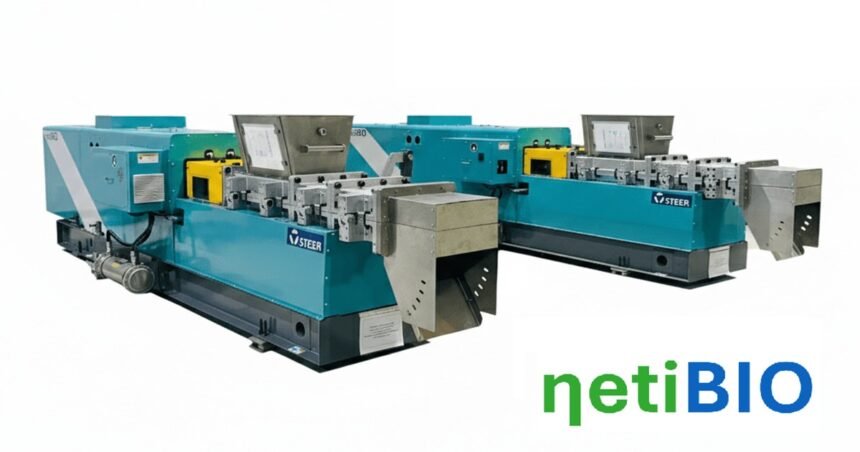
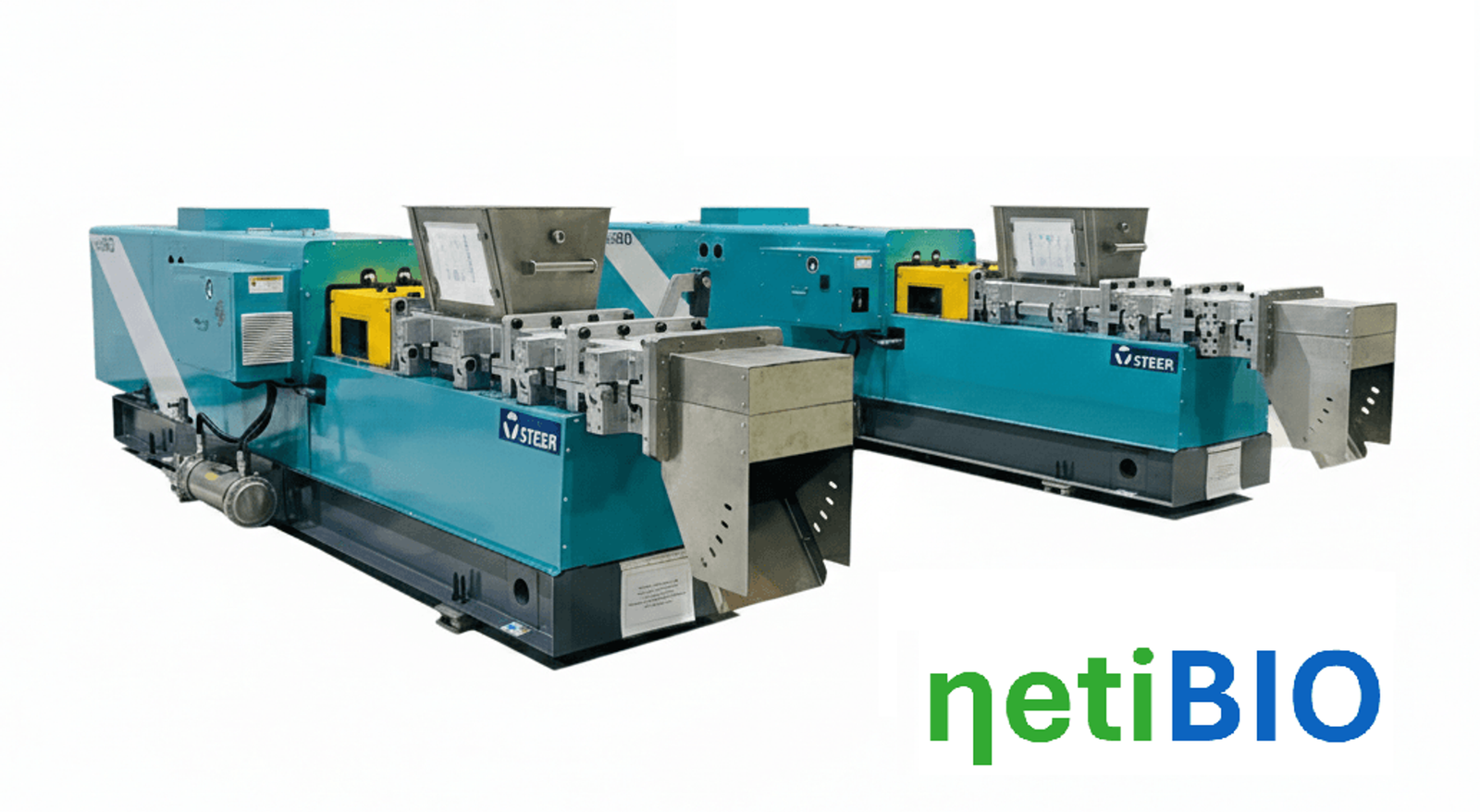 STEER World’s netiBIO biomass processing machines. (Image: STEER World)
The award recognises a solution to one of compressed biogas’s least glamorous — and most decisive — bottlenecks: what happens before the digester. A CBG plant lives or dies on its feedstock, and Indian feedstock is unforgiving. Where European plants typically process softer material such as corn or hay, Indian plants must handle paddy straw and Napier grass, whose fibres, moisture, silica and abrasive character can choke pumps, crust over digesters, stretch digestion times and drag methane yields down. The company says that, over the past 18 months, it has focused entirely on taming those residues, and the results are now running at industrial scale.
At the heart of netiBIO is STEER’s patented FLP technology — Fractional Lobe Processing. Rather than pulverising the biomass, FLP opens and fibrillates the fibres, giving microbes far more surface area to work on while keeping the particle structure uniform and predictable. The treated biomass turns hydrophilic, so it sinks and stays submerged instead of forming a floating crust, and the slurry flows the way the plant’s pumps were designed for. The company says the payoff shows up across the whole plant: pretreatment typically accounts for under 10% of total capital cost and 7–12% of operating cost, yet shorter retention times allow digesters around 30% smaller, with civil construction savings of 20–40%, and a 30–50% increase in specific methane yield from the same feedstock. Pretreatment, in STEER’s phrase, is not a cost — it is a profit multiplier.
The deployment numbers tell the same story. The company says more than 130 netiBIO processing lines are currently under execution across India, with over half already operational, and one Napier grass line alone processes more than 12 tonnes per hour. Its next-generation netiBIO Alpha Series, unveiled at IBET 2025, is a compact, modular bio-processor built specifically for India’s tough biomass, processing up to 300 tonnes per day with low capital and operating costs — and it demonstrated its capabilities live at the expo by processing Napier grass and paddy straw. Earlier in 2026, netiBIO also won a breakthrough technology award at the BBB International Expo and Summit in New Delhi for its biomass pre-conditioning innovation.
More Read
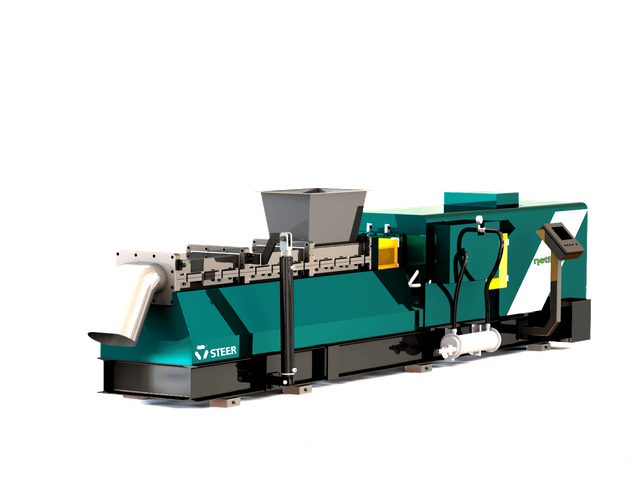 A STEER netiBIO biomass processing unit. (Image: STEER World)
The technology rests on three decades of engineering depth. Founded by Dr Babu Padmanabhan, STEER World today employs more than 500 engineers, scientists and technicians, serves customers in over 50 countries and holds more than 90 granted patents across pharmaceuticals, plastics, food and biomaterials. That materials expertise — the understanding of how fibres behave, how screws wear and how machines survive abrasive feedstocks day after day — is what netiBIO brings to the biogas plant, along with on-site engineering teams that work with developers through commissioning in rural locations far from established industrial infrastructure.
For farmers, the promise is just as tangible. Crop residues that once had little value become feedstock that earns an income, in a farm-to-fuel model that turns a disposal headache into a revenue stream — and every tonne that goes into a digester is a tonne that does not go up in smoke. “This recognition is particularly meaningful because it reflects the progress we have made in addressing a fundamental challenge in India’s CBG ecosystem,” said Nitin Gupta. “With over 130 lines under execution and more than half already operational, we are encouraged by the progress we have made.”
India’s compressed biogas story has always had its feedstock; what it needed was a way to make that feedstock behave. With netiBIO, a Bengaluru engineering house that spent thirty years mastering how materials flow, stretch and transform has given the country’s green-gas plants exactly that — machines that take the toughest straw in the field and turn it into steady, high-yield clean fuel, one fibrillated fibre at a time.
Keep reading: Five Megawatt-Hours in a Box: Inside Trontek’s EKOM, India’s Homegrown Answer to Grid-Scale Storage · Not a Drop of Water: Inside KP Group’s SR 2000 V3.0, the Robot Keeping India’s Solar Giants Spotless · More Energy & Power stories
Like stories like this? Add Exceptional Technology as a preferred source on Google to see more of our reporting in your search results and Discover feed.