A drone that drops out of the sky, a robot that stalls mid-shift on a factory floor, a defence system that fails in the desert — in every one of these machines, the difference between a triumph and a very expensive embarrassment is the battery underneath. In Ahmednagar, Maharashtra, a startup called Adiabatic Technologies has made that hidden layer its entire business: designing and building the complete battery system, from the cell up, for the machines India cannot afford to see stop.
The company’s story has gathered pace this year. In August 2026, Adiabatic raised ₹8.3 crore in a seed round led by Malpani Ventures and Avinya Ventures, with Appreciate Capital, DeVC, San Francisco-based Operators Studio and the UPES Incubator joining in. The company says the capital will take its manufacturing capacity to 100 MWh a year, speed up product development, grow its engineering team and widen deployment across robotics, drones, defence and industrial automation.
The whole stack, under one roof
Adiabatic was founded in 2022 by Darshan Meher, an IIT Hyderabad alumnus who had spent four years inside India’s lithium-ion industry, together with Chandrashekhar Dhangar and Saurabh Gawali. The company works out of a 6,000 sq. ft research and assembly facility in Nagapur MIDC, Ahmednagar, with a presence in Pune — and its pitch is deliberately different from a conventional pack assembler’s. Where most suppliers bolt together imported cells, Adiabatic designs the system in-house: cell selection, pack architecture, thermal management, charger integration and, crucially, its own battery management system.
The BMS is the brain of the pack, and Adiabatic treats it as the product. It tracks voltage, current and temperature cell by cell, balances charge between cells, cuts power when limits are breached and reports the state of health back to the operator — with CAN and RS-485 telemetry and over-the-air firmware updates. For a two-wheeler, an ordinary BMS will do. For a drone that must not fall out of the sky, or a defence platform operating in harsh conditions, the company argues, the BMS is what makes the whole machine trustworthy.
The numbers on the company’s own spec sheet show what that engineering is chasing: charging from flat to 80 per cent in 15 minutes, energy density of 300 Wh/kg, a pack temperature gradient held under 2°C so every cell ages together rather than cell by cell, and more than 3,000 life cycles with over 80 per cent capacity retained. Its packs span LFP and NMC chemistries, and its charger range runs from 3 kW workshop units to 60 kW DC fast-charge stations, all protocol-matched to its packs from the factory.
Twenty thousand systems, twenty-five customers
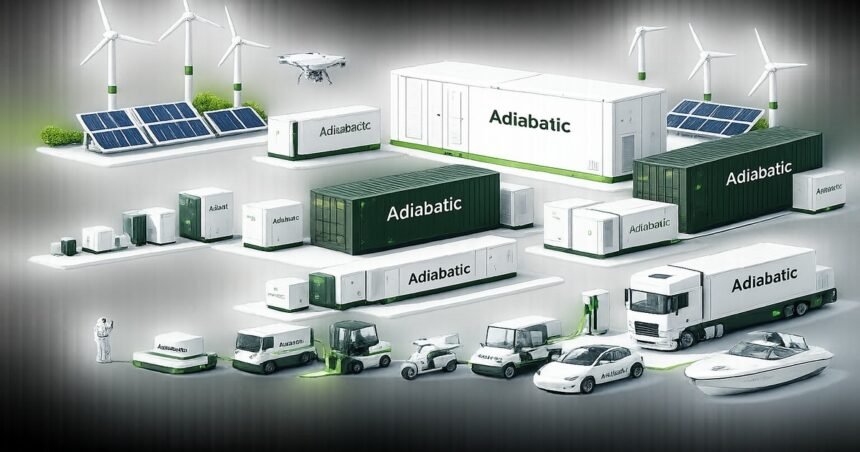
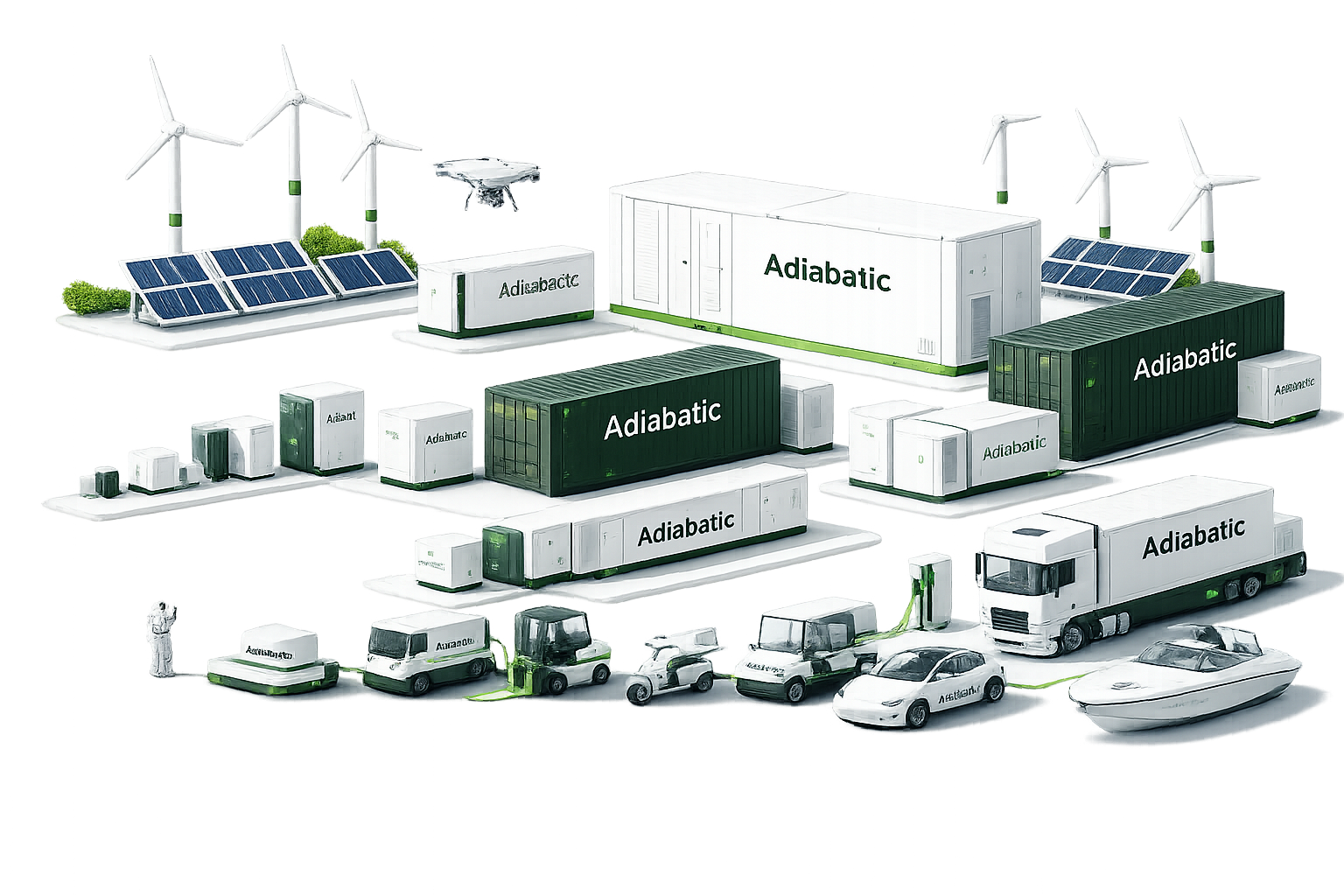
Adiabatic says it has already deployed more than 20,000 battery systems with over 25 OEMs, across robotics, defence, drones, agri-equipment, electric vehicles and solar energy — a broad footprint for a company only a few years old. Its catalogue runs to eleven battery series, each engineered for a single application class, from material handling and autonomous mobile robots to marine craft, medical equipment and battery energy storage for solar.
More Read
The logic is the same in every sector: start from the customer’s duty cycle — load profile, peak draws, cycles per day, temperature range, vibration, dimensional envelope — and build the system around it, rather than asking the machine to fit a catalogue SKU. The company says half of what it ships does not exist on its product page yet, because it is built custom, under NDA, for a specific platform.
A name that is also a promise
The company takes its name from thermodynamics. In an adiabatic process, no heat is transferred between a system and its surroundings — energy stays inside the boundary, doing work, instead of leaking away as waste heat. That is the idea Adiabatic has built its brand on: a battery that wastes nothing, with every joule either becoming useful work or staying available for later.
It is also a bet on where the value in India’s battery story actually sits. India still imports the bulk of its lithium-ion cells, so the competitive question has moved from cells to pack engineering — designing systems that perform reliably under demanding conditions. With its seed round, Adiabatic is now building specialised platforms for autonomous mobile robots, industrial automation and unmanned aerial systems, and scaling towards 100 MWh a year of capacity.
From a 6,000 sq. ft facility in Ahmednagar to robots on factory floors, drones in the field and solar arrays feeding the grid, Adiabatic is quietly becoming the layer Indian hardware stands on. The machines get the glory; the battery makes sure they keep running.
Keep reading: The Building That Breathes: Inside Carbelim’s Living Walls That Eat Carbon · A Power Station in a Box: Inside REPLUS’s RE5K, the Pune Battery Container Storing 5.01 Megawatt-Hours · More Energy & Power stories
Like stories like this? Add Exceptional Technology as a preferred source on Google to see more of our reporting in your search results and Discover feed.