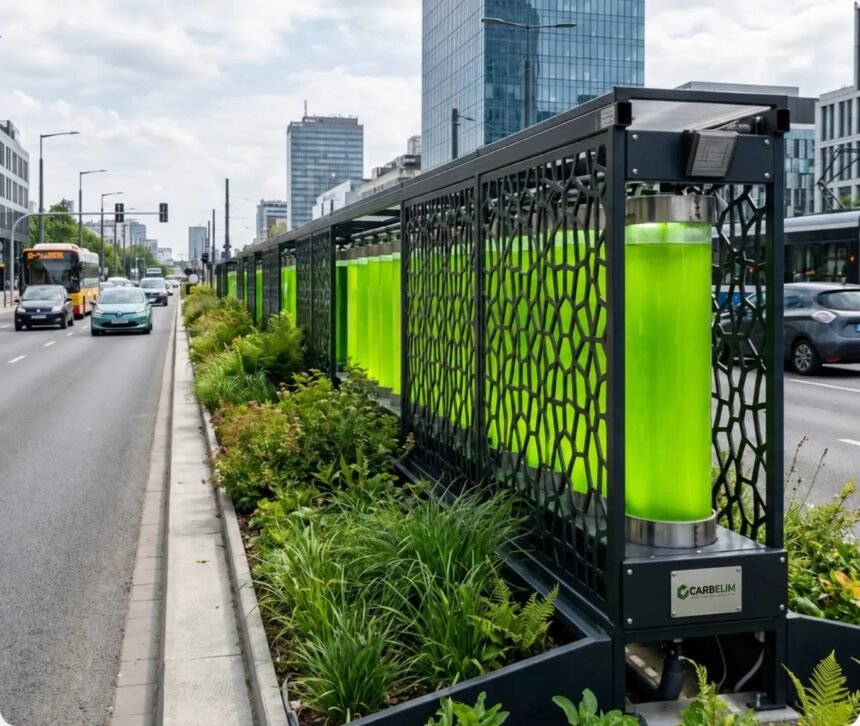
Walk past a Carbelim installation on a busy city street and you will see something quietly extraordinary: tall, glowing green columns of living microalgae, drinking in the traffic’s exhaust and breathing out fresh oxygen. The Kerala climate-tech company is turning buildings, bus shelters and streetscapes into living carbon sinks — walls that do not just stand there, but work.
Carbelim, backed by the Kerala Startup Mission and incubated at IIT Madras, builds microalgae-based photobioreactor systems that capture carbon dioxide and clean the air around them. Its flagship Biomimetic Façade™ turns a building’s walls into what the company calls living carbon sinks, sequestering around 52 kg of CO₂ per square metre every year, while each façade module generates oxygen equivalent to two full-grown trees.
Algae that outwork a forest
The secret is speed. Microalgae fix carbon up to 400 times faster per unit area than mature trees, the company says, which means a slim panel on a wall can do the carbon-capture work of a patch of forest in a fraction of the space. Inside Carbelim’s panels, microalgae cultures circulate through transparent chambers exposed to air and light; as air passes through, the algae absorb CO₂ and pollutants as nutrients, converting them through photosynthesis into biomass and fresh oxygen.
The blend matters too. Carbelim’s systems use eleven types of specialised microalgae, tuned to absorb carbon dioxide while also filtering harmful pollutants — PM2.5 and PM10, nitrogen oxides, sulfur oxides and volatile organic compounds — from the air around them.
A product family for the whole city
The Biomimetic Façade is the flagship, but Carbelim has built a whole family of living infrastructure around the same biology. The PureAir Tower™ is an outdoor biological air purifier the company says delivers the air-cleaning impact of more than 15 mature trees while occupying only a few square metres. The PureAir Bus Shelter™ turns a transit stop into an active air-purification hub, scrubbing CO₂ and smog at street level where pollution is highest. BioDivider™ living green panels double as urban dividers and public installations, and the company’s Micro Algae Tree and Liquid Tree systems bring the same idea to plazas, campuses and transit zones.
For industry, Carbelim offers a biological CCUS platform: the same microalgae systems capture emissions at the point of source for manufacturing plants, power stations and refineries, and the company says deployments at source locations can potentially cut CO₂ emissions by 60–70%.
More Read

Smart, self-adjusting, always watching
Every Carbelim system carries an AI-driven, IoT-enabled monitoring suite. Sensors track air quality continuously — AQI, CO₂, PM2.5, PM10, VOCs, temperature and humidity — and the company’s algorithms adjust airflow, lighting and nutrients in real time to maximise CO₂ absorption. The data feeds live dashboards and ESG reports, so a building owner or a city can watch each installation’s environmental performance as it happens. A single module’s auxiliary power draw is typically just 12–20W, and solar can cover part or all of it.
From captured carbon to permanent storage
What sets Carbelim apart is what happens after capture. The harvested microalgae biomass is blended with regional agricultural, forestry and organic residues and put through high-temperature pyrolysis, producing engineered biochar designed to stay stable in soil for centuries. The company says each tonne of biochar delivers approximately 2.6 tonnes of verified CO₂ removal, with credits verified under internationally recognised standards including Verra VM0044 and Puro.earth — turning a city’s pollution into a durable, traceable carbon sink and a revenue stream.
The engineering is protected by 13 patent filings, seven in the US and six in India, and the company has won international recognition including the SEFFY Social Impact Award at the Sharjah Entrepreneurship Festival 2026.
Founded by a carbon scientist, backed for scale
Carbelim was founded by Dr Karthika Gopi and Rahul Babu. Dr Gopi holds a PhD in nature-based carbon sequestration and brings over a decade of experience in algal biotechnology, including work as a carbon scientist and pilot projects across Europe and the Gulf. The 42-person team of scientists and engineers is now set to grow: on 29 October 2026, Carbelim secured a Rs 10 crore investment from the IIT Madras Unicorn Frontier Fund, becoming the first startup from Kerala to receive investment from the fund, with the cheque handed over by Union Finance Minister Nirmala Sitharaman alongside IIT Madras Director V Kamakoti. The company says the investment will fund technology development and production scale-up, create more than 50 additional jobs, and support its push into international markets.
From a living wall on a city street to a bus shelter that cleans the air while you wait, Carbelim is making a simple, beautiful argument: the infrastructure of a city should not just occupy space — it should regenerate it.
Keep reading: A Power Station in a Box: Inside REPLUS’s RE5K, the Pune Battery Container Storing 5.01 Megawatt-Hours · From Straw to Fuel: Inside STEER World’s netiBIO, the Bengaluru Machine Turning Crop Waste Into Clean Gas · More Energy & Power stories
Like stories like this? Add Exceptional Technology as a preferred source on Google to see more of our reporting in your search results and Discover feed.