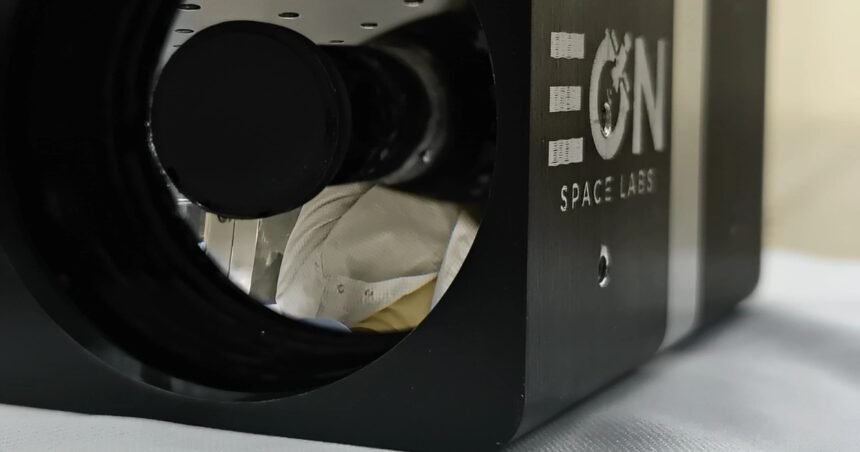
There is a telescope in orbit right now that weighs less than a bag of sugar, sees the Earth in nine different colours at once, and was designed and built in Hyderabad. It is called MIRA, and on 2 October 2026 it rode into space aboard a SpaceX Falcon 9 — a small, square, black box carrying a very large Indian ambition: to stop importing the eyes that watch the planet from above, and build them at home instead.
MIRA is the flagship of EON Space Labs, a Hyderabad deep-tech startup incubated at IIT Madras, founded by Sanjay Kumar, Punit Badeka and Manoj Kumar Gaddam. The company says MIRA is India’s first indigenously developed miniaturised space telescope — and in September 2026, the Indian Patent Office granted it a patent for its “Miniaturized Telescope-Based Imaging System”.
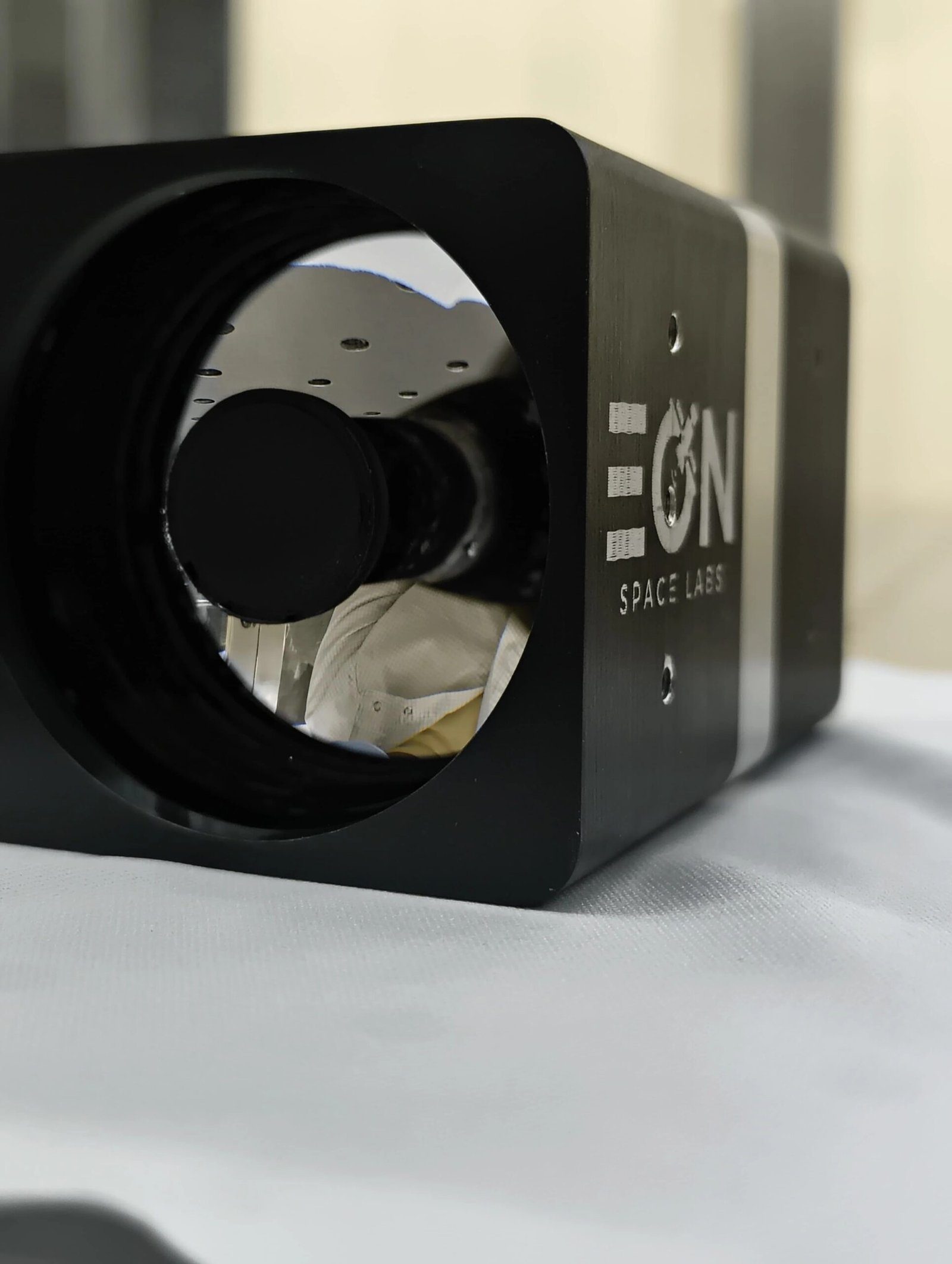
EON Space Labs’ MIRA space telescope. (Image: EON Space Labs)
A telescope carved from a single block of glass
The engineering idea at the heart of MIRA is beautifully simple: instead of assembling a telescope from many separate mirrors and mounts that can shift, flex and fall out of alignment in the violence of launch and the cold of space, EON carves its optics from a single block of fused silica. The company calls it a monolithic optical architecture — one piece of glass, one unmoving geometry.
The payoff is a payload that measures just 54 × 54 × 87 millimetres and weighs 502 grams, yet delivers multispectral imagery across nine bands with a ground resolution of about 9.2 metres and a swath 18.7 kilometres wide. The company says MIRA is three to four times lighter than a conventional space telescope of comparable capability — and at launch prices that can run to thousands of dollars per kilogram, every gram saved is money saved, and every kilogram saved is room for another instrument.
More Read
Before it ever left the ground, MIRA was put through thermo-vacuum testing at a NABL-accredited facility in Ahmedabad, enduring vacuum below 10-5 torr and temperature swings from −20 °C to +60 °C. The company says it emerged with negligible outgassing and zero optical or structural drift, certified to NASA space-grade standards — proof, in the company’s words, that ultra-complex, high-precision imaging platforms can now be built and certified entirely from within India.
Two flights to orbit — and a computer riding alongside
MIRA’s journey to orbit began aboard ISRO’s PSLV-C62 mission in January 2026, integrated with TakeMe2Space’s MOI-1 satellite. Its second flight, aboard SpaceX’s Transporter-18 rideshare mission, lifted off from Vandenberg Space Force Base in California at 12:02 AM IST on 2 October 2026, carrying around 130 payloads to low Earth orbit.
Once again MIRA flew integrated with TakeMe2Space’s MOI-1A spacecraft — and that pairing is what makes this mission more than a camera in space. MOI-1A carries NVIDIA Orin NX-based onboard computing, so selected image-processing and analysis tasks can run in orbit itself. Instead of downlinking huge volumes of raw imagery, the satellite can send down answers: a crop-stress map, a flood boundary, a change alert. The company says that is the future of Earth observation — not more data, but usable intelligence, delivered faster.
That intelligence has a long list of jobs waiting for it. The company says MIRA’s imagery can serve agriculture, marine monitoring, mining, supply-chain management, insurance, disaster response, urban analysis and resource mapping — and, through its iDEX Open Challenge 4.0 win for MIRA, defence and naval surveillance too.
One optical chain, from space to the sky to the ground
Space is only one of EON’s three domains. The same optical expertise feeds LUMIRA, its aerial EO/IR platform for drones, UAVs, eVTOLs and fixed-wing aircraft — including the E40I50, a compact long-range EO/IR payload built to MIL-STD-810H environmental standards with EMI/EMC compliance.
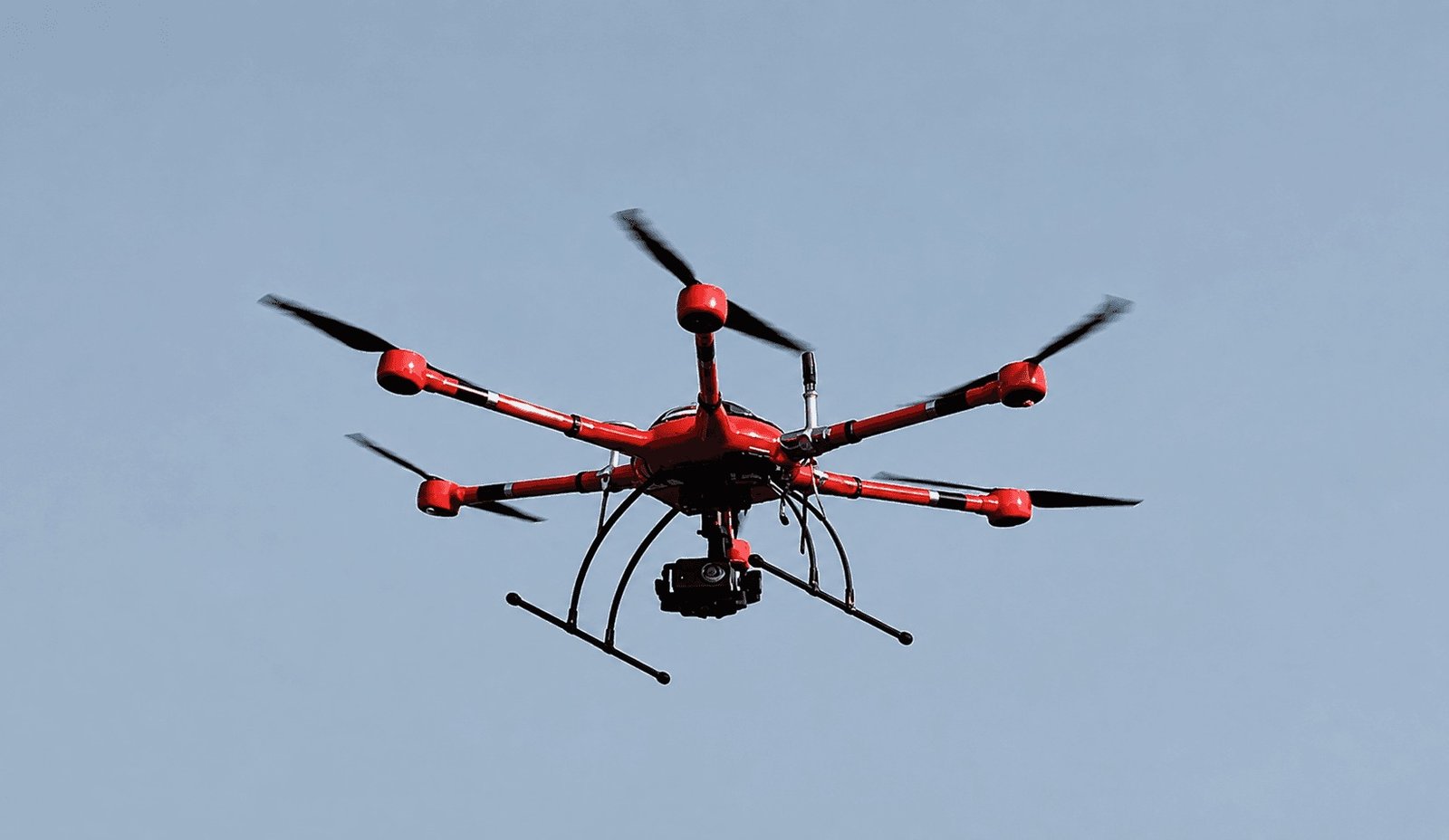
An aerial platform carrying EON’s EO/IR imaging payload. (Image: EON Space Labs)
One of the most striking pieces of that aerial work is a germanium-free thermal imaging system. Germanium, the material most infrared lenses depend on, has faced tight supply constraints; EON’s lenses, the company says, are designed, developed and manufactured from materials synthetically grown in India — cutting lead times from six months to six weeks. Co-founder and COO Punit Badeka says the system has undergone trials aboard Indian Navy ships, where the company says it identified vessels at around 30 kilometres, including in low-visibility conditions.
The company says it is now working with more than seven companies in the space segment, has received inbound interest from around 120 Indian companies for its aerial payloads, and is working with about a dozen companies on ground applications — perimeter surveillance, counter-drone systems and airport monitoring. Payload orders already include Orbited Labs, which will fly an EON payload on an SSLV mission, and Kepler Aerospace, which the company says has placed an order worth around Rs 6–7 crore for an iDEX programme.
Built for India, priced for the world
What makes the EON story sing is the through-line: design, development and manufacturing of optical payloads, all in India, across all three domains. “This proves and enables us to make sure that now the product is indigenised. We do not claim it. We prove that the product is designed and manufactured here in India itself,” Badeka says.
There is even a classroom-sized coda to the story: the company has developed a DIY telescope for school students, designed to let children assemble the instrument themselves and observe the craters of the Moon — with a future version set to add motorised tracking and AI features. Today’s students assembling a telescope by hand; tomorrow’s engineers building the ones that fly.
EON is already preparing another MIRA flight opportunity with ISRO, and the company says higher-resolution successors are on the drawing board — sub-4-metre and 1.5-metre-class imaging payloads for defence applications. A 502-gram telescope proved India can build the eyes. The next ones will see sharper still — and they will be looking out from Indian glass.
Keep reading: Where Roads End: Inside ideaForge’s YETI, the 200-kg Heavy-Lift Drone Built for India’s Toughest Terrain · From Minus 55 to Plus 55: Inside the BvS10 Sindhu, the All-Terrain Vehicle India Is Now Building at Hazira · More Aerospace & Defense stories
Like stories like this? Add Exceptional Technology as a preferred source on Google to see more of our reporting in your search results and Discover feed.