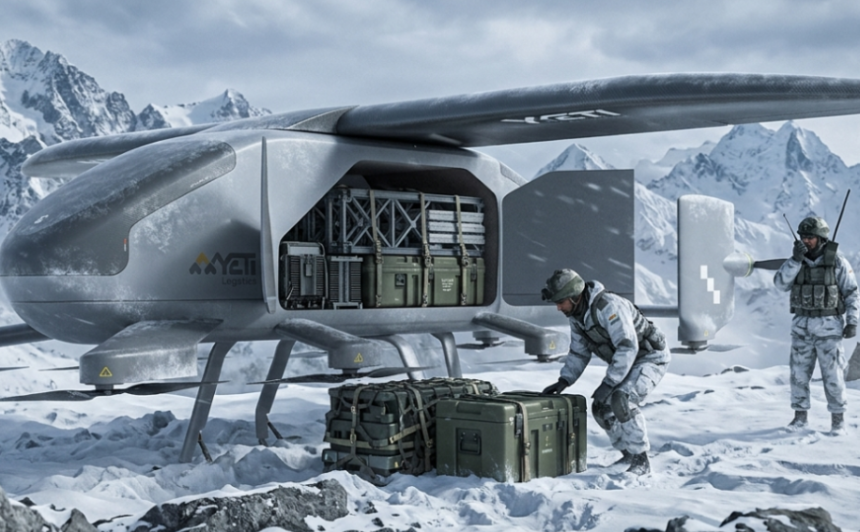
There are places in India where the road simply gives up: a forward post high in the mountains, a flood-cut village, an island station battered by weather. Getting supplies there today often means a long porter trek or an expensive helicopter sortie for a relatively small load. A Mumbai company is building a machine for exactly that gap — an unmanned aircraft big enough to carry 200 kg, smart enough to fly itself, and tough enough to land where there is no runway at all.
The aircraft is called YETI, and it is being built by ideaForge Technology, India’s pioneering drone maker. On 14 October 2026, the government’s Technology Development Board (TDB) signed an agreement to provide ₹151 crore in debt financing for the programme under the Research, Development and Innovation (RDI) Fund — half of a ₹302-crore project that will take YETI from a laboratory-validated prototype to a system proven in its operational environment.
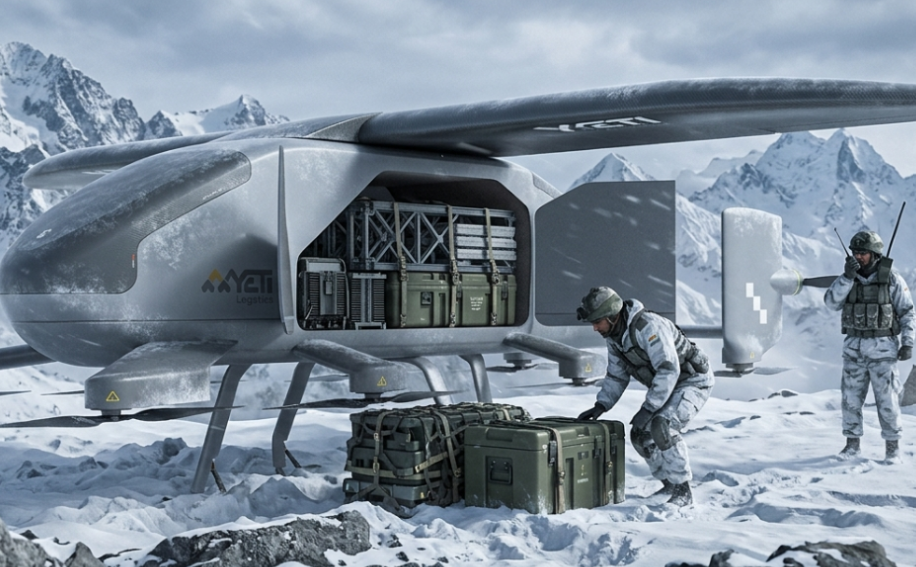 ideaForge’s YETI heavy-lift logistics aircraft being loaded in the mountains. (Image: ideaForge)
A helicopter’s freedom, an aeroplane’s reach
YETI is a hybrid aircraft: it takes off and lands vertically like a helicopter, then transitions to fixed-wing flight for the cruise, combining the flexibility of a rotorcraft with the range of a winged aeroplane. The company says it is designed to carry payloads of up to 200 kg over a targeted range of up to 200 km, flying as high as 6,500 metres above mean sea level — high enough for the Himalayan posts where thin air defeats smaller drones.
It needs no runway. The company says YETI is designed to operate from an unprepared patch of ground roughly 15 metres by 15 metres, so it can land beside a post, a relief camp or a construction site rather than at an airfield hours away. Its propulsion and power systems are distributed and redundant, so the failure of a single component need not end the mission.
Built for places where navigation itself is contested
YETI is being engineered to keep flying when satellite navigation is unavailable, using navigation that does not depend on GNSS signals — a capability that matters enormously in defence missions, where signals can be jammed or denied. The company says it will maintain a communication link of up to 200 km, support swarm operations with multiple aircraft flying together, and travel in containers so it can be moved quickly to wherever it is needed.
More Read

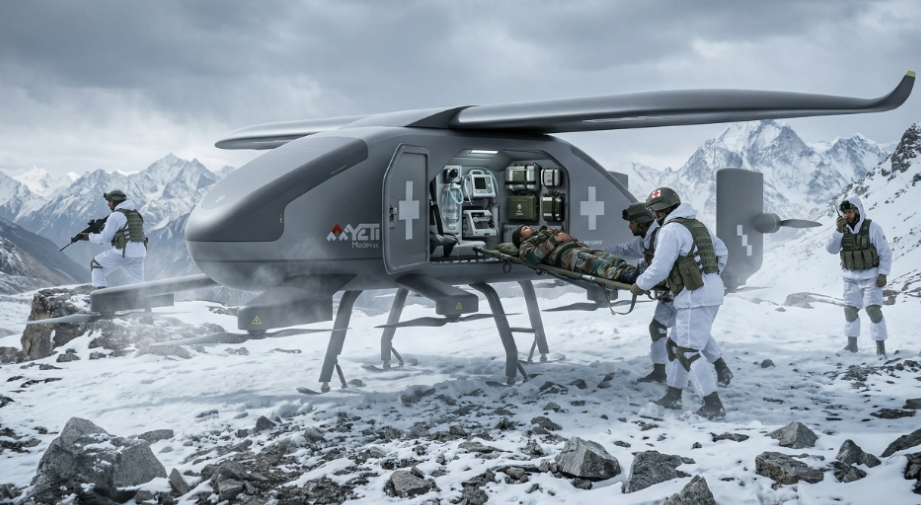 YETI in its medical-evacuation configuration. (Image: ideaForge)
The platform is configurable for the mission at hand. In its medical-evacuation and tactical-transport configurations, the company lists a 200 kg payload over 50 km; in cargo-delivery configuration, it lists payloads from 50 kg to 200 kg with corresponding ranges of about 200 km down to 50 km. The intended applications span cargo transport, medical evacuation and tactical transport, alongside infrastructure construction, industrial logistics, express aerial delivery, offshore logistics and emergency response in difficult-to-access regions.
The first big bet of India’s RDI Fund
The TDB agreement is a landmark in its own right: it was formalised at the inaugural Enterprise Technology Evaluation agreement signing ceremony, the first disbursement event under the government’s ₹1 lakh crore RDI scheme, which aims to catalyse private-sector deep-tech innovation across strategic sectors including AI, robotics, space and advanced manufacturing. ideaForge is among the first companies to secure funding under the framework.
“YETI represents a generational leap in what India can design, build, and operate autonomously,” said Ankit Mehta, ideaForge’s co-founder and chief executive. “Our armed forces and our logistics networks face the daily reality of reaching where roads end, and weather doesn’t cooperate. YETI is our answer to that challenge, which is engineered not just to fly, but to deliver, reliably and repeatably, in the conditions that define the toughest operational environments.”
Rajesh Kumar Pathak, Secretary of the Technology Development Board, said indigenous heavy-lift aerial platforms can play an important role in improving access to remote and difficult-to-reach locations. “Through the RDI Fund, TDB is supporting technology-intensive projects that require sustained investment to progress from advanced development towards deployment,” he said.
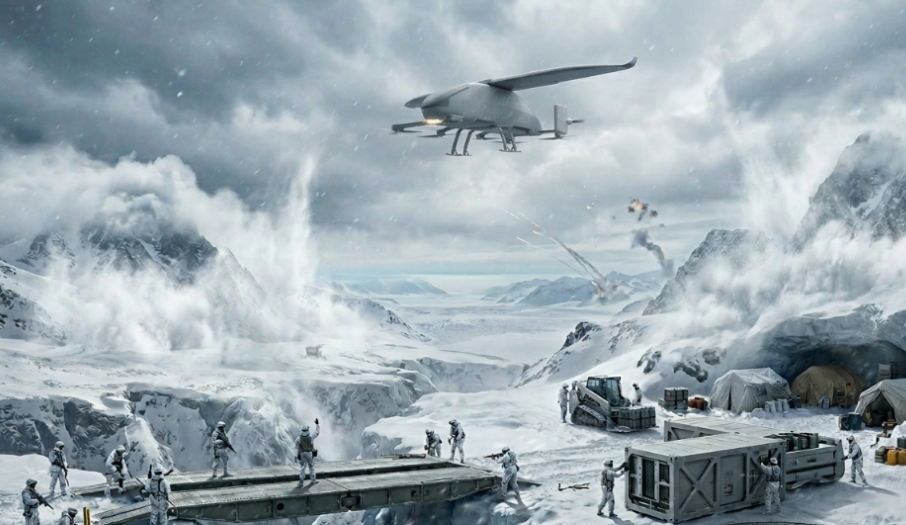 YETI flying over a high-altitude outpost. (Image: ideaForge)
From surveillance pioneer to heavy-lift builder
YETI marks a major expansion for ideaForge. Founded in 2007 by IIT Bombay graduates Ankit Mehta, Rahul Singh and Ashish Bhat, the company built its name on smaller surveillance and mapping drones — including the SWITCH tactical UAV — and says its fleet has flown more than a million missions for defence forces, law enforcement, disaster-response teams and enterprises. YETI, first unveiled as a concept at Aero India 2025, takes the company from aircraft designed to collect information to one designed to physically move cargo.
The timing fits a company gathering pace. In the June 2026 quarter, ideaForge reported revenue of ₹68.6 crore, completed a ₹500 crore institutional placement, and entered the year with an order book of more than ₹300 crore. YETI now gives that manufacturing and autonomy base its most ambitious destination yet: a middle-mile logistics network in the sky, carrying medicine, ammunition, equipment and relief to the places India has always found hardest to reach.
Keep reading: From Minus 55 to Plus 55: Inside the BvS10 Sindhu, the All-Terrain Vehicle India Is Now Building at Hazira · No Rocket Required: Inside Aerolaunch India, the Chennai Startup Sending Science to the Edge of Space on a Balloon · More Aerospace & Defense stories
Like stories like this? Add Exceptional Technology as a preferred source on Google to see more of our reporting in your search results and Discover feed.