A question from a visually impaired student changed everything for Lingampalli Himaja. “Why should I type when I can speak?”
Himaja, a 20-year-old final-year BTech student in Electrical and Electronics Engineering at Shri Vishnu Engineering College for Women in Bhimavaram, Andhra Pradesh, had gone to a school for visually impaired students on a college outreach visit. There she watched students write Braille the traditional way — punching every dot by hand with a slate and stylus, a slow and tiring process that also demands learning reverse Braille patterns before anything can be read back.
She decided to build a better way. The result is RUDHRA, a voice-enabled Braille printer that turns spoken words into embossed Braille — and it has just earned a place in the global Top 20 of the James Dyson Award 2026, one of twenty student inventions shortlisted from around the world.
How RUDHRA works
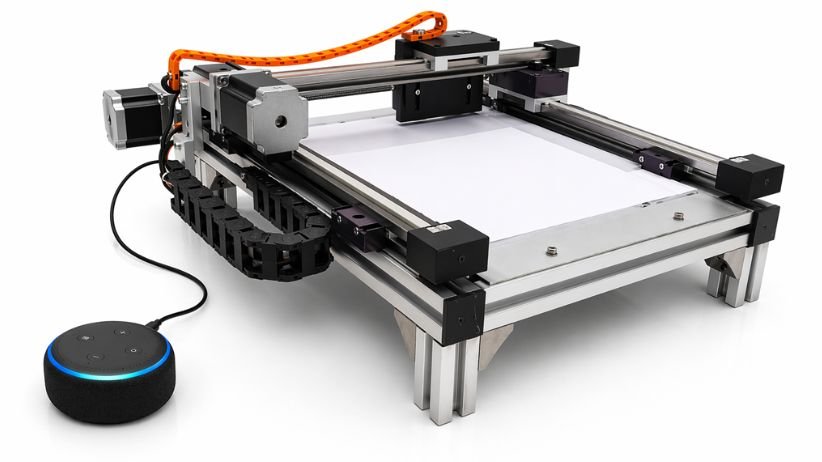
RUDHRA lets users create, edit and print Braille documents entirely through voice commands. Spoken words are converted into text through Alexa, a Raspberry Pi processor translates the text into reverse Braille patterns, and a solenoid embossing mechanism punches the dots onto paper. The device repeats the spoken input back for confirmation before it prints, and its printer head moves along the X and Y axes while the paper stays stationary — so the finished page reads in its normal orientation, with no reverse-learning needed.
The first version was very different. Himaja’s early prototype used six push buttons arranged in the standard Braille pattern, with the Raspberry Pi interpreting the input and the solenoid punching the dots. It was the student’s question — why type when you can speak — that pushed the design to voice.
Two years from idea to the world stage
Himaja started the project in the second semester of her second year and worked on it for nearly 18 months, building the initial device by the end of 2025 with support from her faculty guide Rohit Balaji and ophthalmologist Dr UV Ramanaraju, whose UV Subbaraju Memorial Trust runs the school she visited. The prototype cost around ₹1.5 lakh to build, using components from a robotics company and online suppliers. Redesigned for student use, Himaja estimates the cost can come down to ₹50,000–60,000.
More Read

The name carries its own story. RUDHRA is inspired by Lord Shiva, known as Trinetra — the three-eyed one, whose third eye stands for wisdom and seeing beyond ordinary perception. The idea, Himaja says, is the same: opening an alternate doorway to knowledge for people who cannot see in the conventional way, through Braille they can read by touch.
RUDHRA won the India national stage of the James Dyson Award 2026, worth around ₹6 lakh, ahead of ViabilityX, a passive organ preservation and transport system from the National Institute of Design, Ahmedabad, and Trike 2π from Anna University. The global Top 20, announced on 14 October 2026, was selected by a panel of 12 Dyson engineers from the UK, the US, Singapore, Malaysia and the Philippines, judging entries from 30 countries on functionality, originality, design process and commercial viability.
The final step is now with Sir James Dyson himself, who will select the global winners, to be announced on 4 November 2026. Each winning invention receives £30,000 to support further development and commercialisation.
Himaja’s next steps for RUDHRA are already mapped: a more compact design, improved accuracy, an automatic paper-feeding system, AI-based assistance for more natural interaction, and the patenting process.
From a school visit in Bhimavaram to a global shortlist judged by Dyson’s own engineers, RUDHRA is a reminder of what Indian student engineering looks like at its best — a real problem, met where it lives, and solved with tools that put independence first.
Like stories like this? Add Exceptional Technology as a preferred source on Google to see more of our reporting in your search results and Discover feed.