


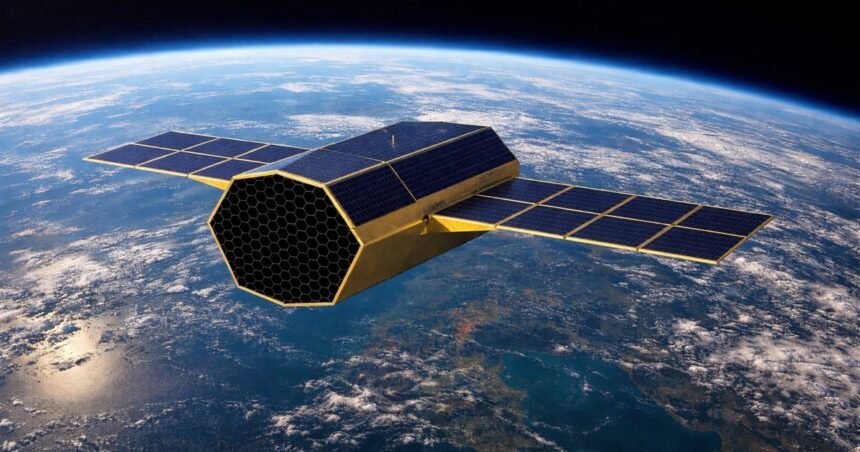
Two hundred kilometres above Earth, the air is so thin that most satellites would fall out of the sky within days. Orbitt Space, an Ahmedabad startup founded by two former ISRO scientists, is building a satellite that does not fight that thin air — it breathes it.
In October 2026, the company successfully test-fired its indigenous air-breathing electric propulsion system, reaching 18 millinewtons of thrust using air as the only propellant. Company co-founder and CEO Christopher Parmar told The Times of India that every component of the system was designed and built in-house in India, and that the milestone paves the way for an orbital demonstration in the near future.
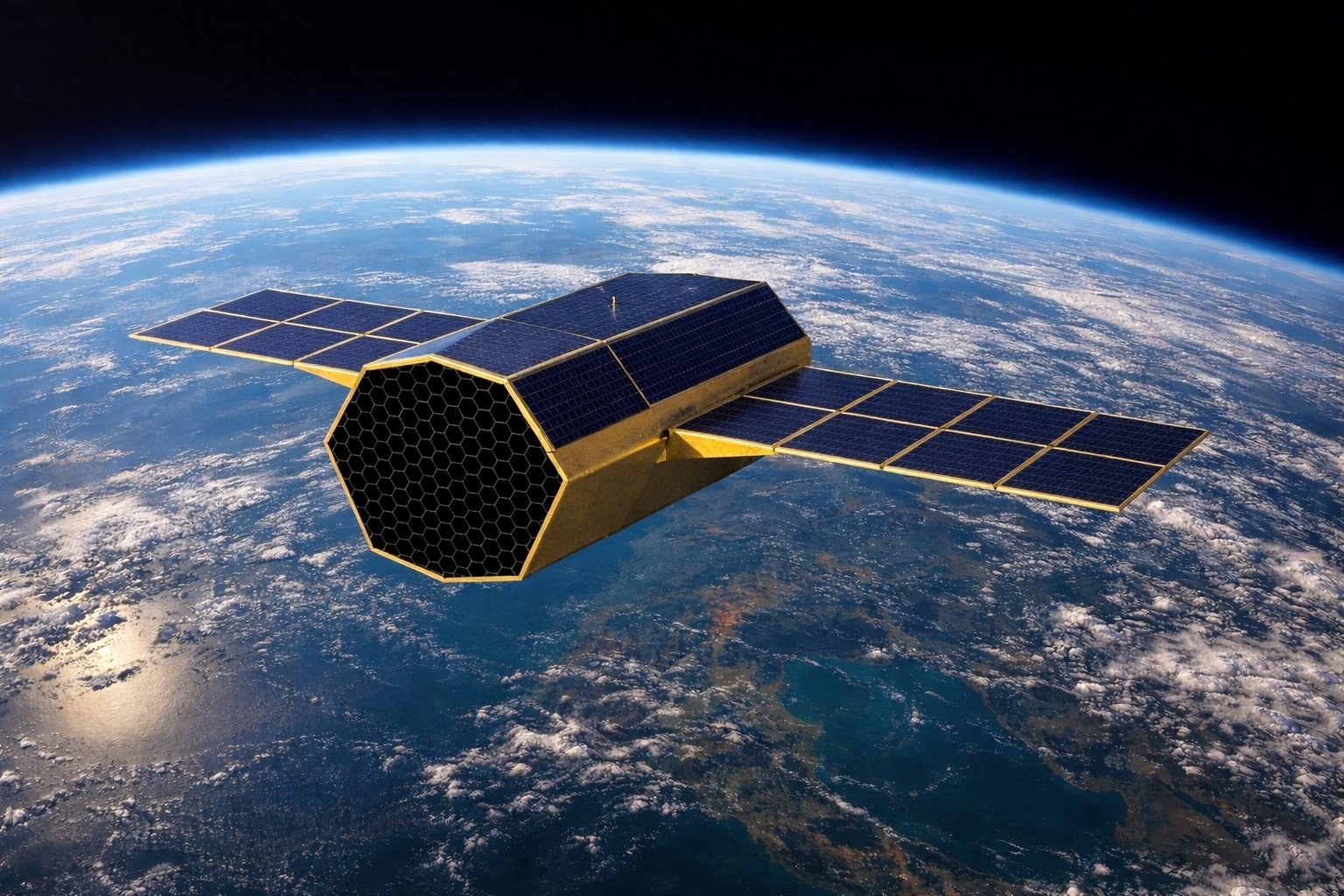
Orbitt Space’s VLEO satellite, with its air-breathing propulsion intake facing forward. (Image: Orbitt Space)
The orbit everyone skipped
Orbitt Space is aiming at Very Low Earth Orbit — also called Ultra-Low Earth Orbit — the band below 250 kilometres, with its platform designed for around 200 kilometres. It is a region most satellite operators have avoided, because the atmospheric drag there is intense and a satellite carrying a finite fuel tank would burn through its propellant just staying in place.
That same closeness to Earth is what makes the orbit so exciting. The company says flying at around 200 kilometres delivers up to 16 times sharper imagery with simpler, lighter payloads, much faster communication links, and lower radiation exposure that allows standard electronics to be used instead of costly radiation-hardened components. And because drag naturally pulls objects down, missions in this band are self-cleaning: when a satellite’s work is done, it deorbits on its own, leaving no long-term space debris behind.
More Read

How an air-breathing engine works
Orbitt Space’s air-breathing electric propulsion (ABEP) system turns the problem into the fuel. An intake at the front of the satellite collects the residual atmospheric gases — mainly oxygen and nitrogen — that are still present at those altitudes. Solar power ionises the collected gas, and the charged particles are accelerated and expelled to generate thrust, continuously compensating for drag.
With no onboard propellant tank to empty, the company says a satellite can keep station for five to seven years in an orbit where conventional satellites would last only days. The system relies on a precision intake design, advanced plasma thrusters and real-time adaptive control to manage air capture, ionisation and thrust in an environment where atmospheric density changes constantly.
That propulsion system is built into a modular, high-agility 200 kg-class satellite bus that the company is designing as a complete platform: propulsion, power and payload systems tightly integrated, so a customer can add their payload and fly. The company describes its role as infrastructure, not competition — it provides the orbital platform, and customers own their data and mission outcomes.
From ISRO to a new orbital layer
Orbitt Space was founded in early 2025 by Christopher Parmar and Anupam Kumar, who each spent more than eight years at ISRO working on satellite design, testing and deployment. Parmar’s work there spanned geocommunication, navigation and opto-quantum communication, while Kumar brought deep experience in satellite testing.
The company raised $1 million in pre-seed funding led by pi Ventures, with participation from IIMA Ventures, to build its team and accelerate prototype development and testing. Parmar recently explained the company’s propulsion concept to Prime Minister Narendra Modi at ESTIC 2026, the Emerging Science, Technology and Innovation Conclave in New Delhi.
Orbitt Space’s roadmap now runs from ground testing and qualification — including vibration and vacuum-chamber evaluations — towards an in-orbit demonstration, with the company targeting its first operational satellite with air-breathing electric propulsion in 2027–2028. Its planned applications span Earth observation, low-latency telecommunications, climate monitoring, surveillance and scientific missions.
If the orbital demonstration succeeds, it will open a whole layer of near-Earth space that has stayed largely empty until now — sharper eyes, faster links and cleaner skies, powered by the very air that once made the orbit unusable.
Keep reading: Light as a Weapon: Inside Carbine Systems’ H.A.R.A., India’s First Private Laser Weapon · Clocks in the Sky: Inside VyomIC, India’s Homegrown GPS Alternative · More Aerospace & Defense stories
Like stories like this? Add Exceptional Technology as a preferred source on Google to see more of our reporting in your search results and Discover feed.







