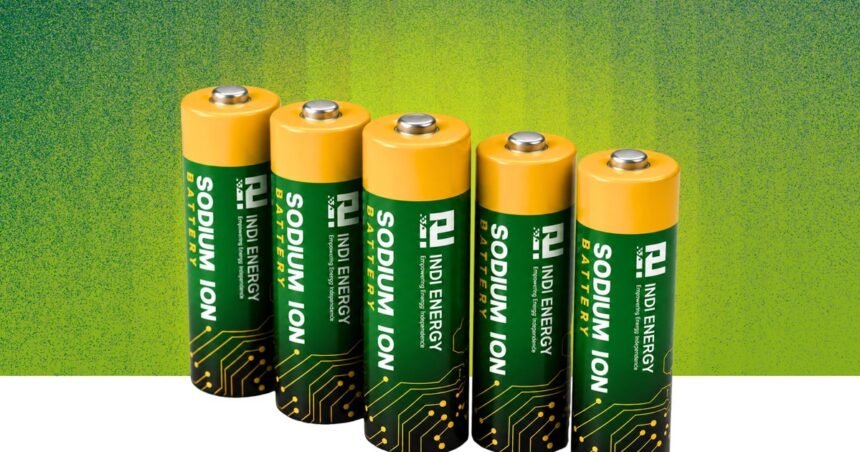
Image credit: IndiEnergy official photograph of its sodium-ion battery cells.
Every October, farmers across north India burn crop residue to clear their fields, and the smoke settles over Delhi for weeks. The stubble is treated as waste with no better use — which is exactly why it keeps getting burned. In Roorkee, a startup called IndiEnergy looks at that same stubble and sees something else entirely: the raw material for a battery.
From stubble to hard carbon
The heart of IndiEnergy’s work is a material called BioBlack. It is hard carbon — the anode material inside a sodium-ion battery, the layer sodium ions move in and out of as the cell charges and discharges — made from agricultural waste. The company’s feedstocks are rice straw and sugarcane bagasse, the fibrous residue left after sugarcane processing. Its published patent application describes a method for producing hard carbon from rice straw: preparing the biomass, removing impurities and applying controlled heat treatment to arrive at the carbon structure a battery needs.
Hard carbon matters because sodium-ion batteries cannot simply reuse the graphite anode of a lithium-ion cell. Sodium ions are larger, and they need hard carbon’s disordered structure to move in and out freely. The company says BioBlack delivers a reversible capacity of 330 ±5 milliampere-hours per gram — a measure of how much charge the material can store and release per gram under its stated test conditions.
Making the parts, not just the cell
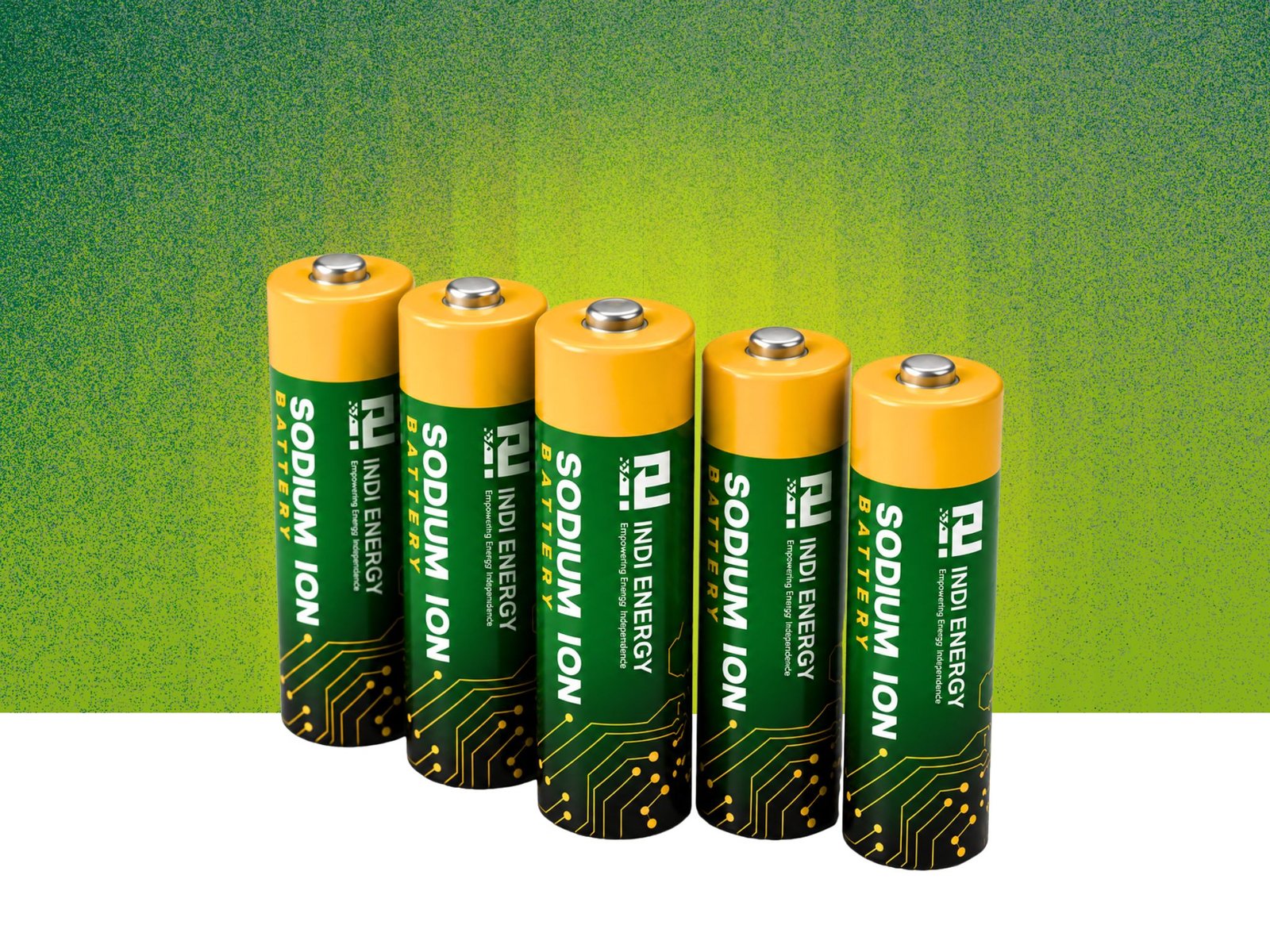
IndiEnergy’s approach is to build the components rather than assemble imported ones. Alongside BioBlack, the company produces its own sodium-ion cathode and its own electrolyte, and combines them into pouch cells. That vertical position is the point: India’s battery manufacturing depends heavily on imported cells and materials, and a company that makes the anode, cathode and electrolyte itself is not exposed to that supply chain in the same way.
The company says its cells reach 90 to 95% energy efficiency with a cycle life above 2,000 cycles, and handle fast charging without thermal runaway. The idea began when founder and chief executive Akash Soni returned from working on lithium batteries in China in late 2018 to build something in India. He founded IndiEnergy in 2019 with Professor Yogesh Kumar Sharma, Dr Asit Sahoo and Dr Nagesh Kumar, all from IIT Roorkee, and the company works from the institute’s TIDES Business Incubator.
More Read

The market it is chasing
The market IndiEnergy names is not electric cars. Sodium-ion cells hold less energy per kilogram than lithium, which matters in a vehicle and matters far less in a solar installation or a street light. The company has aimed instead at the lead-acid batteries that still dominate Indian applications from e-rickshaws to inverters to solar street lights — cheap, heavy, short-lived and toxic to recycle badly. Sodium, by contrast, is abundant and cheap, and a sodium cell built from farm waste is aimed squarely at that incumbent.
The applications the government identified for the technology run from grid-scale storage and UPS and inverter systems to solar street lighting and lower-speed electric mobility — e-rickshaws, e-scooters and e-cycles. It is the unglamorous backbone of India’s energy use, and exactly where a cheaper, safer, homegrown battery can make the biggest difference.
Backed by the state
Recognition came early. IndiEnergy won the National Startup Award 2022 in the energy storage category, and has also won DRDO’s Dare to Dream 3.0 challenge. And on 2 April 2026, the Technology Development Board, under the Department of Science and Technology, announced financial assistance to the company for commercialising hard carbon derived from agricultural and biological waste — backing aimed at establishing indigenous production of the anode material at commercial scale.
The company has a pilot production plant and has described moving towards mass production, with about $1.59 million raised across three rounds from investors including Mumbai Angels, BIG Capital and Finkurve Financial Services. From a field of burning stubble to a battery cell built entirely from Indian materials and Indian know-how, IndiEnergy is turning one of India’s most visible waste problems into the foundation of its energy storage future.
Keep reading: Blades That Come Back: Inside Suzlon and Grasim’s Recyclable Wind Turbine · From Tirupati to Telangana’s Giga Corridor: Inside Amara Raja’s ₹2,320 Crore LFP Battery Bet · More Energy & Power stories
Like stories like this? Add Exceptional Technology as a preferred source on Google to see more of our reporting in your search results and Discover feed.