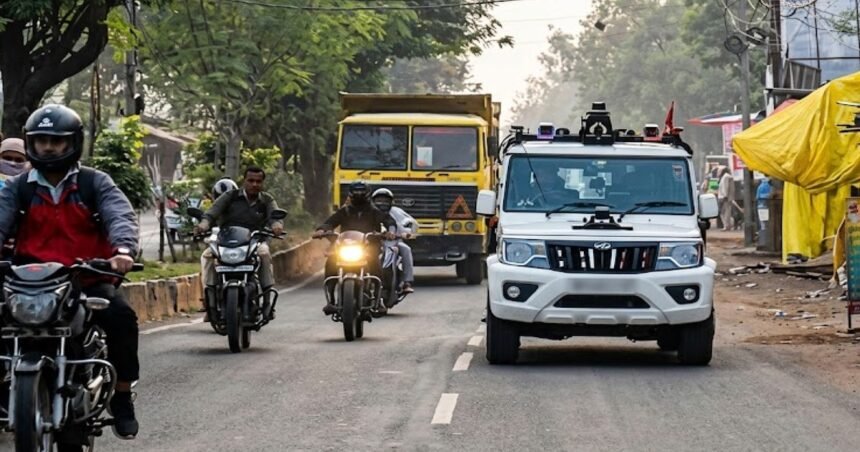
Most self-driving cars learn their manners on the wide, well-marked roads of California. In Bhopal, a startup called Swaayatt Robots is teaching cars to drive themselves on roads where none of those rules apply — no lane markings, no signals obeyed, trucks, bikes, cattle and crowds all sharing the same stretch of tarmac at once. If a car can drive itself here, the company says, it can drive itself anywhere.
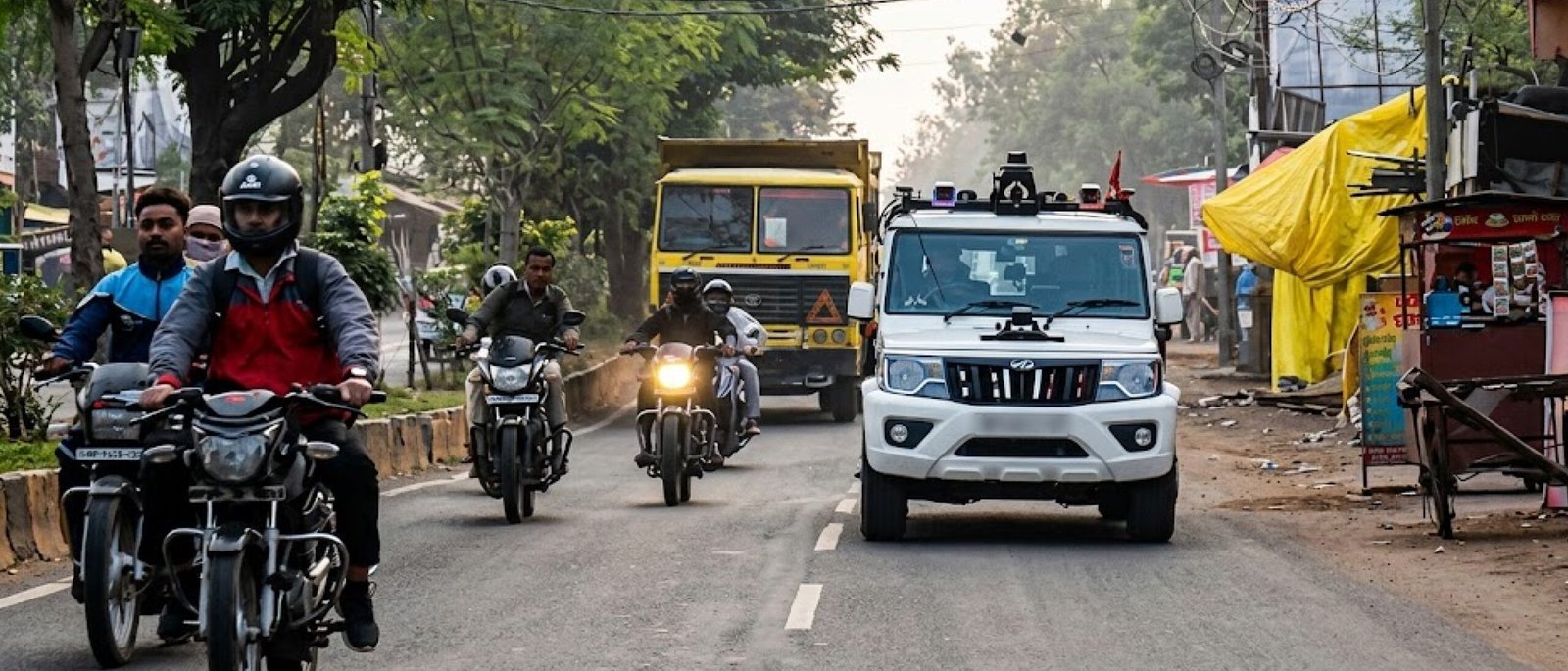
Swaayatt Robots Pvt. Ltd. is building a universal autonomous driving system — software and hardware that can be fitted to almost any vehicle and drive it without a human at the wheel. Its test vehicles are ordinary Indian workhorses, a Mahindra Bolero and a Mahindra Thar, rebuilt as drive-by-wire machines with cameras, sensors and a roof full of computing. The goal, the company says, is Level 5 autonomy: a car that needs no driver at all, on any road.
A car rebuilt by hand
The story starts with a single second-hand car and a stubborn idea. Founder Sanjeev Sharma, an IIT Roorkee electrical engineering graduate with a master’s in computational science from the University of Alberta, turned down a PhD offer from the University of Massachusetts Amherst and came home to India in 2014 to build a driverless car for Indian roads. He started Swaayatt Robots in 2015 — “Swaayatt” is Sanskrit for autonomous — with just ₹35 lakh in the bank. A single LiDAR sensor alone would have cost nearly ₹1 crore to import, so the team set out to do without one.
The first prototype was Sharma’s own Mahindra Bolero, converted by hand into a drive-by-wire vehicle: a custom wheel encoder to measure speed and acceleration, a displacement unit for wheel odometry, and mechanisms to work the clutch, shift the gears, press the accelerator and turn the steering wheel. A robotic manipulator even shifts between Drive and Reverse, the way a human hand would. The same treatment has since been given to a Mahindra Thar the team calls Deep Xplorer.
The brain that needs no map
Most autonomous driving stacks lean on high-definition maps — centimetre-perfect charts of every road. Swaayatt’s does not. The company says its algorithms generate road boundaries and lane delimiters in real time, from what the cameras see, which is why the system can drive on roads that have never been mapped at all. The team describes itself as one of only three companies in the world building autonomous driving without high-fidelity maps.
Under the skin are proprietary algorithms built over a decade of research. One of them, DGN-I, detects obstacles and segments everything on the road at 15.66 billion floating-point operations per second, according to the company. Motion planning is learned through deep reinforcement learning — the same family of techniques Sharma researched at Alberta — so the car learns to negotiate the criss-cross movement of Indian traffic rather than following a fixed script.
More Read
Tested where driving is hardest
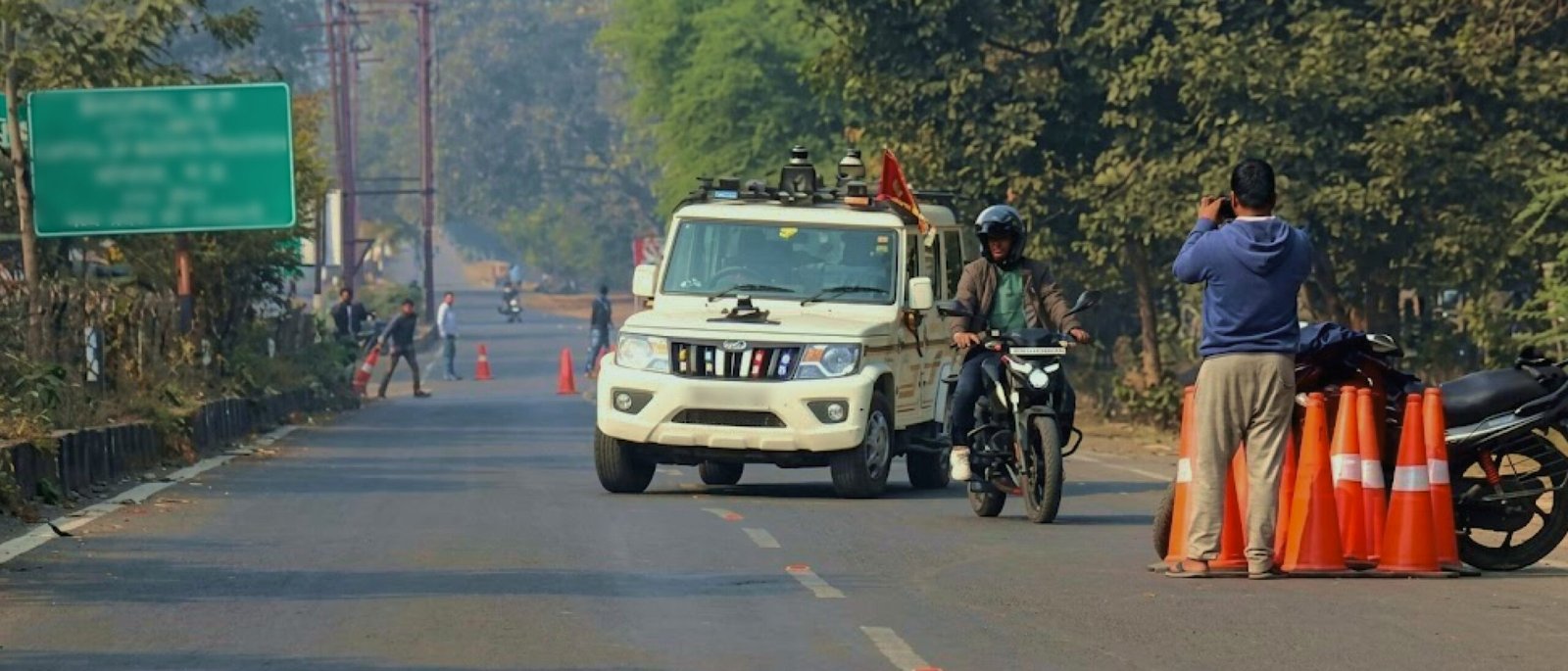
The proving ground is the point. Swaayatt says it has run more than 80 public demonstrations and tested its system over 60,000 km of Indian roads, from city streets to dirt tracks. Its videos show the Bolero threading through a crowded toll plaza, negotiating bidirectional traffic on a single-lane road, crossing unmanaged intersections and driving off-road — the situations where most self-driving systems simply give up.
The tests keep getting harder. In September 2026 the team took the autonomous Thar up narrow mountain ghat roads at more than 90 kmph, fine-tuning the system so the SUV holds its line through fast curves without skidding or drifting. A month later it demonstrated the Thar reversing on its own down a single-lane road to make way for an oncoming truck — the kind of everyday negotiation Indian drivers do without thinking, and one of the hardest things to teach a machine.
The backing behind the bet
Investors have noticed. Swaayatt raised a $3 million seed round from a US investor in 2021, followed by a $4 million post-seed round in June 2024 at a valuation of $151 million. Along the way it has picked up a ₹30 lakh grant from the Ministry of Electronics and Information Technology, $110,000 from NVIDIA and an early prize from Axilor. Mahindra Group chairman Anand Mahindra has praised the work, saying Sharma is “using complex math to target level 5 autonomy”.
The ambition is deliberately universal. The system is designed to be installed in any type of vehicle, not built for one particular car — the same stack that drives a Bolero through Bhopal could, the company says, drive trucks, buses and cars anywhere in the world. That is the bet: solve autonomy on the hardest roads on Earth, and everywhere else follows. The cars are already driving. The roads are next.
Keep reading: The Heart of the Machine: Inside Naxatra Labs, the Ahmedabad Startup Building India’s EV Motors From Scratch · 24,000 Nm of Torque and a Steering Wheel in the Middle: Inside Tresa Motors’ Electric Truck · More Automotive & Mobility stories
Like stories like this? Add Exceptional Technology as a preferred source on Google to see more of our reporting in your search results and Discover feed.