


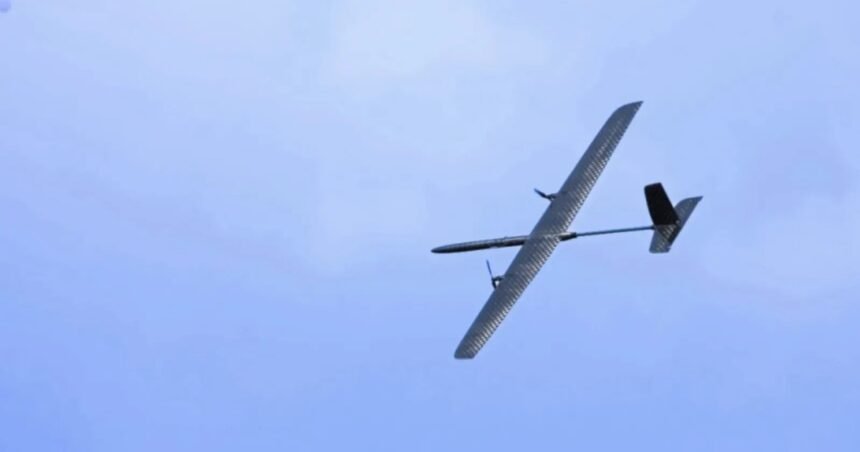
Less than a metre above the Bay of Bengal, an aircraft was flying loops all by itself. No pilot, no remote control, no fuel-burning cruise — just a small fixed-wing machine skimming the waves at more than 100 kilometres an hour, climbing, turning, diving and climbing again, seven times in a row. That is the moment Alteon, a Bengaluru startup founded by a 20-year-old, proved its big idea can fly: an aircraft that harvests its energy from the wind itself, the way an albatross does, and stays airborne for months instead of hours.
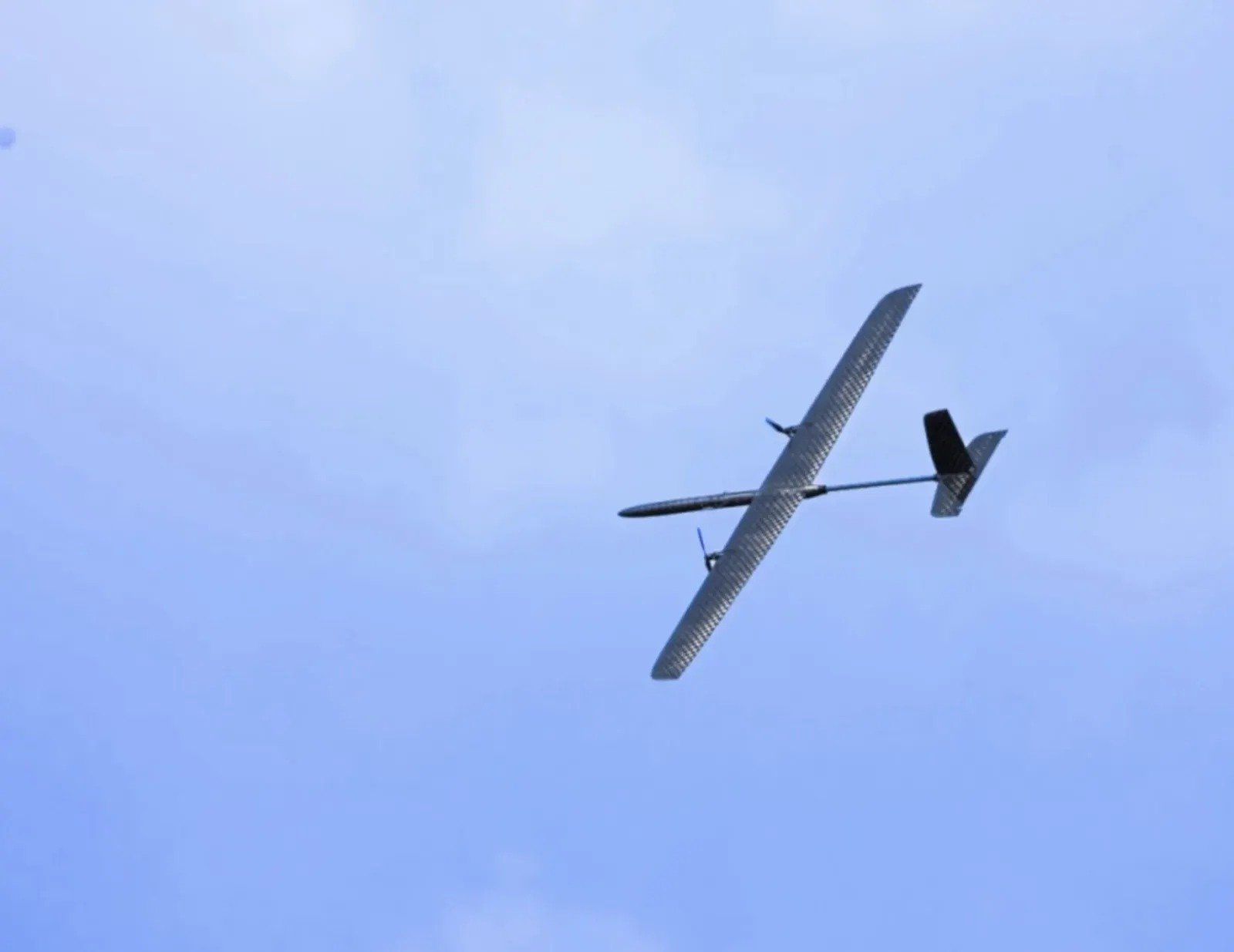
Alteon’s dynamic-soaring aircraft in flight. (Image: Alteon)
Borrowing the albatross’s trick
The technique is called dynamic soaring, and the wandering albatross has perfected it over millions of years. The bird crosses the boundary between slow-moving air near the ocean surface and faster-moving air just above it, gaining speed and altitude with every crossing — travelling 800 to 1,000 kilometres a day without flapping its wings. Alteon is building that trick into an autonomous aircraft: a small fixed-wing platform with a wingspan of about three metres, designed to fly close to the water, climb into the faster air, turn, and dive back down, extracting energy from the wind shear at each pass instead of burning fuel or draining a battery.
The company’s stated ambition is aircraft that can remain airborne for months — and ultimately for more than a year. For scale, the longest continuous flight ever recorded by an aircraft is 67 days, set in April 2025 by Zephyr, the stratospheric solar aircraft flown by Airbus subsidiary AALTO. Alteon is aiming for more than five times that, on an airframe with a wingspan of roughly 10 feet.
Seven loops, one metre above the sea
In an offshore test in early August 2026, Alteon’s aircraft autonomously completed seven O-shaped dynamic-soaring cycles over the Bay of Bengal at speeds above 62 miles per hour, flying within about a metre of the water’s surface. The demonstration showed the aircraft could hold altitude within a metre while maintaining speed above 100 kilometres an hour — the precise, aggressive manoeuvre the wind-shear harvesting technique demands, flown over a moving ocean with no human pilot correcting for waves, gusts and drift in real time.
More Read

The company’s next milestone is what founder Samay Sanghvi calls “energy-neutral dynamic soaring”: the aircraft holding altitude with its propulsion switched off, living entirely on what it pulls out of the wind. The team is now working through the engineering problems that stand between the August demonstration and that goal — autonomy, structures, aero and more — at a pace that matches the ambition: the company says it conducted more than 200 test flights within a 30-day period, building four to five experimental aircraft every week for testing.
A 20-year-old founder and a 20-person team
Sanghvi began building radio-controlled aircraft straight out of high school in 2023, and formally incorporated Alteon in 2025. The startup now has a team of 20 people working from a 10,000-square-foot facility in Bengaluru. In August 2026 the company announced a $2.5 million (about ₹24 crore) pre-seed round led by Lachy Groom — the solo investor known as an early Stripe employee and co-founder of AI robotics company Physical Intelligence — with participation from Together Fund, the operator-led venture firm co-founded by Girish Mathrubootham and Manav Garg. Alteon had earlier received backing from Emergent Ventures and investor 1517.
The funding will take Alteon from the August offshore milestone toward autonomous dynamic soaring without propulsion, and toward fleets of aircraft deployed over the ocean.
Eyes over 7,500 kilometres of coastline
Alteon’s first destination for its aircraft is maritime surveillance. A fleet that stays airborne for months can watch the ocean continuously rather than through periodic patrols — tracking ship movements and fishing activity, curbing illegal fishing and smuggling, monitoring critical offshore infrastructure such as pipelines and cables, and supporting defence, search-and-rescue, and weather and ocean mapping. For India, with roughly 7,500 kilometres of coastline and a vast exclusive economic zone to monitor, persistent, low-cost eyes over the water are a capability a satellite pass or a manned patrol aircraft can only approximate.
That is the promise Alteon is chasing: not simply longer flights, but continuous, autonomous presence over the ocean — an aircraft that treats the wind as its fuel tank, and never has to come down.
Keep reading: The Jet Drone That Hunts in Swarms: Inside VEDA Aeronautics’ Sureshastra, the Loitering Munition the IAF Ordered Twice · The Pod That Blinds Enemy Radars: Inside Data Patterns’ TALON SHIELD, the Homegrown Jammer for India’s Su-30MKI Fleet · More Aerospace & Defense stories
Like stories like this? Add Exceptional Technology as a preferred source on Google to see more of our reporting in your search results and Discover feed.







