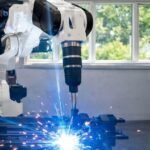
Every electric vehicle that rolls off an Indian assembly line was itself built on a line — and some of the most important of those lines were designed and built in Pune. At its high-tech facility in Velu, on the Pune–Bengaluru highway, Jendamark India builds the automated assembly lines that put India's electric vehicles together: battery packs, inverters, motors and powertrains, assembled by machines the company designs, programmes and commissions itself.
The company says it built India's first automated battery-pack and inverter assembly lines, for Mahindra Electric — the country's e-mobility trailblazer. The lines were a first in more than one way: the company says it was the first time an automated assembly line of this kind had been developed in India for an Indian customer, and its teams in India and South Africa designed a concept that had never existed before, for a product that had not originally been designed for automation. The project, the company says, covered a prismatic-cell automatic battery-pack assembly line with digital worker instructions and full traceability, alongside the power-electronics line that drives the vehicle.
From Port Elizabeth to Pune
Jendamark India is the Indian engineering arm of Jendamark Automation, a company founded in 1992 in Port Elizabeth, South Africa, that has spent more than three decades building assembly systems for the world's carmakers. The group entered India in 2014, when it took a majority stake in Pune-based Techcellency Engineering, a manufacturing firm founded in 1998; the company says it became a 100 per cent subsidiary of the Jendamark group in 2019.
The India arm is headquartered in Pune, with its main manufacturing facility at Velu in Bhor taluka, and offices in Chennai and Bengaluru. In April 2025 the company opened a new Tech Design Centre in Baner, Pune, to power its global engineering work. The company says it has around 343 people on its rolls, according to provident-fund records, and its filings show revenue of ₹101.85 crore in FY2025, up about 42 per cent on the previous year.
The EV lines, and the software that runs them
Jendamark India's EV work spans battery-pack assembly lines, motor lines, rotor lines and inverter lines, along with lines for vehicle control units, motor control units and low-voltage DC-DC converters. Its robotic grippers handle battery cells — cylindrical, prismatic and pouch — without damage, and its busbar separators keep manual connections safe from short-circuits. Laser welding, magnet insertion and vision inspection are built into the lines, and every line carries the company's own Industry 4.0 software, the ODIN Manufacturing ecosystem.
ODIN is the company's own creation, and it is what turns a line of machines into a smart factory. The company says its ODIN Workstation gives operators step-by-step instructions on an interactive touch screen, cutting training periods from weeks to days, and records every step so that each battery pack's history is traceable — the company says the system supports compliance with India's AIS 156 standards for EV batteries. Alongside it sit ODIN Phantom for vision inspection, ODIN Ensure for in-process quality checks, and ODIN Maintenance, Insights and Engage for the people and data around the line.
More Read

The company's customer list reads like a roll call of Indian automotive manufacturing. The company says it works with Mahindra, Hero, Sharda Motors, Dana, Skoda, Ashok Leyland and Kalyani Technoforge, among others, and its catalytic-converter assembly lines help customers meet Euro 6 and Bharat Stage 6 emission norms.
Precision for the skies as well
The same Pune facility that builds EV lines also builds tooling for the aerospace industry — jigs, fixtures and precision-machined components for leading aerospace manufacturers. The company says its aerospace division is EN 9100:2018 certified, the aerospace quality standard technically equivalent to AS9100D, and that it has been certified by Boeing for the company's global defence programmes. It is a second, quieter pillar of the Pune operation, and one the company says it wants to grow.
AI comes to the shop floor
In November 2026, Jendamark India teamed up with Siemens at the company's Transform: Innovation Day 2026 in New Delhi, under the theme "AI for the Real World". On 18 November, at the JW Marriott in Aerocity, the company showcased its ODIN Manufacturing suite running on the Siemens Edge platform — demonstrating, the company says, how industrial AI and real-time intelligence can move from the top floor to the shop floor. The showcase included a collaborative robot doing automatic pick-and-place, operator guidance on screen, part genealogy tracked by barcode, tool positioning by AI vision, and in-process quality checks with ODIN Ensure.
It was a fitting stage for a company that has spent a decade putting software at the heart of its machines. The company is also, it says, the core distributor for Dobot collaborative robots in India, bringing the world's leading cobot brand into Indian factories alongside its own lines.
A year of building
2025 has been a year of expansion for the Pune operation. Alongside the Baner Tech Design Centre, the company signed a memorandum of understanding in July 2025 with Volektra Inc. to bring magnet-free electric motor technology into scalable industrial production — the company says the partnership pairs Volektra's patented motor technology, which eliminates rare-earth materials, with its own automation-driven, high-precision production lines. The company has also signed a manufacturing memorandum of understanding with Vimag Labs, the Bengaluru startup building EV motors without a single rare-earth magnet, to support the scale-up of its motors.
The expansion follows the inauguration of Assembly Hall 4 at the Pune facility in August 2024, along with an on-grid solar power plant and a new R&D innovations lab. The company says its sustainability programme includes a 200 kW rooftop solar facility, water conservation and lean manufacturing — and that its new hall, its new design centre and its growing order book all point the same way: more of India's factories, built by Pune hands.
Jendamark India is not a startup story. It is the story of a global automation house that chose Pune as its engineering home, built the lines that build India's electric vehicles, and keeps adding the next capability — software, AI, aerospace, green motors — to the same factory floor. At the Factory Automation Expo in Moshi this week, that is the story on display.
Keep reading: First in the World at Reading Data: Inside Genloop, the Bengaluru Startup Building India’s Own AI · Production That Never Pauses: Inside Botsync, the Robots Keeping Factory Lines Moving · More Industrial Automation & Technology stories
Like stories like this? Add Exceptional Technology as a preferred source on Google to see more of our reporting in your search results and Discover feed.