


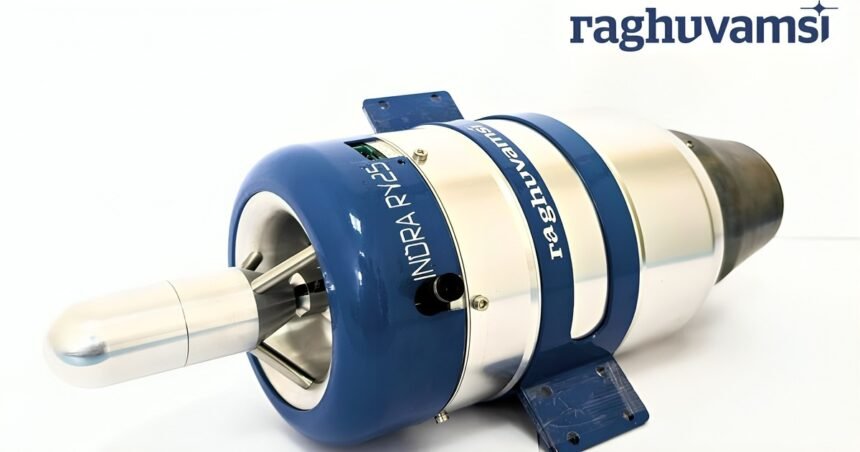
On a test stand in Hyderabad, a jet engine no bigger than a household water heater spools up, and a blue-white plume of flame roars out of its nozzle. It is a small engine with a very large job: to give India its own propulsion for the jet-powered drones, target aircraft and loitering munitions that the country’s armed forces are buying in growing numbers. The engine is called INDRA, and the company behind it, Raghu Vamsi Aerospace Group, spent two decades making precision parts for the world’s biggest aerospace names before deciding to build the engine — and the aircraft around it — itself.
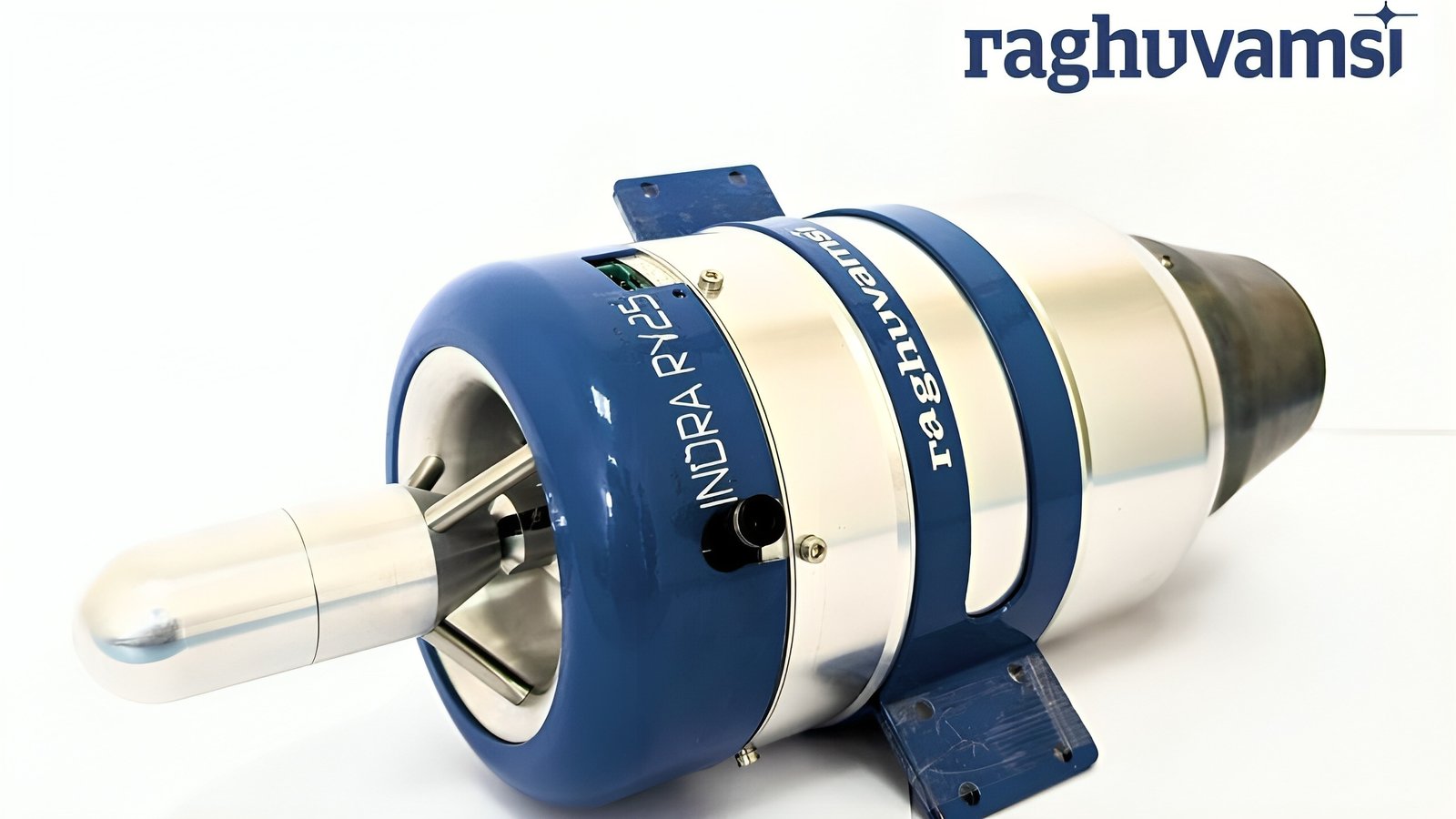
A jet engine, built from scratch in Hyderabad
The INDRA family is the heart of the story. The company says it is the first in India to develop a fully indigenous micro turbojet engine, and it now builds the family in four variants producing 14, 19, 25 and 40 kilogram-force of thrust. The first of the line, the INDRA RV25:240N, was unveiled in February 2024, developed with IIT Hyderabad and tested at the company’s Hyderabad facility in the presence of DRDO officials. In June 2025 the company took the 40 kgf version to the Paris Air Show, where it was unveiled alongside its first jet-powered drone.
That matters because the engine is the hardest part of a small jet drone to buy. Most drone makers around the world still import their micro turbojets; Raghu Vamsi designs, machines and assembles its own, in-house, from raw material to test firing. The company’s jet-powered drones, the company says, can fly above 6,000 metres, faster than 600 km/h, and carry payloads of more than 20 kilograms — performance that puts them in the class of equipment the armed forces use for counter-drone work and strike missions.
From an engine to a fleet
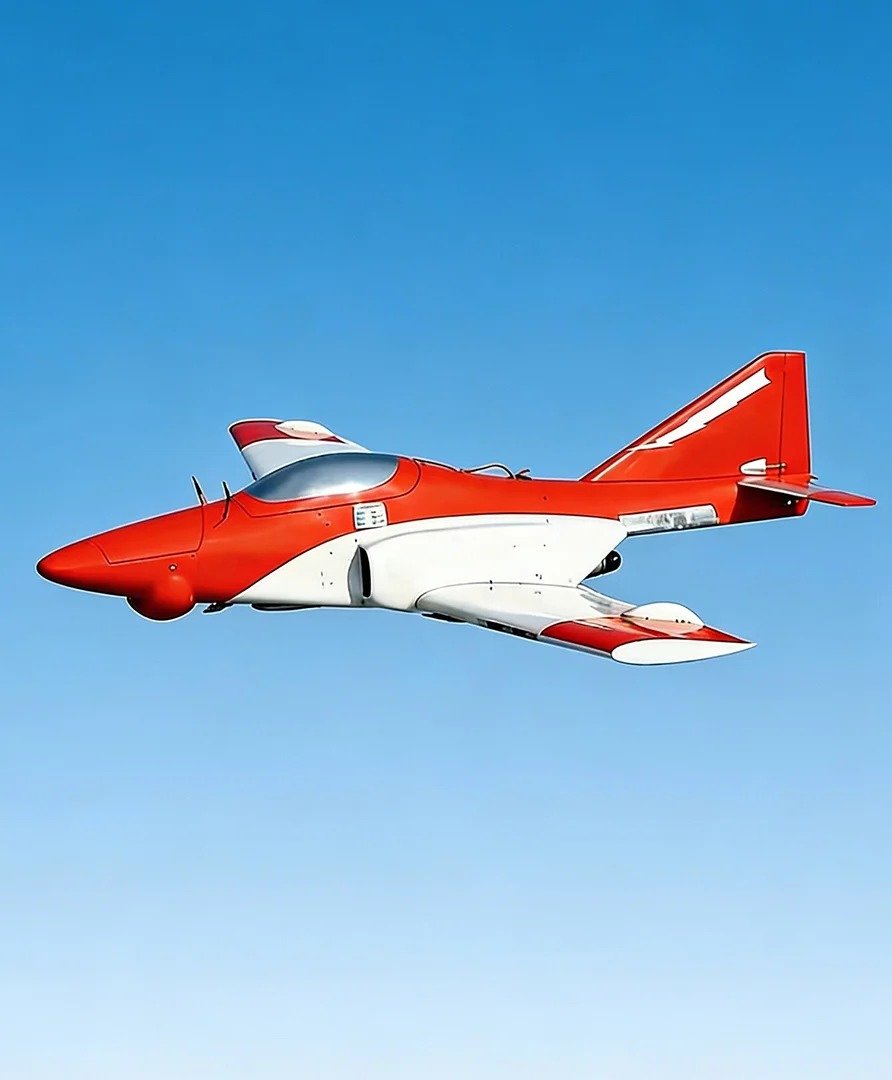
With the engine proven, the company built the aircraft around it under its deep-tech brand, ARROBOT. The best known is the Astra 100, a jet-powered kamikaze UAV with a range of 200 kilometres and a top speed of 450 km/h, which the company says has completed successful test trials. Its flight control, propulsion and telemetry are all indigenous. The jet-powered line-up also includes target drones, decoy drones, stealth bomber drones and long-range kamikaze drones, all flying on the company’s own engines.
In November 2026 the company raised the stakes again, opening a new DeepTech design, production and integration facility — the Citadel Campus at Hardware Park, near Hyderabad’s international airport — backed by more than Rs 1 billion of investment, and unveiling a new product line: the RV Astra, RV Maya, RV Lakshya, RV Rudra, RV Indra, RV Yodha and RV Dhristi. The company says the new systems fly beyond 300 kilometres at speeds up to 650 km/h, covering surveillance, deep strike, battlefield logistics and mission support.
The ground game
ARROBOT’s ambitions do not stop at the sky. On the ground, the company builds a tracked unmanned ground vehicle that navigates autonomously between waypoints with 360-degree collision avoidance and carries payloads of up to 2.5 tonnes, autonomous mobile robots that haul up to four tonnes around factories, and autonomous aircraft tugs and heli-tugs that taxi aircraft and helicopters without a human in the cockpit. In the air, its electric surveillance drones include tethered systems that can watch an area continuously for 24 hours, and the RV Rudra hybrid uses electric propulsion for vertical take-off and landing with an internal-combustion engine for forward flight — longer endurance, heavier payloads, greater range.
More Read

A supplier that became a builder
What makes this story different from most Indian defence startups is the factory behind it. Raghu Vamsi began as a precision manufacturer, machining flight-critical components, gears and assemblies for GE Aerospace, Collins Aerospace, Honeywell, Boeing, Safran, Rolls-Royce and Pratt & Whitney. Today the group employs more than 1,200 people across more than 10 facilities in three countries, with in-house sheet-metal, composites and electronics divisions and more than 200 CNC machines. It even bought its way into the American supply chain, acquiring Syracuse-based WMT Precision, a 40-year-old maker of fuel nozzles, for $8.5 million.
The company says its products are around 90% indigenous and entirely manufactured in India, and the order book backs the claim of momentum: more than Rs 2,500 crore, following a $40-million funding round in July 2026. The November launch also brought four partnerships — with the Indian Army’s 515 Base Workshop to co-develop drone platforms, with Bharat Dynamics Limited to co-develop fully indigenised 200 kgf thrust-class engines for next-generation autonomous fighter-aircraft platforms, with IIIT Hyderabad on AI-based autonomy, perception and swarm intelligence, and with ARCI on laser cladding, additive manufacturing and thermal-barrier coatings for aero engines.
What comes next
The roadmap climbs higher still: the company has spoken publicly about a 4.9 kN-class turbofan engine, in the thrust class of the engines that power cruise missiles and tonne-class UAVs. As founder and managing director Vamsi Vikas put it at the Citadel launch, the investment is about more than building capacity — it is about building core defence technologies in India, engineered for the next era and benchmarked globally. From a machine shop that once made other companies’ parts, Raghu Vamsi is now building the engines, the drones and the robots itself — and selling the idea that India can be a supplier of high-technology aerospace systems to the world.
Keep reading: The Jellyfish Net That Stops a Fleeing Boat: Inside Big Bang Boom’s Cnidaria Aqua Tether · The Satellite That Finds Leaks Underground: Inside Aumsat, the Mumbai Startup Saving India’s Water · More Aerospace & Defense stories
Like stories like this? Add Exceptional Technology as a preferred source on Google to see more of our reporting in your search results and Discover feed.







