


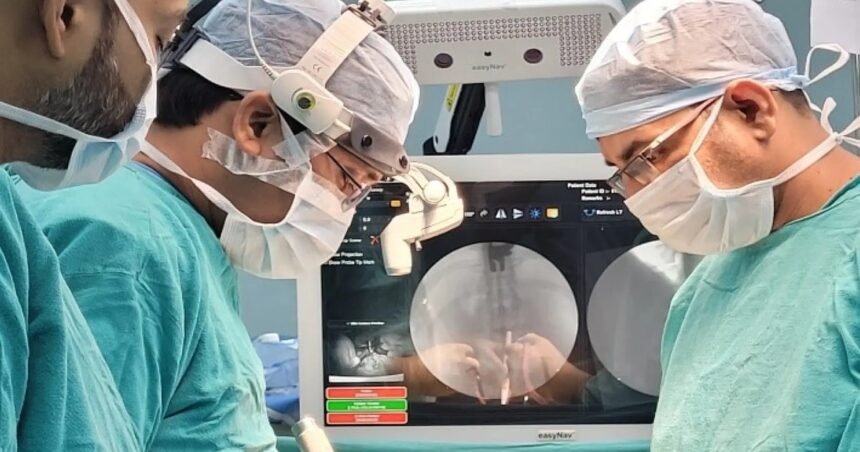
In a small town in Maharashtra, a surgeon used a navigation system to operate on a young child from a farming family — the kind of complex surgery that once meant a journey to a big-city hospital. On the screen beside the operating table, the surgeon could see exactly where the tip of the instrument sat inside the child’s anatomy, millimetre by millimetre. The map on the screen was built from the child’s own CT scan, and the instrument was tracked in real time by a camera overhead. The system guiding the surgeon’s hand was designed and built in Bengaluru — for a fraction of what imported systems cost.
That system is easyNav™, from HRS Navigation. Founded in 2015 by Arpit Paliwal and Shweta Paliwal, the Bengaluru company builds what it describes as India’s first indigenous surgical navigation platform: a kind of GPS for the operating theatre, for brain, spine and ENT surgery. The company says its systems are now installed in more than 200 hospitals and have supported over 20,000 surgeries across 20 states.
A GPS for the operating theatre
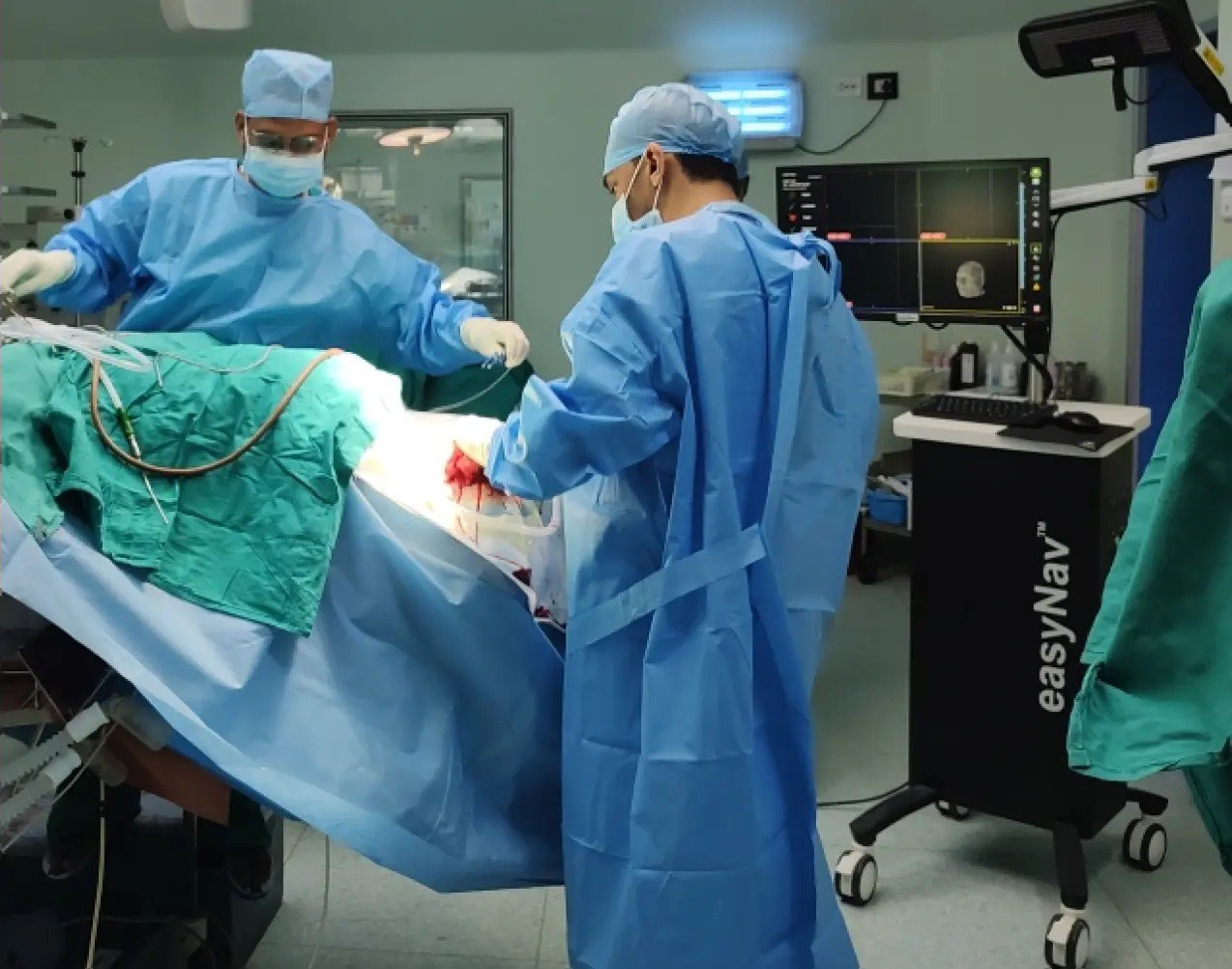
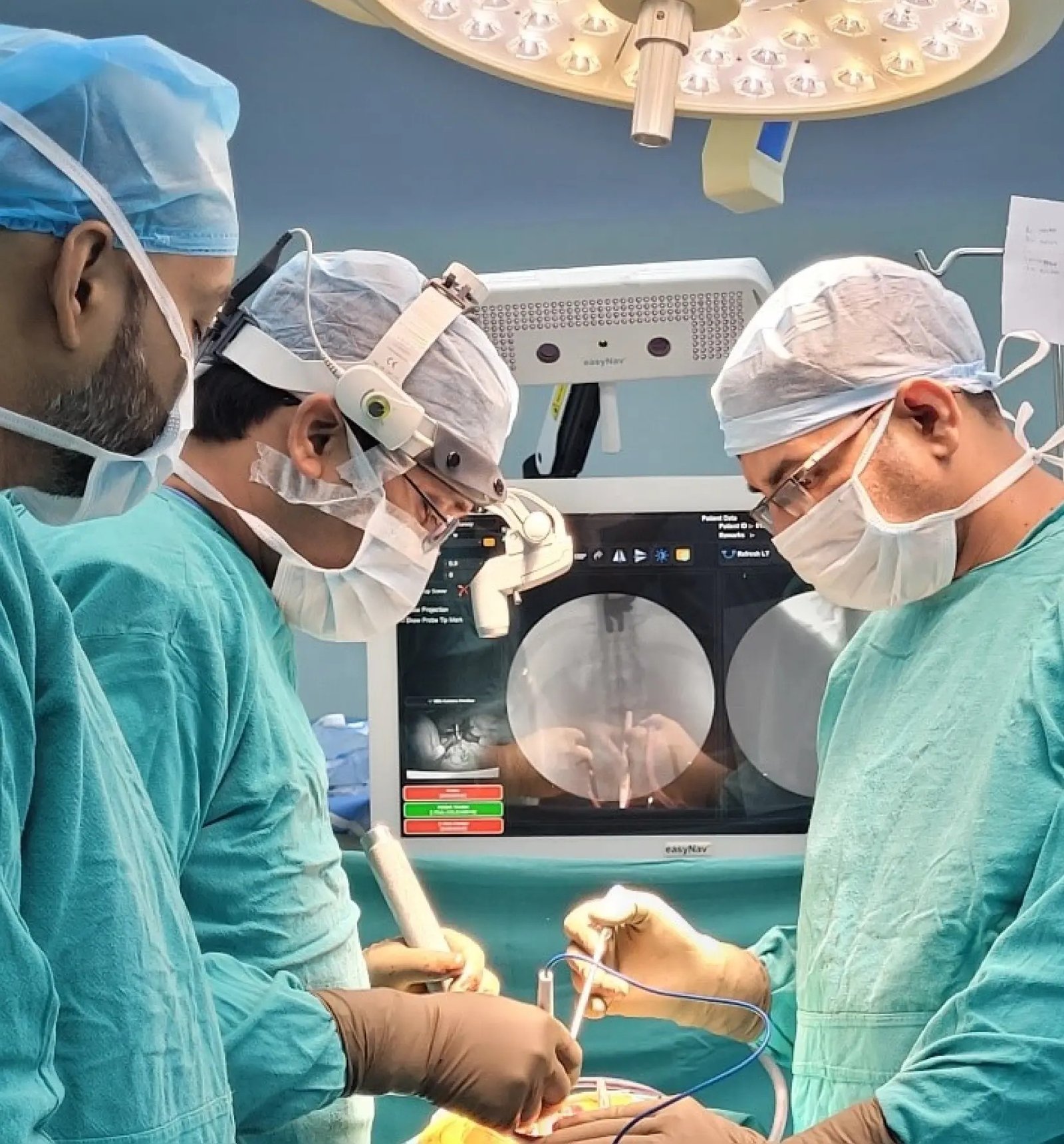
Navigating the brain or the spine is not unlike driving through unknown territory, as Arpit Paliwal puts it: you switch on your GPS. easyNav does something similar inside the human body. It builds a three-dimensional map of the patient’s anatomy from pre-operative CT or MRI scans, then tracks the surgeon’s instruments in real time with a stereoscopic infrared camera, showing their position against nerves, blood vessels and other critical structures on screen.
The system uses optical pattern recognition to detect and track specially marked instruments, and its fiducial-less registration — point registration at anatomical landmarks followed by surface registration — delivers sub-millimetre accuracy, the company says, without the skin markers or single-use consumables that imported systems depend on. The company cites studies showing that navigation-assisted surgery lifts accuracy to 90–95 per cent, from 70–80 per cent with freehand techniques.
Built for Indian operating theatres
Imported surgical navigation systems typically cost &rupee;1.5–3 crore, which is why image-guided surgery has long been concentrated in big-city hospitals. HRS Navigation set out to build a system that works with the equipment Indian hospitals already have. easyNav is an open platform that integrates with any third-party CT scanner and any C-arm machine, from conventional models to the latest flat-panel systems, and it slots into existing operating-theatre infrastructure without demanding a rebuild.
The economics are the point. The company prices easyNav at roughly &rupee;50–90 lakh — around half the cost of imported systems — and because there are no consumables, there is no per-procedure cost beyond the annual maintenance fee. That is what lets a hospital in a smaller town offer complex brain and spine surgery at rates its patients can afford, sometimes free for patients who cannot pay. The company’s installations now range from smaller centres in places such as Guntur and Gorakhpur to larger institutions including Apollo Hospitals and AIIMS facilities.
More Read

Two platforms, one idea
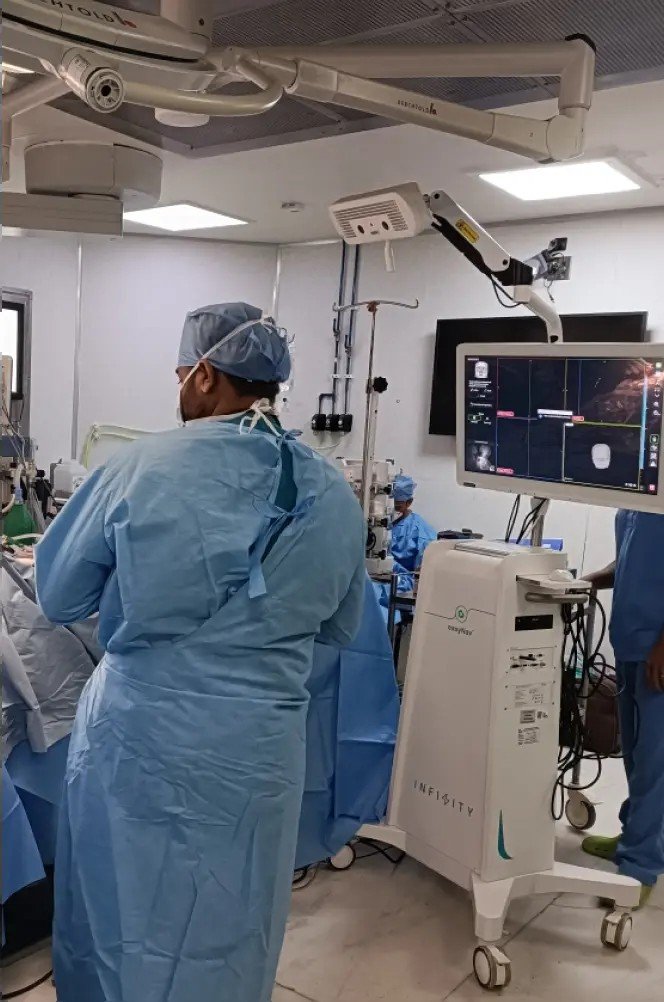
HRS Navigation offers easyNav in two platforms. easyNav 2.0 is the optical neurosurgical navigation system, while easyNav Infinity adds advanced sensors and software and integrates with operating-room equipment, serving both large tertiary hospitals and smaller regional centres aiming to modernise their neurosurgery or spine units.
Across the three specialities, the system is tuned to the anatomy in front of it. The cranial system uses advanced diffusion tensor imaging to visualise white-matter tracts in the brain, so surgeons can steer around essential structures. The spine system supports pedicle screw placement, interbody fusion, deformity correction and spinal tumours, and because it navigates from pre-acquired imaging, it cuts the number of intra-operative C-arm images needed — reducing radiation exposure for patients and staff alike. The ENT system covers sinuses, nasal passages and skull-base procedures with zero consumables: no cables, batteries or markers to replace. The company has also built a knee navigation system for total knee replacement surgery.
The road ahead
HRS Navigation bootstrapped for its first seven years, building the technology from the ground up with grants from central and state government agencies. In November 2025 it raised $5 million in a pre-Series A round led by GVFL, with Physis Capital, Sathguru Catalysers, India EXIM Bank and KITVEN, to scale manufacturing and take easyNav to more hospitals in India and abroad. The company says it has filed six patents, earned an iF Design Award from Germany and an A’ Design Award from Italy, and runs a manufacturing facility in Bengaluru that is audited by government agencies.
Next on the company’s roadmap is robotics for image-guided procedures, with an initial focus on spine surgery by 2027, and expansion beyond India — nearly 90 per cent of its customers are Indian today. From a Bengaluru workshop to operating theatres in more than 200 hospitals, HRS Navigation is putting a surgeon’s GPS within reach of the hospitals that need it most — one precise, affordable operation at a time.
Keep reading: The Pen That Prints Living Tissue: Inside Quixotix Bioprinting’s Handheld Bioprinter from NIT Rourkela · The Chemicals Inside Every Chip: Inside Shivtek Spechemi’s Bid to Supply India’s Fabs · More Chemicals, Materials & Life Sciences stories
Like stories like this? Add Exceptional Technology as a preferred source on Google to see more of our reporting in your search results and Discover feed.







