


Ask a frontier AI model a question in Hindi, Tamil or Bengali, and you can feel the translation happening — the model thinks in English and reaches your language second. For a country with 22 scheduled languages and hundreds of mother tongues, that second-hand fluency has always been the quiet compromise at the heart of artificial intelligence. A Delhi research lab has spent the last few years refusing that compromise, and this week it showed the world what the alternative looks like.
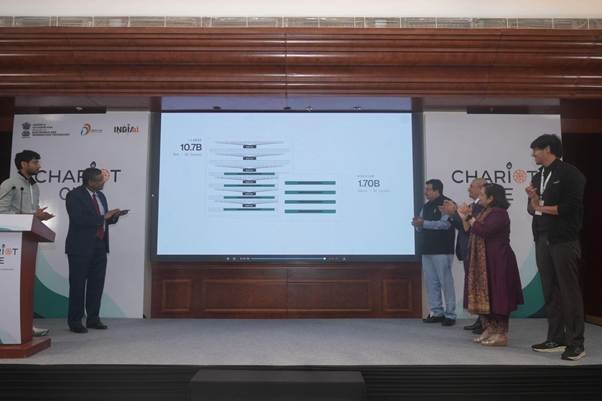
Chariot, a frontier AI research lab headquartered in Delhi, has launched Chariot-1, a suite of foundation models pre-trained from scratch in India under the IndiaAI Mission. The launch and research showcase took place at Bharat Mandapam, New Delhi, on 25 November, and was inaugurated by S. Krishnan, Secretary of the Ministry of Electronics and Information Technology (MeitY). Chariot is one of the first four teams selected under the IndiaAI Mission to build India’s sovereign foundation models.

Three ideas that make Chariot-1 different
The launch was not just a model release; it was a research showcase, and the Chariot team presented three innovations it built into the training of Chariot-1. The first is IndicShift, an open-source technique that gives Indian scripts a shared alphabet. Instead of treating each script independently, it maps 1,012 characters across 12 Indian scripts onto 350 shared letters. The company says the approach uses up to 2.5 times fewer tokens on Indian text than OpenAI’s GPT tokeniser, and improves performance on Indian languages by 5% to 8% on the same compute, while holding performance in English and code.
The second is Nested Training, which trains three complete model sizes simultaneously in a single training run, on one set of weights. The company says it delivers a 62% improvement in training speed compared with training the three sizes separately — and it is what lets the same model family run everywhere from a data centre to a laptop, a smartphone or an edge device.
The third is Mixture of Vocabularies, which divides the model’s vocabulary into 11 groups and scores only the relevant group at a time. That cuts the vocabulary entries scored per word by 5.7 times, and the company says it delivers a 38% improvement in training speed on the same GPUs.
A language model in three sizes
The Chariot-1 LLM is an 11-billion-parameter mixture-of-experts model, with 4 billion active parameters per token. Pre-trained from scratch in India, it comes in three sizes — 10.7 billion, 1.7 billion and 745 million parameters — so the same foundation can serve a data centre deployment, a laptop, or a device at the edge. The point of the three sizes is not a product line; it is a bet that Indian AI should be deployable wherever Indians actually compute.
More Read

A voice that knows what numbers mean
Alongside the language model sits Chariot-1 TTS, a text-to-speech model that generates speech in English and 10 Indian languages: Hindi, Bengali, Marathi, Tamil, Telugu, Kannada, Malayalam, Gujarati, Punjabi and Odia. The model offers more than 50 voices, handles code-mixing between languages, and supports instant voice cloning.
Its most quietly impressive skill is understanding context. The model reads a piece of text and decides for itself how numbers, dates, currencies, units, URLs and abbreviations should be spoken aloud — the kind of thing traditional speech systems make the user spell out by hand. On the Async TTS Pronunciation Benchmark, built from 1,029 real-world sentences and 2,251 instances of non-standard text across 42 categories, the model recorded over 97% verbalisation accuracy, according to the Ministry’s release. It also recorded a Hindi character error rate of 7.60% and an average of 6.47% across nine other Indian languages, the lowest among the systems evaluated in the reported tests.
The team that came home to build it
Chariot is led by co-founders Parth Sarthi and Suvrat Bhooshan, two Stanford graduates who chose to return to India to build frontier AI here. The team brings experience from Google DeepMind and Meta’s FAIR lab, alongside Stanford, Georgia Tech, IIT Delhi and IIT Bombay. Before returning, Parth Sarthi led the Applied Evals team at OpenAI; his RAPTOR retrieval technique, published at ICLR 2024, now lives inside frameworks like LangChain and LlamaIndex.
The lab’s thesis is that audio is a modality, not a domain — and that speech models should eventually reason the way text models do: planning, verifying and revising before they answer. Its first public step in that direction was Chariot-1-ASR Realtime, the live speech-recognition system for 10 Indian languages we covered in October. Chariot-1’s LLM and TTS are the next steps: the language and voice halves of the same foundation.
The team’s earlier work already reaches millions of Indians. It dubbed Mann Ki Baat into multiple languages for Doordarshan’s regional channels, built the World Cup bot that answered fans in Shah Rukh Khan’s voice, sang 600,000 birthday songs for Cadbury, and built the cloned celebrity voice behind HDFC Bank’s scam-awareness campaign — work that won a Silver Lion at Cannes and the Grand Prix at Goafest.
Why it matters
Chariot-1 is a demonstration that world-class AI can be conceived, developed and trained in India. The launch event also featured a fireside conversation between Vishal Dhupar, Managing Director for South Asia at NVIDIA, and Suvrat Bhooshan, on where AI research goes next. MeitY Secretary S. Krishnan congratulated the team, describing the launch as “a significant achievement for India’s technology ecosystem”.
The IndiaAI Mission, approved in March 2024 with an outlay of Rs 10,371.92 crore over five years, was designed to nurture exactly this kind of team — and Chariot-1 is now one of its first working answers. A foundation model that thinks in eleven languages, trained from scratch on Indian soil, is not just a technical milestone. It is the beginning of AI that speaks to India in India’s own voices.
Keep reading: The AI Coworkers That Never Log Off: Inside Vorflux, the Startup Turning Slack Into a Self-Driving Engineering Team · The Earbuds That Hear Only You: Inside antimattr’s Voice-First Wearables for the Age of AI Agents · More Industrial Automation & Technology stories
Like stories like this? Add Exceptional Technology as a preferred source on Google to see more of our reporting in your search results and Discover feed.







