


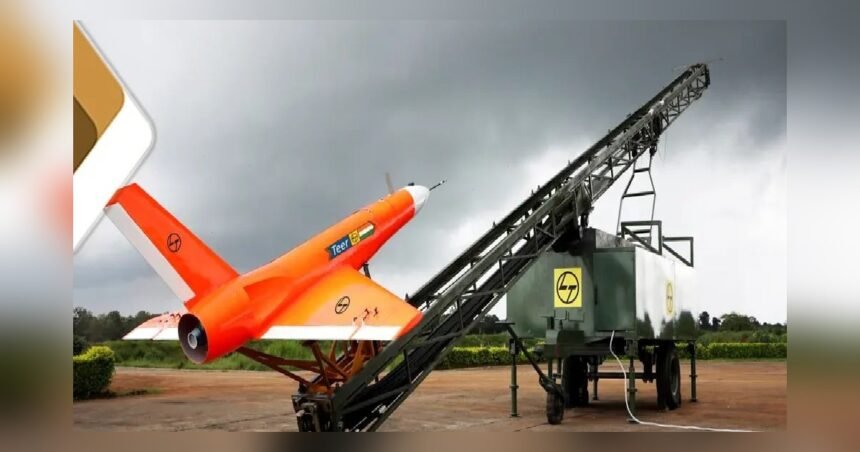
Image credit: L&T — official visual of the TEER aerial target, a programme Aethrone has worked on in collaboration with L&T.
Some of the most useful aircraft in a modern military never need a runway at all. On 3 November 2026, fresh coverage of Pune-based Aethrone Aerospace put the spotlight on a company that has spent a decade building exactly that kind of machine: indigenous vertical take-off and landing (VTOL) drones, target drones, launchers and recovery systems for the Indian Army and Navy — built almost entirely without venture capital, on engineering revenue and a single small incubation grant.
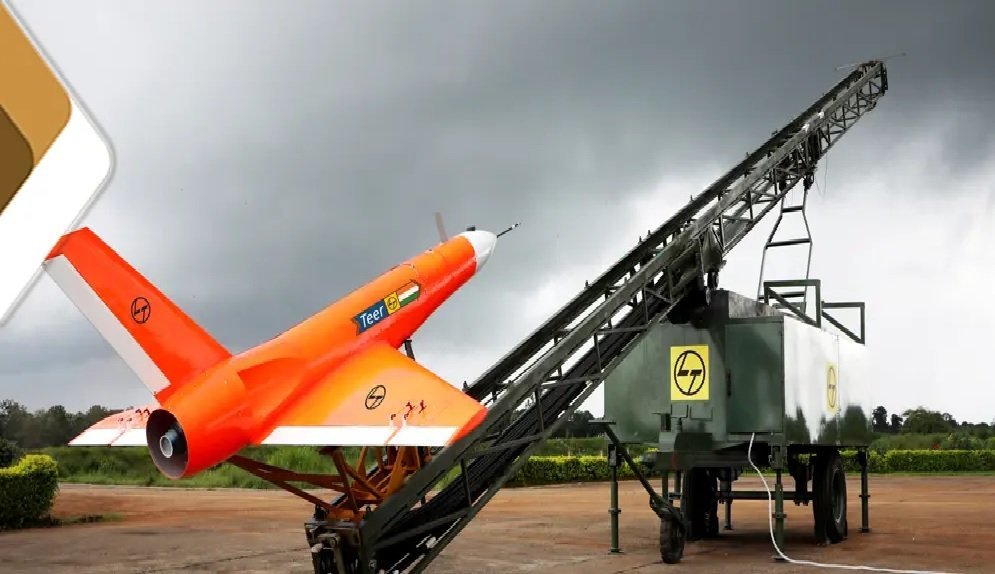 The TEER aerial target on its launcher — aerial targets and launcher systems are core to Aethrone’s portfolio, developed in collaboration with L&T.
Built in Pune, incubated at IIT Kanpur
Aethrone Aerospace was founded in 2015 by mechanical engineer Farzin Irani and IIT Kanpur aerospace researcher Prakhar Nandi Srivastava. The company is incubated at the Startup Incubation and Innovation Centre (SIIC) at IIT Kanpur, and the company says the only outside funding it took in its early years was a Rs 12 lakh SIIC grant — spent on a single piece of equipment, a 3 m × 5 m × 2 m composite curing oven that let the team manufacture large, lightweight carbon-fibre components in-house instead of relying on external suppliers.
Everything else came from the company’s own work. Aethrone funded its high-risk drone research from engineering-services revenue, and the company says it has delivered more than 160 projects for OEMs, defence laboratories and research institutions, with engineering design and computational fluid dynamics work for organisations including DRDO, HAL, BEL, L&T, Tata and Bharat Forge. Today the company has a design lab in Viman Nagar, a manufacturing facility in MIDC Pune, and a north office at IIT Kanpur — and the company says it is bootstrapped and profitable.
The drones that train the forces
Aethrone’s target drones are built to be shot at — in the best possible sense. These unmanned aircraft act as simulated aerial threats during military training, letting defence personnel practise detection, tracking and engagement with anti-drone guns, lasers and microwave systems. The company says it has sold more than 100 custom target drones to the Indian Army and Navy, tested extensively at Pokhran, Kurnool, Karwar and Chitradurga, and delivered them against tender timelines as short as ten days.
More Read
The company’s project list includes the TEER aerial target and the VTOL Vedh platform, both developed in collaboration with L&T, alongside engineering partnerships with Larsen & Toubro, Godrej and Hindustan Aeronautics Limited. It has also sold 200 mechanical launcher systems to defence and aerospace clients — ten varieties of launchers, the company says, covering drones from 5 kg to 150 kg and launching them at speeds from 15 to 60 metres per second.
VTOL drones that land on moving ships
The VTOL work is where Aethrone’s engineering gets most ambitious. A VTOL drone takes off and lands vertically, with no runway — which makes it usable from forward positions, remote terrain and naval vessels, exactly the places where conventional aircraft operations are hardest.
Two of Aethrone’s VTOL platforms were developed under iDEX, the government’s Innovations for Defence Excellence programme — the company is a two-time iDEX winner. Its search-and-rescue VTOL drone is designed for maritime emergencies: it takes off from a naval ship, autonomously detects a person in the water using AI, and drops a lifebuoy marker. The company says it flies for 1 hour 15 minutes in good conditions, handles winds up to 18 metres per second, operates on solid-state batteries down to −20°C, and can land in a tight 2 × 2 metre space on a ship travelling at 40 to 50 km/h — reliably, the company says, even in rough Sea State 4 and Sea State 5 conditions.
Its gunnery alignment VTOL drone tackles a quieter but expensive problem: every six months, naval ships must verify that their automated guns align perfectly with radar-detected targets — work that has traditionally tied up manned helicopters, pilots and aviation fuel. Aethrone’s drone hovers in place as the calibration point instead, automating the job at a fraction of the cost.
The safety net underneath it all
One of Aethrone’s most quietly successful divisions builds the parachutes that save drones when something goes wrong. Its custom parachute recovery systems cover drones from 2 kg to 400 kg, including 80 kg jet-powered systems, and the company says onboard accelerometers detect sudden altitude loss or motor failure and eject the parachute automatically, bringing the aircraft down at a controlled 5 metres per second. Some fixed-wing target drones skip landing gear entirely and use these parachutes as their primary landing mechanism.
The growth curve tells the story of a company finding its footing: the company says revenue rose from approximately Rs 1 crore in FY2024 to Rs 3–4 crore in FY2025 and Rs 8.5 crore in FY2026, with a target of around Rs 15 crore for FY2027 based on existing service contracts and component sales alone. In September 2026, the company also signed a memorandum of understanding with OBSC Perfection to explore a joint precision manufacturing facility in New Mexico, USA — a first step towards taking its aerospace and defence engineering global.
From a small flat in Pune to drones that train India’s forces, land on moving ships and catch falling aircraft mid-crisis, Aethrone Aerospace is a reminder that some of India’s most consequential defence engineering comes not from the biggest balance sheets, but from the most persistent workshops.
Keep reading: From Premises to Production: Inside Magellanic Cloud’s New Tactical Drone Facility for India’s Forces · Built Without the Blueprints: Inside izmo Microsystems’ Indigenous Pitch Detector for India’s Fighter Jets · More Aerospace & Defense stories
Like stories like this? Add Exceptional Technology as a preferred source on Google to see more of our reporting in your search results and Discover feed.







