


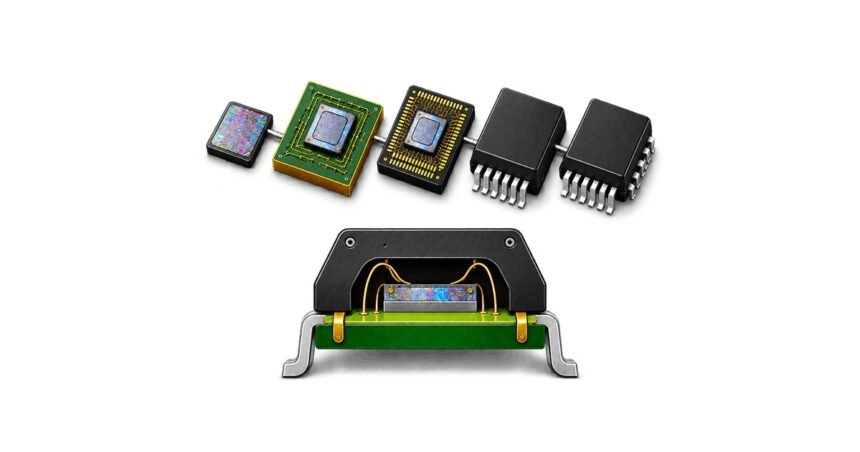
Image credit: izmo Microsystems — official company visual.
Every military aircraft flying today depends on knowing exactly which way is up. Pitch — the nose-up, nose-down angle of an aircraft — is one of the most basic facts a pilot and a navigation system need, moment by moment. For years, the small component that measured it on several Indian military aircraft and helicopters came from a single foreign maker, and its supply was irregular and limited. On 3 November 2026, izmo Microsystems of Bengaluru announced it had solved that problem entirely in India: it has developed and completed defence qualification of an indigenous Pitch Detector, a fully compatible Indian replacement for the imported part.
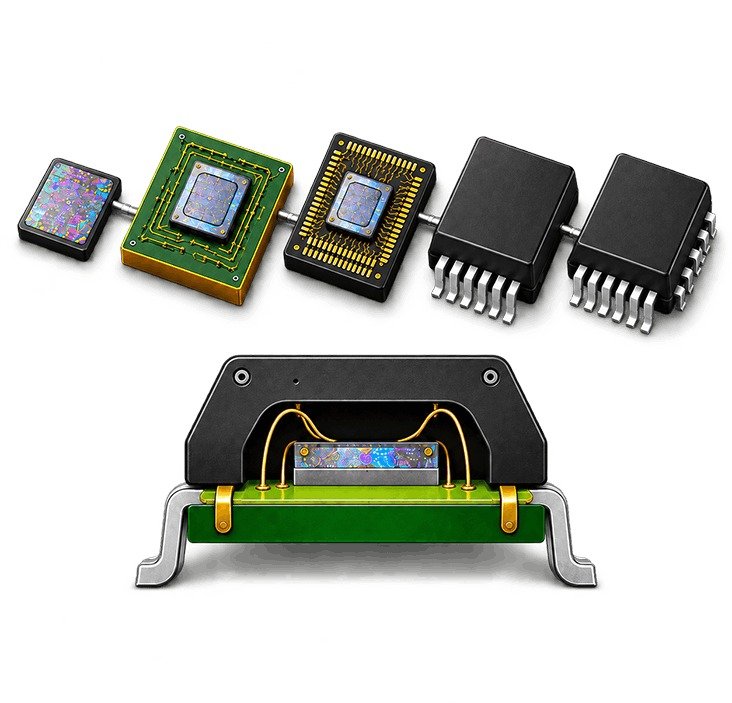 izmo Microsystems’ advanced semiconductor packages, built at its Bengaluru facility (official company visual).
The component that keeps aircraft level
The Pitch Detector is a critical avionics component. The company says it senses an aircraft’s pitch attitude and provides correction data to the gyromagnetic compass navigation system — the instrument that keeps a heading true in flight. It is used across multiple military aircraft and helicopter platforms currently in active service, so a gap in its supply is not a minor inconvenience; it touches the readiness of the platforms that depend on it.
That is what makes this announcement so satisfying. izmo Microsystems did not simply find another supplier. It undertook a complete indigenisation programme and built a fully compatible replacement in India, reducing dependence on imported components and strengthening domestic supply chain resilience for a part the armed forces cannot do without.
Rebuilt without the blueprints
The most remarkable part of the story is how the replacement was made. The company says it reengineered the original component without access to its design documentation. Starting from the finished part and its required behaviour, its engineers redesigned the electronics using modern technology and manufactured a fully compatible replacement in India.
More Read

Reverse-engineering a flight-critical component to full compatibility, with no drawings to work from, is exacting work. Every electrical characteristic has to match, every interface has to behave identically, and the finished part has to slot into existing aircraft systems without modification. izmo Microsystems says it did all of that — design, engineering, manufacturing and qualification — as one complete product development programme.
Qualified to a military standard
The component was developed and manufactured at the company’s DSIR-recognised advanced semiconductor packaging facility in Bengaluru, and the company says it has successfully qualified to the military reliability standard MIL-PRF-38534. That qualification is the stamp that matters for defence electronics: it means the part has met the rigorous reliability requirements demanded of components that fly in military service.
The achievement, the company says, demonstrates its ability to take on complete product development programmes, from design and engineering through manufacturing and qualification — and it reflects the growing maturity of a technology platform that combines advanced electronics design with high-reliability semiconductor packaging and manufacturing.
Why this opens a much bigger door
The Pitch Detector is one component, but the capability behind it is far wider. The company says these integrated capabilities position it to address a wider range of defence and aerospace indigenisation opportunities, particularly where imported components are obsolete, difficult to procure, or no longer supported by their original manufacturers.
That is a large and growing field. India’s defence budget for FY2026–27 stands at ₹7.85 lakh crore, including ₹2.19 lakh crore for capital expenditure, and the company says the increasing emphasis on indigenous procurement and import substitution is opening more opportunities to apply its engineering and manufacturing capabilities across the defence electronics sector. The same capabilities already support its work across defence, aerospace, silicon photonics and other advanced semiconductor applications.
izmo Microsystems is no newcomer to this world. The Bengaluru company, the semiconductor subsidiary of listed izmo Limited (NSE: IZMO, BSE: 532341), describes itself as India’s first specialist in silicon photonics packaging and advanced system-in-package manufacturing, working from a state-of-the-art cleanroom facility in Bengaluru. In September 2026 it developed an innovative high-frequency RF package for semiconductor devices operating at up to 40 GHz, designed, developed and manufactured entirely in India for defence and secure wireless communication applications — and its in-house R&D unit has been formally recognised by the Department of Scientific and Industrial Research (DSIR).
A tiny avionics part, rebuilt from scratch without its blueprints and qualified to a military standard, is exactly the kind of quiet engineering win that keeps India’s aircraft flying on Indian parts. izmo Microsystems has turned a supply vulnerability into a domestic capability — and shown that the same team can do it again for the next obsolete or hard-to-source component in line.
Keep reading: Seeing Through Cloud and Darkness: Inside PierSight’s Varuna, the Ahmedabad Satellite Constellation Watching the Oceans · The Wires Inside the World’s Fighter Jets: Inside Rossell Techsys, the Bengaluru Maker Doubling Its Aerospace Factory · More Aerospace & Defense stories
Like stories like this? Add Exceptional Technology as a preferred source on Google to see more of our reporting in your search results and Discover feed.







