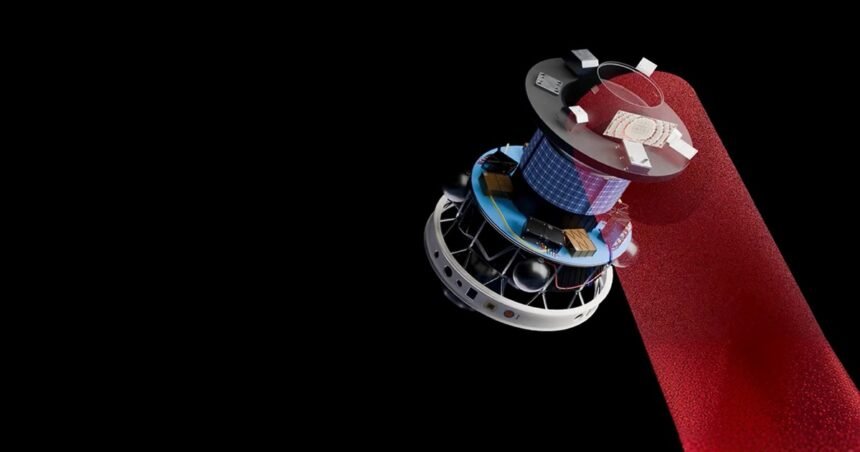
Picture the Indian Ocean at midnight, under thick monsoon cloud. No camera can see through that darkness — but a radar can. That is the simple, powerful idea behind PierSight Space, the Ahmedabad startup building a constellation of radar satellites that watch the oceans in all weather, day and night, and never blink.
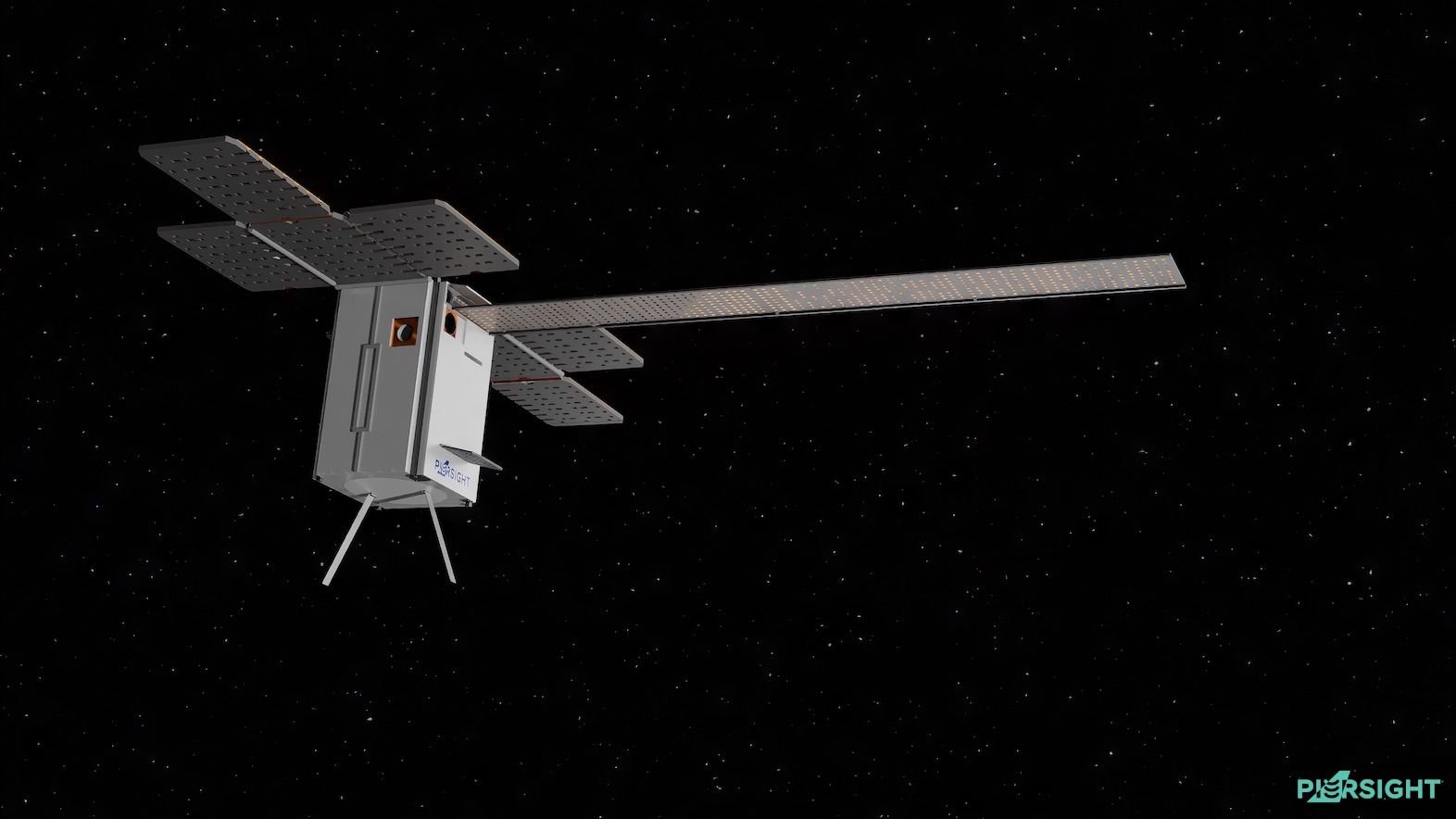 PierSight’s Varuna satellite, carrying a synthetic aperture radar and AIS receiver over the oceans (official company visual).
A radar eye that never closes
Optical satellites go blind at night and in cloud. Synthetic aperture radar (SAR) does not. It sends out radio waves and reads what bounces back, so it images the sea through cloud, rain and darkness — exactly when maritime watchers need it most. PierSight pairs that radar with AIS, the tracking signal ships broadcast, fusing the two so a vessel can be identified even when it has switched its tracker off. The company says its Varuna satellites will be the world’s first to combine SAR and AIS, with next-generation AIS-2.0 (VDES) on board.
The plan is a constellation of 32 SAR + AIS satellites, built for persistent maritime surveillance. The company says each pass will deliver around 1-metre resolution — sharp enough to identify a vessel’s class, not just its presence — with a revisit time of about 30 minutes, so dark vessels cannot hide between passes. Each imaging strip covers 3,840 by 50 kilometres, the company says, sweeping entire ocean basins in a single pass.
Proved in space in nine months
Varuna began as a demonstrator built in just nine months. The 6U CubeSat, roughly the size of a shoebox, carried an indigenously developed deployable reflectarray antenna and a modular software-defined radar and radio, the company says. It flew in December 2024 aboard ISRO’s PSLV C-60, and the company says every key system — from the SAR electronics to the power conditioner and the software-defined radio — was successfully tested and validated in orbit, qualifying the payload subsystems to TRL-7. A BPSK signal received from Varuna confirmed its radio systems were working flawlessly.
That flight was the springboard for Varuna 2.0, the company’s first commercial satellite. Its reflectarray antenna has now cleared key performance tests at ISRO’s Compact Antenna Test Range Facility (CATF) in Ahmedabad, achieving over 50% aperture efficiency — beyond its initial design targets — with integration with the satellite bus underway and a launch planned for late 2026.
More Read
What the constellation watches for
The watchlist is the everyday business of the sea, made visible from orbit. The company says its satellites will help coast guards, navies, port operators, insurers and shipping lines monitor exclusive economic zones, track ship movements, spot illegal, unreported and unregulated fishing, detect oil spills, catch dark vessels running without AIS, and geo-fence critical infrastructure such as undersea cables and pipelines. The same radar eye serves disaster response and infrastructure monitoring, where all-weather visibility matters most.
PierSight is also building the analytics layer on top of the data. Its MATSYA platform, the company says, turns SAR and AIS data into actionable maritime intelligence, with alerts for real-time threat monitoring. Alongside Varuna, the company builds Vidura, a foliage-penetrating SAR payload for drone platforms, and it is part of the IN-SPACe-backed Allied Orbits consortium building India’s first public-private Earth observation constellation, where the company says it provides the complete SAR backbone alongside Pixxel, SatSure and Dhruva Space.
Built in Ahmedabad, for the world’s oceans
PierSight was founded in Ahmedabad in 2023 by Gaurav Seth, a former ISRO scientist, and Vinit Bansal, a former National Instruments engineer. The company says its philosophy is deliberately different from legacy SAR: instead of one large, general-purpose satellite, it builds smaller, mission-specific systems, tuned to exactly the resolution, revisit and swath a job needs — at roughly a tenth of the cost of current market alternatives. Total funding has reached $8 million, the company says, from investors including the Sustainable Ocean Alliance’s Seabird Ventures and CE-Ventures.
From a shoebox-sized demonstrator built in nine months to a 32-satellite constellation watching the oceans every half hour, PierSight is turning India’s radar expertise into a persistent eye over the seas — an Ahmedabad-built watchtower, 500 kilometres up, that sees through cloud and darkness alike.
Keep reading: The Wires Inside the World’s Fighter Jets: Inside Rossell Techsys, the Bengaluru Maker Doubling Its Aerospace Factory · Eyes Above, Ears Everywhere: Inside Arka Aerospace’s Cyberhound, the Tethered Drone That Sees and Listens · More Aerospace & Defense stories
Like stories like this? Add Exceptional Technology as a preferred source on Google to see more of our reporting in your search results and Discover feed.