


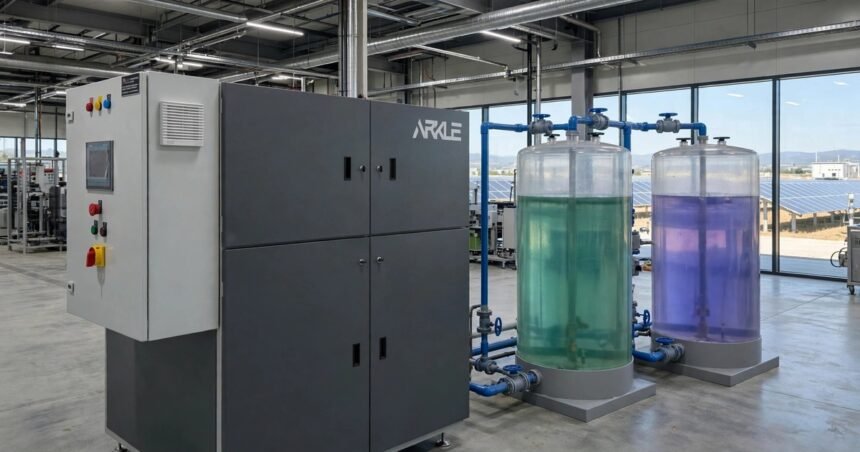
India is adding solar and wind power faster than almost any country on earth — but the sun sets every evening and the wind does not blow on demand. The missing piece is storage that can hold a day’s sunshine until the night needs it, and hold it again the next day, and the next, for decades. Lithium-ion batteries fade a little with every cycle. A Hyderabad company called Arkle Energy has built a battery that stores its energy in liquid instead — and the company says it keeps its full capacity for more than 25 years.
A battery made of liquid
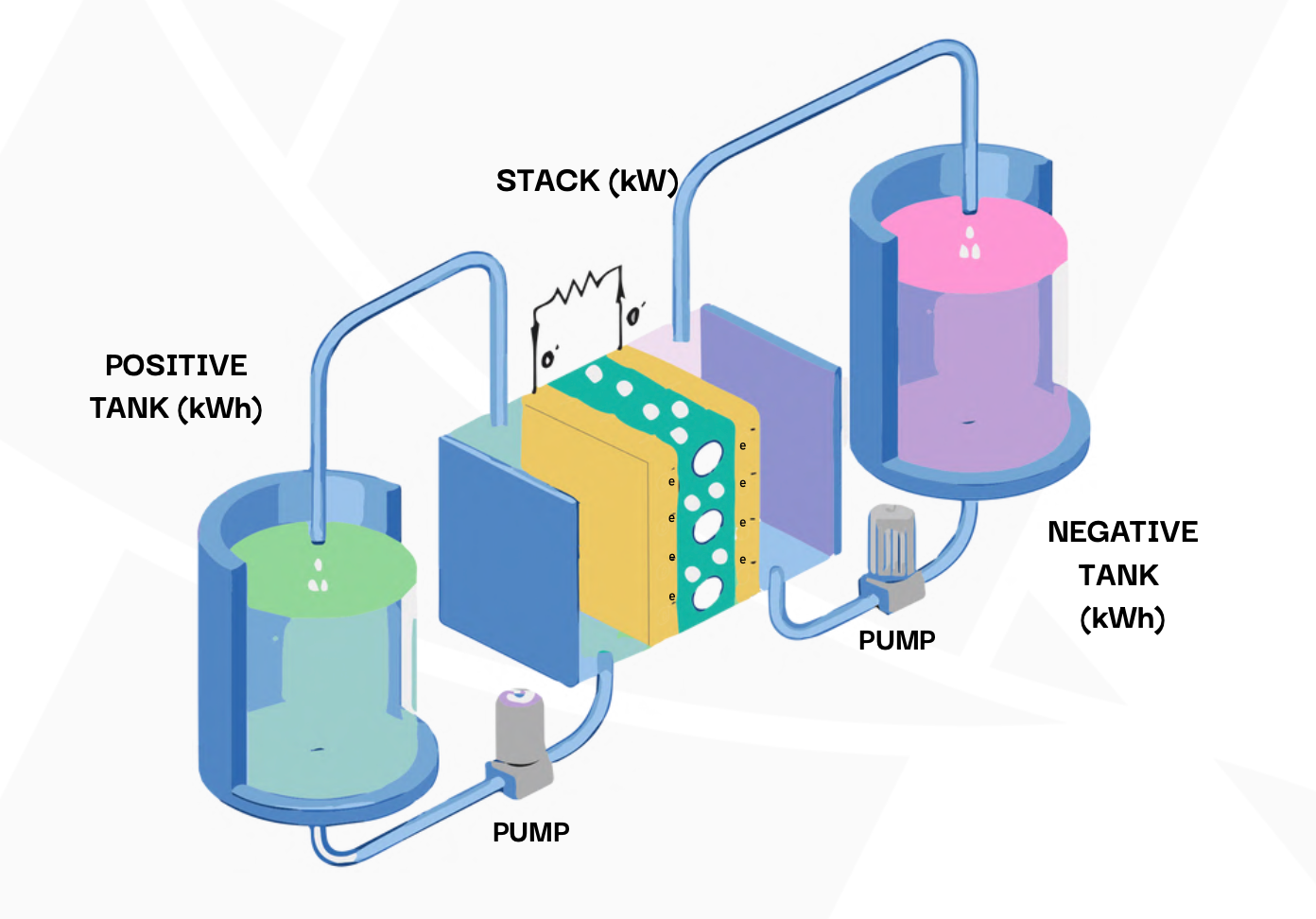
Arkle’s system is a vanadium redox flow battery. Instead of locking energy inside solid cells, it stores it in a water-based vanadium electrolyte held in external tanks. Pumps circulate the positive and negative electrolytes through a central reactor stack, where the charge is exchanged and electricity flows out. Because the energy lives in the liquid, power and capacity scale independently: add more stacks for more kilowatts, add more electrolyte for more hours. The company’s modular blocks pair 10 to 30 kW stacks with 60 to 120 kWh tanks, in configurations that run for 6 to 12 hours — and the architecture stretches to discharge windows of up to 32 hours.
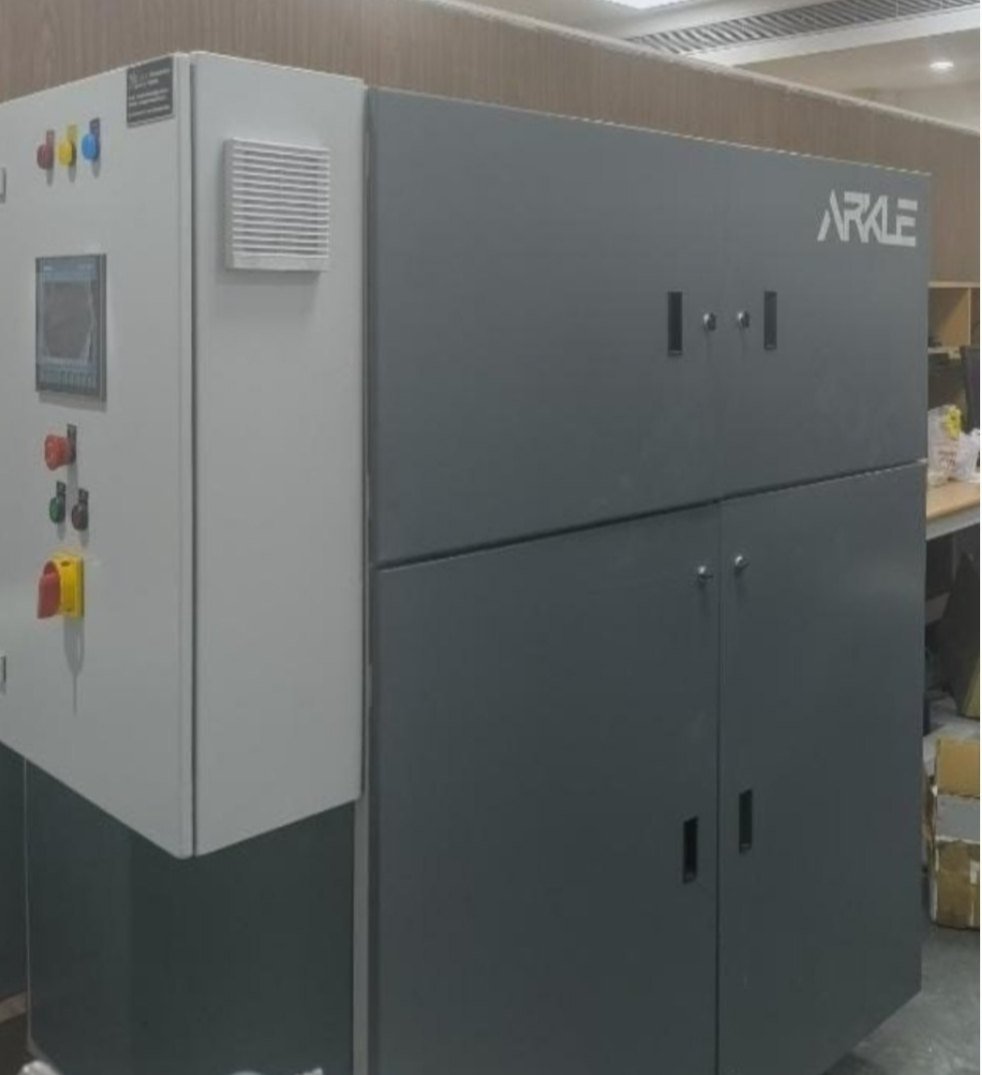
Arkle engineers the whole system in-house, in three parts. Arkhon is its line of high-performance reactor stacks, built with proprietary flow frames and membranes. Arkelyte is its stability-optimised vanadium electrolyte, formulated for energy density, temperature resilience and circular recovery. And Arkhave is the integrated battery management and supervisory control platform that synchronises pumps, valves, sensors, power conversion and grid-level SCADA interfaces, so the whole installation runs as one coordinated machine.
Built to outlast the grid it serves
What makes the chemistry special is what it does not do. The electrolyte is water-based, so it cannot catch fire — there is no thermal runaway to manage, no cooling farm to babysit. And because the same vanadium ions simply change state as they charge and discharge, the battery does not wear out the way solid electrodes do. The company says its systems are designed for an operational life beyond 25 years and up to 20,000 charge-discharge cycles with virtually zero capacity degradation — the storage asset holds the same capacity in year twenty-five as it did on day one.
The economics follow the same long arc. The company says the vanadium electrolyte retains 60% of its residual value after 25 years, for reuse or resale, and it offers the electrolyte on a leasing model so customers pay for storage as a service rather than buying a depreciating asset. For utilities, industrial campuses and telecom towers — places where uptime and fire safety are non-negotiable — a battery that never fades and never burns is a different kind of proposition.
From the lab to DRDO
The technology is already winning work where it matters most. In July 2026, IIT Palakkad’s Technology IHub announced that Arkle Energy had won DRDO’s first-ever vanadium redox flow battery project — the company’s fifth consecutive VRFB project win. The company builds on research collaborations with IIT Madras and IIT Palakkad, is backed by Pi Ventures, and was selected for T-Hub’s Blueprint fellowship for deep-tech founders. Pilot sites with DISCOMs, independent power producers and commercial and industrial campuses are under execution, with 5 to 20 MWh assets being locked in through 2026, and The Economic Times reported in June 2026 that the company was in talks to raise about Rs 20 crore, having raised $460,000 so far.
More Read

A Hyderabad company building India’s storage backbone
Arkle Energy was founded in 2023 and is led by co-founder and chief executive Jeevith Reddy, alongside a team of electrochemists and engineers. Its vision is India’s long-duration storage backbone: a grid where utility, industrial and community assets run on round-the-clock renewable power, supported by resilient vanadium flow storage. Telecom tower backup, industrial peak shaving, renewable firming and grid stability programmes are the first places that backbone is going up.
When the sun sets over a solar farm, the power it made does not have to vanish with the light. In Arkle’s tanks, it waits — in liquid, safe, and ready — for as long as the night needs it. That is storage built for the decades India is about to live through.
Keep reading: Thorium, Bottled: Inside SUK-M, the Pune Startup Building India’s First Thorium Microreactor · The Brain Inside Every Battery: Inside RC Labs, the Bengaluru Startup Building India’s Intelligent Battery Management Systems · More Energy & Power stories
Like stories like this? Add Exceptional Technology as a preferred source on Google to see more of our reporting in your search results and Discover feed.







