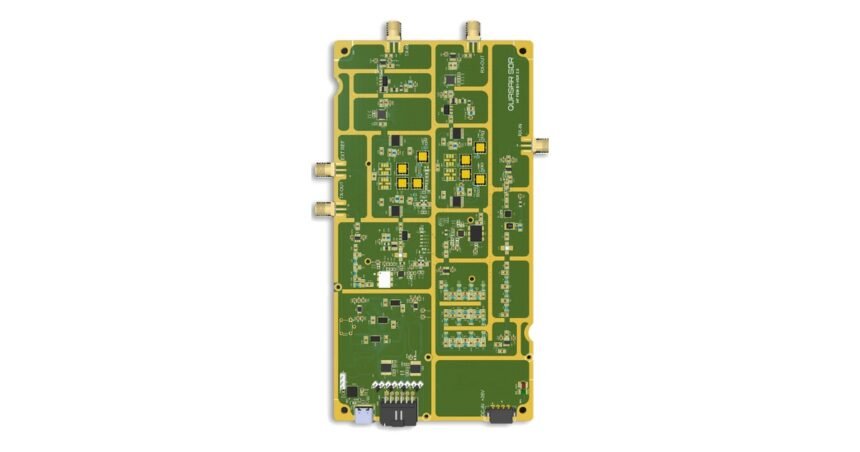
Satellites are wonderful until they are not — jammed, congested, or simply absent over the long distances an air force must operate across. When that happens, the most dependable link is one of the oldest: high-frequency radio, bounced off the ionosphere to reach thousands of kilometres without a single relay in between. The Indian Air Force wants that link to speak digital, and in October 2026 it signed a contract with Pune’s Cyronics Innovation Labs for an indigenously developed Wideband HF Modem, announced through the IAF’s VayuSaksham innovation initiative and shared by the Defence Innovation Organisation’s iDEX programme.
The modem answers a very specific call: iDEX’s Defence India Startup Challenge for a “Wide Band HF Modem for Networked Secure Voice, Data and Video Communication.” Where a standard narrowband HF modem squeezes through a thin slice of radio spectrum, a wideband modem opens up a much wider channel — and wider channels carry more: digital data at higher rates, the kind that can move beyond voice into data and video traffic for networked military operations. Cyronics says it designed the modem from the ground up under the iDEX framework.
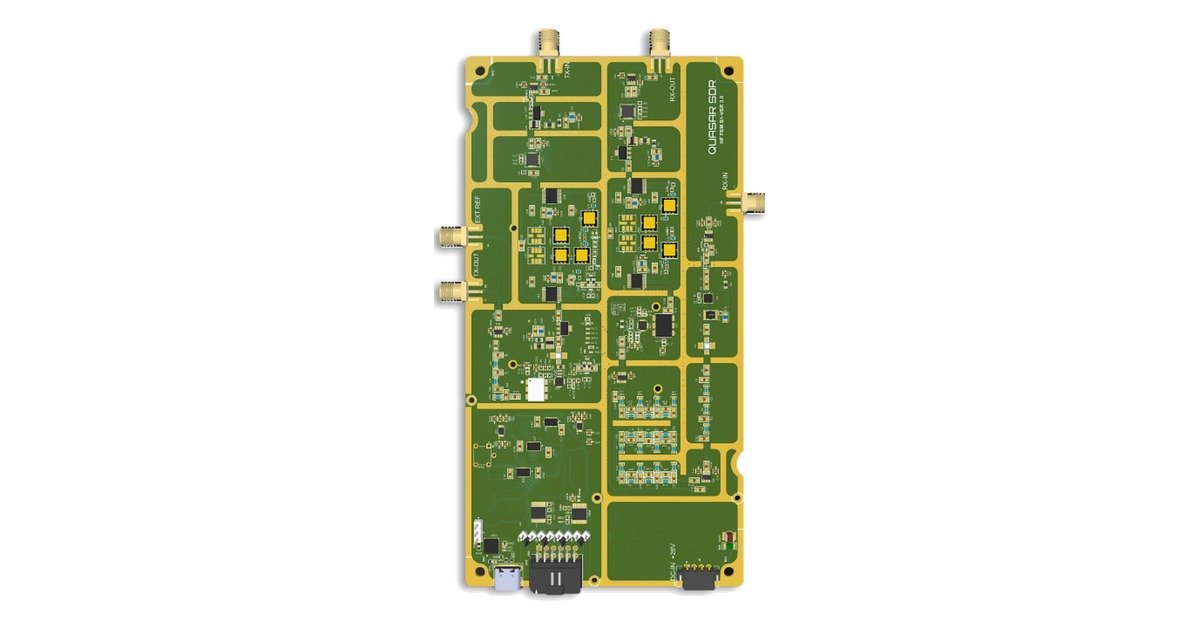
The whole radio chain, engineered in Pune
Cyronics Innovation Labs, founded in 2020 and operating under its QUASAR RF & Microwave brand, does something few Indian startups attempt: it engineers both halves of the radio in-house. Its catalogue runs from 36-plus precision tactical antennas covering 30 MHz to 18 GHz, to broadband software-defined-radio front-end modules spanning 1.8 MHz to 18 GHz — designed, EM-simulated, chamber-tested and manufactured in India. The company runs three facilities across Pune for design, anechoic-chamber testing and manufacturing, and counts customers across the defence ecosystem, including Kirloskar Oil Engines, Navstar Integrated Systems (Navy) and Theta Controls (Army).
For the HF band specifically, Cyronics fields a four-board front-end family: the B1 up/down converter that moves signals between the SDR and the 1.8–30 MHz band, a 50 W power amplifier, an antenna tuning unit that matches the transmitter to whatever antenna is in the field — whips, dipoles, wire antennas — and a harmonic filter bank with transmit/receive switching. The full chain also ships as a single ruggedised enclosed assembly, aimed at applications the company lists as 2G/3G ALE, MIL-STD-188-141 and wideband 4G ALE.
An EW track record too
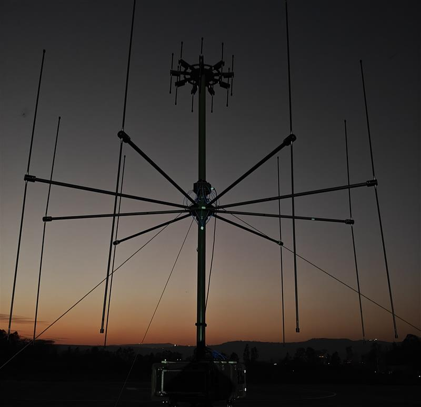
The Air Force contract is not the company’s first tryst with military electronics. Cyronics has also unveiled a fully indigenous Remote ESM and Direction Finding system for the Indian Army — electronic support measures that detect and analyse emissions across a broad spectrum and pin down signal sources for commanders in the field. The same talent that built direction-finding arrays in the field (pictured above at sunset) now puts wideband digital waveforms on HF for the Air Force.
The significance is the ownership. An indigenous modem means the Air Force can adapt waveforms and equipment to its own operational needs and modify them over time — capabilities that imported radios never quite offer. For a service that flies across the subcontinent and beyond, having its long-range beyond-line-of-sight voice, data and video ride on Indian-designed hardware is exactly the kind of quiet engineering win that compounds for decades.
More Read

Keep reading: The Hovering Kamikaze Drone NATO Ordered From Bengaluru: Inside Zulu Defence’s DRAP · The Machine Shop the World’s Plane-Makers Trust: Inside JJG Aero’s Precision Play · More Aerospace & Defense stories
Like stories like this? Add Exceptional Technology as a preferred source on Google to see more of our reporting in your search results and Discover feed.