


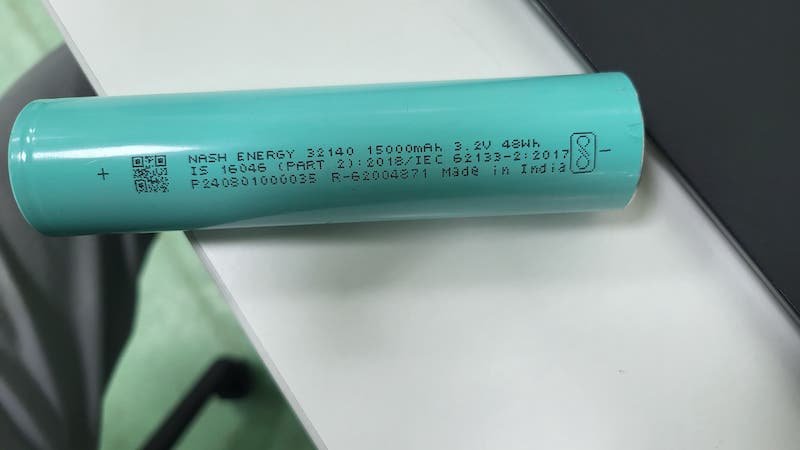
Nearly every lithium-ion battery pack assembled in India starts life as somebody else’s cell — a cylindrical can or a prismatic brick shipped in from abroad, dressed up in an Indian enclosure. A company born from a six-decade-old manufacturing family decided that was the wrong way to build an energy industry, and went straight at the hardest link in the chain: the cell itself. The company is NASH Energy, part of the Nash Group, and its Bengaluru plant is India’s first mass-scale LFP cell manufacturing line, according to the company.
The star of that line is the NEI32140E — a 32140-format cylindrical LFP cell rated at 3.2 V and 15 Ah (48 Wh), BIS-certified to IS 16046. It was designed and developed at the company’s wholly owned R&D centre in Japan and is manufactured in Bengaluru. LFP was a deliberate chemistry choice: the company says its stability, long life and cost profile suit everything from India’s punishing summers to price-sensitive two-wheelers, three-wheelers and stationary storage.
Technology made in India, not just assembled in India
The engineering bet behind NASH Energy is chemistry ownership. With Hitachi as a global partner, the group acquired a Japanese company specialising in electrochemistry, giving it what the company calls full independence in its LFP technology — while NMC development runs through a US-based joint venture. That depth shows up in the numbers the company reports: around 165 Wh/kg in production cells today, 190 Wh/kg already achieved at lab scale in Japan, and a target beyond 300 Wh/kg by 2030.
The R&D muscle is split across two continents — about 17 Japanese scientists in Japan and a team of 17–18 engineers and electrochemistry PhDs in India — with academic partnerships including Okayama University. And the Nash Group’s manufacturing pedigree does the rest: the group supplies auto majors like Hyundai, Kia, Daimler and Volvo alongside energy names like Siemens, Schneider, ABB and Hitachi, and says it can manufacture over 90% of a battery pack in-house.
A 10 GWh roadmap
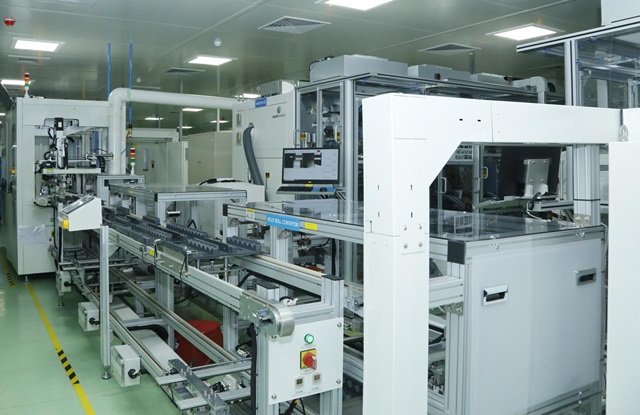
The Bengaluru plant opened at 600 MWh of annual capacity, is scalable to 1.5 GWh, and anchors a company roadmap targeting more than 10 GWh of cumulative capacity by 2030. Alongside it sits a four-phase localisation plan: metallic components first, leveraging Nash Industries’ 50-plus years of sheet-metal expertise, then electrolyte and non-metallic components, and finally foils, separators and electrode materials.
The portfolio keeps widening. In January 2026 the company commissioned a prismatic battery-pack line, and a collaboration with US-based Rincell is aimed at manufacturing NMC cells in India for drones, defence, aerospace and electric mobility. More than 50 customers worldwide are already in the company’s orbit, and BIS-certified sample cells are in qualification with EV and energy-storage OEMs. At The Battery Show India 2026, running October 22–24 at Greater Noida, NASH Energy is showcasing the NE32140 alongside 5 kWh and 16 kWh packs, e-rickshaw and two-wheeler solutions, and 261 kWh and 500 kWh battery energy storage systems. “We are making long-term investments to build indigenous capabilities and make India self-sufficient in energy storage technologies,” says Sanjay Wadhwa, Chairman of NASH Energy.
More Read

The cell is the heart of every battery system — and for the first time at this scale, India is making its own.
Keep reading: Fuel From the Barber’s Floor: Inside Techofest Global, the Gujarat Startup Turning Human Hair Into Bioethanol · Chasing a Star in a Bottle: Inside Pranos Fusion, the Bengaluru Startup Building India’s First Private Tokamak · More Energy & Power stories
Like stories like this? Add Exceptional Technology as a preferred source on Google to see more of our reporting in your search results and Discover feed.







