
A phased-array radar does something that still feels like a small miracle: it steers its beam across the sky in microseconds without moving a single part. No dish swings, no antenna tilts — the beam simply jumps, shaped and steered entirely by electronics. At the heart of that trick sits a beamformer chip, and for a long time, India bought that chip from abroad. A Bengaluru startup called FermionIC Design decided to change that — and its chips are now rolling off production lines in volume.
FermionIC Design is a fabless semiconductor company from Bengaluru that designs high-performance radio-frequency (RF) and millimetre-wave chips for radar, satellite communications and telecom infrastructure. Founded in 2020 by Gautam Kumar Singh, Prasun Bhattacharyya, Abhra Bagchi and Shabaaz Syed, the company builds the silicon that lets antennas think — chips that control the phase and amplitude of signals across many channels so a radar beam can be pointed, split and reshaped in software.
The chip that steers the beam
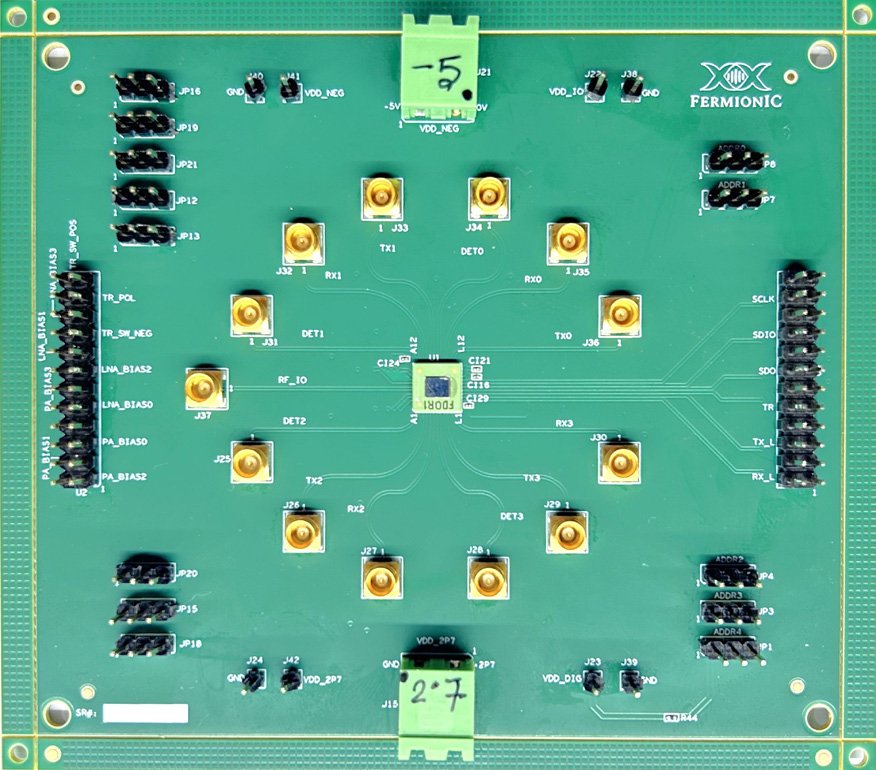
FermionIC’s flagship product is the FD3R4411, a 4-channel X-band beamformer IC built in a silicon-germanium (SiGe) process. The company describes it as India’s first 4-channel X-band beamformer IC, designed for next-generation time-division-duplex (TDD) phased-array antennas. In plain terms, one FD3R4411 drives four antenna channels at once, adjusting each channel’s signal with fine-grained phase and gain control so the combined beam points exactly where the system wants it — and moves in a fraction of a blink.
That capability matters for ranging radars, imaging radars and next-generation surveillance platforms, where a beam that can be steered electronically is faster, more reliable and harder to jam than a mechanically scanned dish. The company says the FD3R4411 has already been adopted by multiple public and private organisations, and its roadmap runs further: phased-array transceivers, RF switches, high-linearity power amplifier chains and integrated front-end ICs for intelligent sensing, adaptive communications and AI-enabled RF systems. Alongside the beamformers sits a mixed-signal family — ultra-low-noise low-dropout regulators, low-phase-noise crystal oscillators and serialiser/deserialiser products — the quiet supporting cast that keeps high-frequency systems clean and stable.
Designed in India, built at world scale
A chip design is only half the story; somebody has to manufacture it, package it and test it. FermionIC has put together a manufacturing chain that the company says keeps nearly the entire value chain within India, while also reaching the world’s biggest foundries.
In September 2025, FermionIC partnered with Tata Electronics, which acts as its outsourced assembly and test partner — providing flip-chip ball grid array assembly, wafer-level testing and post-silicon validation for the FD3R4411. The partnership took the beamformer from design into staggered volume production starting in the fourth quarter of 2025, on what the company calls an accelerated timeline.
More Read

Then, in June 2026, came the milestone that put FermionIC on the global semiconductor map: GlobalFoundries, the foundry that manufactures chips for giants like Qualcomm, MediaTek and Broadcom, agreed to manufacture FermionIC’s RF chips — the first semiconductors designed by an Indian company to be made by GlobalFoundries. The company’s chief executive, Gautam Kumar Singh, said the collaboration lets FermionIC deliver complex, production-grade RF silicon rather than prototypes, and build the confidence its customers in strategic applications need. By October 2026, the company told Nikkei Asia it was shipping its chips in medium volumes, and planned to scale slowly from there.
Backed from the start by India’s chip mission
FermionIC was among the first set of startups selected under the government’s Semicon India Future Design programme, the Design Linked Incentive scheme that backs Indian chip design, announced in 2023. In September 2024, the company raised $6 million in a round led by Lucky Investment Managers, the firm of investor Ashish Kacholia, with associates participating — capital that has gone into turning deep RF engineering into shipping product.
The arc is a neat one: a Bengaluru team designs a chip that once had to be imported, proves it in Indian radar systems, packages and tests it with Tata Electronics, and manufactures it with one of the world’s leading foundries. The beamformer is a small piece of silicon, but it sits at the sharp end of India’s radar and communications future — and it is now, unmistakably, made in India.
Keep reading: Hours Into Minutes: Inside Haber, the Pune Company Teaching Factories to Run Themselves · No Tracks, No Magnets, No Shutdown: Inside Hachidori, the Bengaluru Company Teaching Robots to Find Their Own Way · More Industrial Automation & Technology stories
Like stories like this? Add Exceptional Technology as a preferred source on Google to see more of our reporting in your search results and Discover feed.