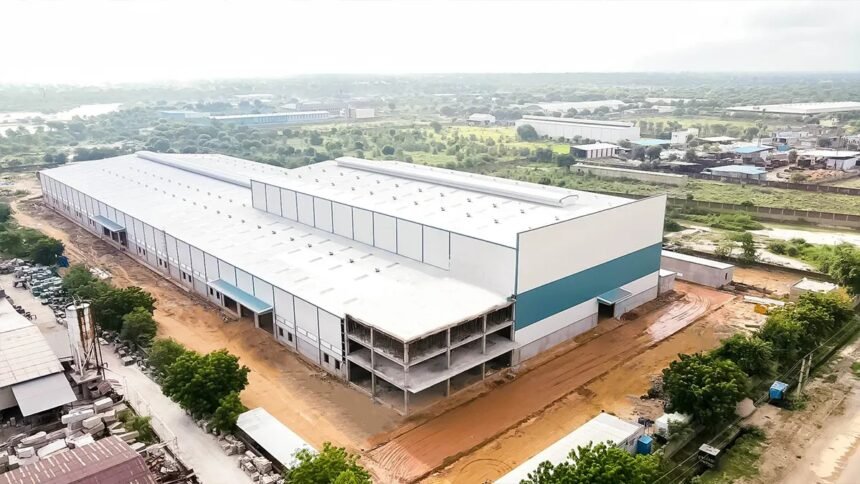
Every big Indian growth story needs a building to live in. The warehouse that holds a company’s stock, the factory floor where its machines run, the cold storage that keeps food fresh, the school or hospital that serves a new town — someone has to build all of it, and build it fast. For more than 25 years, that someone has often been EPACK Prefab.
EPACK Prefab, formally Epack Prefab Technologies Limited, is one of India’s leading makers of pre-engineered and prefabricated buildings. The company designs, manufactures and installs complete steel buildings on a turnkey basis, and its structures now stand across industrial, infrastructure, institutional and commercial India. In October 2025, the company listed on both the NSE and the BSE, a milestone that marked its journey from a Greater Noida manufacturer founded in 1999 to a nationally recognised building-technology brand.
What the company builds
At the heart of EPACK Prefab’s work is the pre-engineered building, or PEB: a steel structure whose every beam, column, purlin and panel is designed and precision-fabricated in a factory, then shipped to site and assembled in a fraction of the time conventional construction takes. The company says its turnkey industrial facilities — warehouses, factories and cold storage — go up to 50 percent faster than traditional builds, a speed advantage that matters enormously when a business is racing to open a new plant or a logistics hub.
Around that core, EPACK Prefab offers a full menu of factory-built construction. Its prefabricated modular structures serve as site offices, classrooms, healthcare facilities, labour accommodation and testing labs. Its light gauge steel framing, or LGSF, brings lightweight, flexible steel construction to residential and commercial buildings. And its insulated sandwich panels — made with PUF, EPS, rockwool and glass wool cores — give walls and roofs thermal efficiency and structural strength in a single factory-finished product.
The company’s reach spans sectors most Indians touch every day. In industry, it builds warehouses, factories and cold storage. In infrastructure, it engineers large-scale projects including airport terminals, metro stations, aircraft hangars and foot-over bridges. In institutions, it delivers schools, hospitals, hostels and offices. Its special buildings range from sports arenas and stadiums to shelters and portable cabins. Alongside the building business, the company also manufactures expanded polystyrene sheets and blocks for construction, packaging and consumer goods.
The engineering edge: a building designed like a product
What makes EPACK Prefab’s approach different is that it treats a building the way a factory treats a product. Every structure begins in one of the company’s three design centres in Noida, Hyderabad and Visakhapatnam, where engineers design the building down to the last connection. Manufacturing is automated, and the company says every product passes through 47 quality checkpoints before it leaves the factory. Digital-first onboarding keeps project kick-offs smooth, and customer-focused teams carry each project from design through installation.
More Read
That factory discipline is what makes the speed possible. Because the steel is cut, drilled, welded and finished under controlled conditions rather than on a dusty site, quality stays consistent, waste stays low, and assembly on site becomes a precise, rapid process. The company’s buildings carry ISO 9001:2015 and ISO 14001:2015 certifications, and its client list features names such as L&T, Reliance Industries, ABB and Power Grid — companies whose own engineers have praised EPACK Prefab’s quality, responsiveness and ability to meet deadlines.
Scale built over 25 years
EPACK Prefab’s manufacturing footprint tells the story of its growth. The company operates three plants — at Greater Noida in Uttar Pradesh, Ghilot in Rajasthan and Mambattu in Andhra Pradesh — with a combined pre-engineered building capacity of 133,924 metric tonnes per annum and sandwich insulated panel capacity of 510,000 square metres, as stated in its IPO filings. Its annual report puts FY26 revenue at ₹1,525 crore, with a pending order book of ₹1,113 crore as of 31 March 2026, and the company employs more than 1,900 people including contract staff.
That scale is still growing. The company is setting up a new manufacturing facility at Ghilot for continuous sandwich insulated panels and pre-engineered steel buildings, and expanding its Mambattu plant to add further pre-engineered building capacity. A greenfield plant in Gujarat is also planned, adding further capacity for India’s booming construction demand.
Building the India that is coming
India is in the middle of a construction transformation. Warehousing is booming on the back of e-commerce and organised retail, data centres are rising to power the digital economy, factories are expanding under the manufacturing push, and new institutions are needed in every growing town. Each of these needs buildings that are fast, durable, energy-efficient and delivered on time — exactly the promise of pre-engineered and prefabricated construction.
EPACK Prefab sits right at the centre of that shift. A company that began in 1999 making polystyrene products has grown into a listed building-technology leader that can design a hospital, a hangar or a hyperscale warehouse in a design centre, manufacture it in a factory, and raise it on site in record time. As India builds more, and builds faster, the quiet factory-made revolution that EPACK Prefab leads is only going to matter more.