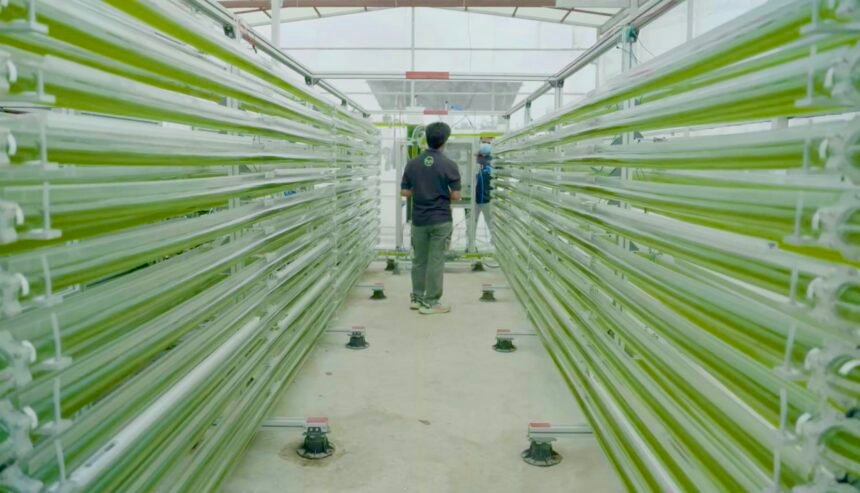
In a bright hall in Hazaribagh, in the middle of Jharkhand’s industrial belt, rows of clear tubes glow a vivid green. Inside them, microscopic algae are doing something no smokestack filter ever could: they are eating the carbon dioxide pouring out of a factory and turning it into the ingredients of a face cream. The tubes belong to Intrinsic Foundries, and the company says its photobioreactors turn industrial emissions into lipids, proteins and pigments — the same biochemicals that go into skincare, supplements and food.
Intrinsic Foundries was founded in 2023 by Shreyansh Jain, Sanjay Jain and Umang Jain, and it is headquartered in Hazaribagh, Jharkhand, in the heart of India’s industrial corridor. Shreyansh Jain studied at BITS Pilani and Cornell University and trained at Shell and Imperial College’s carbon capture facilities, and he built the company on a simple idea: carbon is not a waste to be buried, but a raw material waiting to be used. The startup calls its approach carbon-to-value biomanufacturing, and in November 2026 it won one of the beauty world’s biggest stages for it — L’Oréal’s Big Bang 2026 Grand Finale in Singapore.
The algae that eats smoke
The heart of the system is the photobioreactor: a train of transparent tubes in which selected microalgae grow on sunlight, water and carbon dioxide. Flue gas from an industrial stack is channelled into the reactors, and the algae absorb the carbon as they multiply. The biomass is then harvested and fractionated in a cascade biorefinery into lipids, proteins, pigments and materials — including vegan carmine, the red pigment prized by cosmetics makers — at yields the company says buyers can specify against. One biomass stream, the company says, becomes ingredients for cosmetics, nutraceuticals, food, pharmaceuticals and advanced materials.
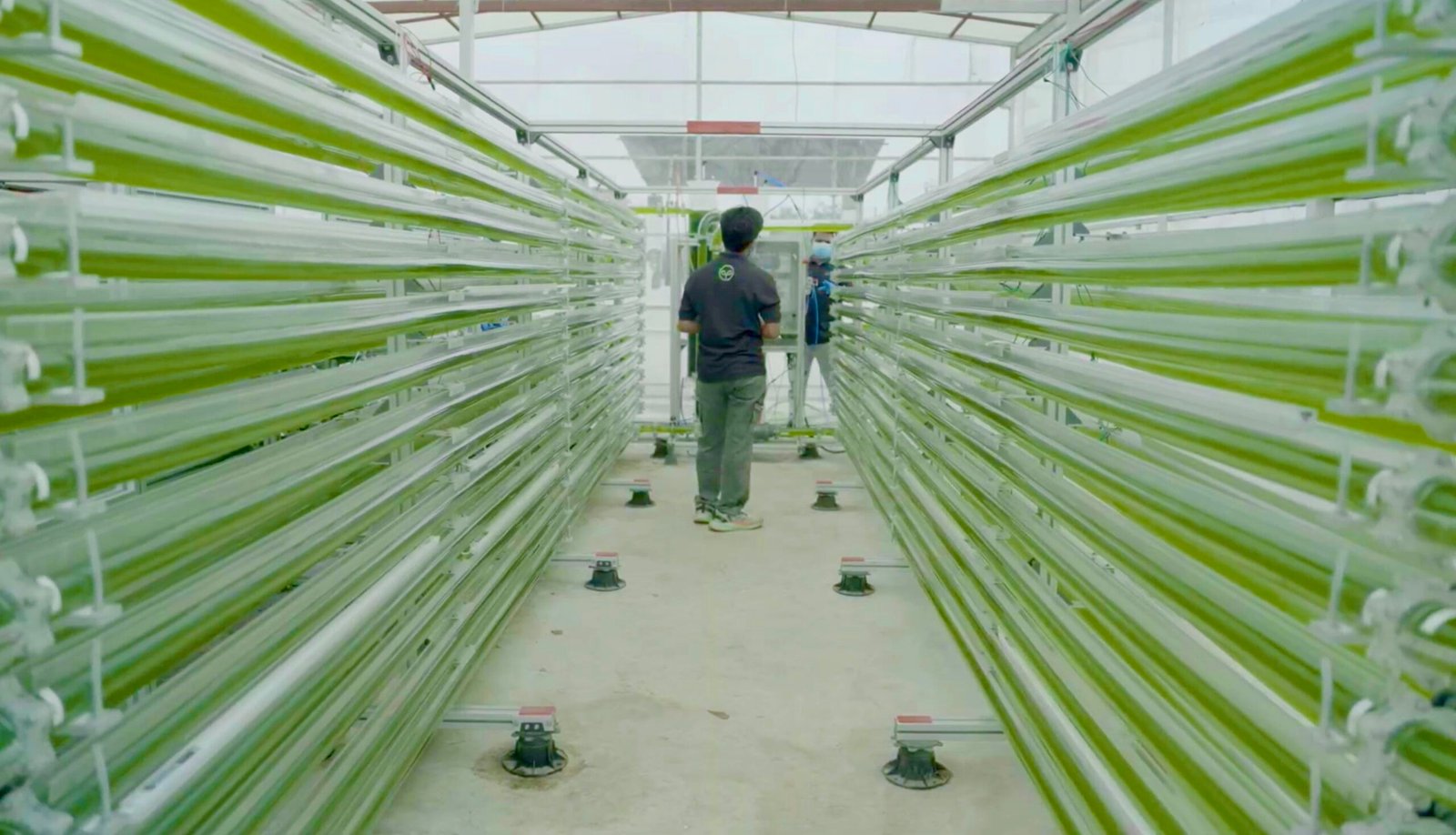
Intrinsic Foundries’ photobioreactor hall in Hazaribagh, where microalgae turn industrial carbon dioxide into biochemicals. (Image: Intrinsic Foundries)
What makes the system deployable, rather than just clever, is the engineering around the biology. The reactor tubes are extruded on site — the extruder travels, not the tube — so a finished photobioreactor train is built where it will run, with no freight, breakage or long lead times. A patent-pending Carbon Banking step stores captured CO2 as bicarbonate and carbonate in the culture medium, so capture no longer has to happen at the same moment as growth, and the same reactor family can run on flue gas, bottled CO2 or direct air capture. Control sits on Siemens S7-1200 PLCs, the same class of hardware the host plant already runs, and the company’s Intrinsic Pulse layer gives operators live monitoring, alerts and a single view across reactors, sites and cycles.
More Read

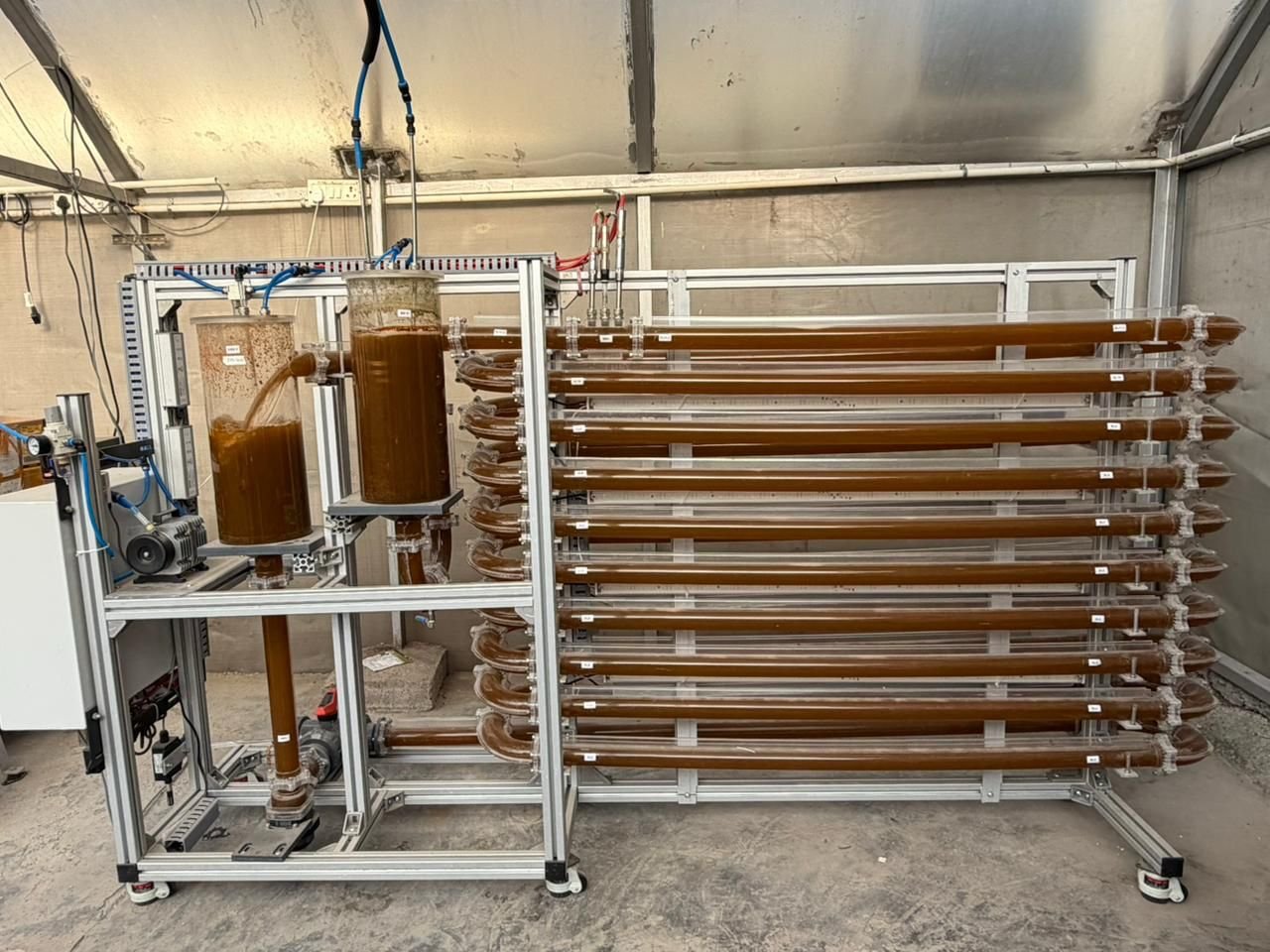
A 100-litre photobioreactor train at Intrinsic Foundries’ facility. (Image: Intrinsic Foundries)
MITRA: a carbon foundry in India’s industrial heartland
The company is now building its first full-scale home for the technology: MITRA, an integrated bio-CCU and biomanufacturing hub on its Hazaribagh campus, with an 80-kilolitre Algal BioFoundry at its centre. MITRA brings capture and carbon banking, cultivation, harvest and the cascade biorefinery onto one site, and the company describes it as a working template rather than a showpiece — each block is modular, so the same design can be dropped next to a cement kiln, a steel mill or an ethanol plant without redrawing the process. The project is backed by a BIRAC grant and has been cleared by the programme’s Apex Committee, and the company puts the platform’s maturity at TRL 7 to 8.
The technology has already proved itself on real flue gas. In 2025 Intrinsic completed a proof of concept at a thermal power plant, demonstrating sustained carbon capture and stable operation under real-world conditions, and the company says its reactors have since run continuously for more than 150 days at an industrial site. It is already supplying Indian cosmetic and nutraceutical brands, and its work was recognised at home too: the venture was named among the winners of the National Bio Entrepreneurship Competition 2025, run by the Centre for Cellular and Molecular Platforms (C-CAMP) in Bengaluru.

Strain work in Intrinsic Foundries’ laboratory in Hazaribagh. (Image: Intrinsic Foundries)
From a Jharkhand campus to a L’Oréal stage
The momentum reached a new level in February 2026, when Intrinsic raised Rs 12 crore in a seed round led by Transition VC to run industrial pilots, expand research, file intellectual property and build its engineering and commercial teams. Then, on 13 November 2026, L’Oréal named Intrinsic Foundries one of three winners of its Big Bang Beauty Tech Innovation Program at the SAPMENA Grand Finale in Singapore — the only Indian winner, alongside two Australian startups. Each winner earns a fully funded commercial pilot with one of L’Oréal’s international brands, a year of mentorship from senior leaders, and potential reach across 35 markets in South Asia Pacific, the Middle East and North Africa.
For a company built in Hazaribagh, that is a remarkable leap: ingredients grown from a factory’s own smoke, headed for the shelves of one of the world’s largest beauty companies. The road ahead, the company says, is more industrial pilots and its first one-tonne-per-day commercial plant within the next 12 to 24 months — and a country that has committed Rs 20,000 crore over five years to carbon capture, utilisation and storage is building the market around it. From a Jharkhand campus to a Singapore stage, Intrinsic Foundries is showing that the smoke leaving India’s factories can come back as something worth buying.
Keep reading: The ICU That Follows You Home: Inside iLive Connect, the Gurugram Startup Keeping a Doctor on Watch Around the Clock · The PCR Lab That Fits in a Palm: Inside Huwel Lifesciences, the Hyderabad Company Taking DNA Testing to India’s Smallest Clinics · More Chemicals, Materials & Life Sciences stories
Like stories like this? Add Exceptional Technology as a preferred source on Google to see more of our reporting in your search results and Discover feed.