


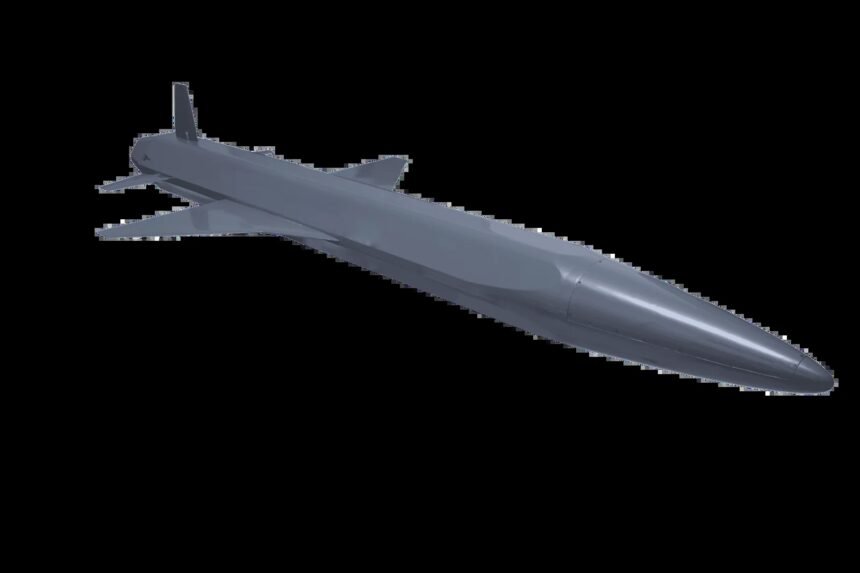
In Nagpur, a defence company founded by a former Indian Air Force Vice Chief is building one of the most intriguing machines in modern naval warfare: an expendable, jet-powered aerial decoy that can make a hostile air-defence radar believe it is staring down a frontline fighter. And now the Indian Navy has picked it. JSR Dynamics has won an Indian Navy contract under the iDEX (Innovations for Defence Excellence) initiative to develop MGLD-N, a naval variant of its Miniature Ground Launched Decoy, adapted to launch from compact canisters on warship decks.
Image: JSR Dynamics (official company image) — the MGLD aerial decoy.
A decoy that needs no runway
The naval adaptation is the story. The base MGLD is a low-cost, expendable, autonomous, high-performance aerial vehicle that uses a turbojet engine plus a booster rocket for ground launch, and executes flight profiles that mimic fighter-aircraft transit speeds and radar signatures — freeing up real fighter aircraft that would otherwise be risked as decoys.
For MGLD-N, JSR Dynamics has re-engineered the airframe around life at sea. The wings fold automatically, shrinking the storage footprint aboard a ship, and twin solid-propellant rocket-assisted take-off (RATO) boosters punch the aircraft out of a compact box-shaped canister — no runway, no catapult, just a small patch of deck. Once airborne, a sustainer turbojet generating around 1,500 newtons of thrust takes over for powered cruise. The company’s stated specifications for the decoy configuration claim a range of approximately 1,650 km, around three hours of endurance and a cruise speed of Mach 0.6, in a 400-kg airframe measuring 4.29 metres long with a 2.86-metre wingspan.
How the deception works
In its decoy configuration, MGLD-N is designed to carry an active radar emulator and an electronic-warfare jammer, backed by both active and passive radar-cross-section (RCS) augmentation systems. The combination is meant to replicate the flight behaviour, transit speeds and radar signatures of operational combat aircraft — including advanced platforms like the Rafale — presenting a convincing threat picture to enemy radar operators and integrated air-defence networks. An adversary that scrambles fighters or fires precious surface-to-air missiles at a decoy has spent real resources on a ghost.
One airframe, two missions
What makes MGLD-N especially elegant is its modularity. The same canister-launched airframe can be reconfigured for a tactical strike role: the internal fuel tanks swap out for a 125-kg high-explosive warhead, turning the deceiver into a weapon. The naval contract was awarded under the Indian Navy’s DISC-7 (Defence India Start-Up Challenge) and SPRINT initiatives, both built to accelerate indigenous technology into frontline service.
More Read


Image: JSR Dynamics (official company image) — the JSR Dynamics facility in Nagpur.
A Nagpur house of guided munitions
JSR Dynamics was established in 2018 and is led by founder Air Marshal Shirish Baban Deo (Retd.), a former IAF Vice Chief — a war-fighter’s pedigree that shows in the product philosophy: designed by war fighters, for war fighters. The company lists ten product lines spanning glide bombs, powered munitions and precision-guidance kits.
The MGLD family is part of a proven design lineage. The weaponised sibling, MGLD-W, is a 400-kg ground-launched missile-drone with a 150-kgf turbojet, a range of 297 km and a top speed of 0.85 Mach. The company’s Khagantak-243 long-range glide bomb — which the company describes as the longest-range glide bomb in its class — holds an Indian Air Force production contract awarded in February 2025, and cleared its drop trial in September 2026. Its 400-kg-class cruise missile, LRP2GM, has already won an Indian Navy Open Challenge, and the company has signed a teaming agreement with Bharat Electronics (BEL).
With MGLD-N, the Navy’s ships could soon carry expendable aerial assets in a deck-side box — a quiet, canister-sized revolution in how Indian warships project presence and misdirection over the horizon.







