
A transistor stores a zero or a one. The device built by a team at the Indian Institute of Science in Bengaluru stores 16,500 distinct levels — and that single difference could redraw the economics of artificial intelligence. The technology is a molecular memristor, a brain-inspired device that stores and computes in the same place, and it is now being taken to market by a Bengaluru company called MBrain AI.
A memory that computes
Modern AI runs on a costly commute. In a conventional chip, the processor and the memory live apart, so every calculation in a neural network means shuttling data back and forth — and the energy cost is dominated by memory access rather than computation: about 94% of the energy in a convolutional neural network goes into DRAM access rather than computation. The brain does it differently: it stores and computes in the same place. MBrain AI’s technology follows the brain’s lead.
At the heart of the platform is a molecular memristor, a device that is at once memory and resistor. The molecular system was designed by Sreebrata Goswami, Visiting Professor at CeNSE, and built around a ruthenium-based molecular complex. As molecules and ions shift inside a thin film barely 60 nanometres thick, they create thousands of distinct, stable electrical states. By applying precisely timed voltage pulses, the team learned to trace those movements and map each one to a distinct signal — a molecular diary of more than 16,000 levels, reported as 14-bit kinetic molecular memristors in the team’s paper in the journal Nature in September 2024.
Arranged in a microscopic crossbar, with a memristor at every intersection, the devices perform vector-matrix multiplication — the core operation of every neural network — in a single step, where a digital chip needs thousands of sequential operations. The team built a custom circuit board able to measure voltages as tiny as a millionth of a volt to pinpoint each state, and to show the platform at work they recreated NASA’s iconic Pillars of Creation image from James Webb Space Telescope data on a tabletop computer, in a fraction of the time and energy a traditional system would need.
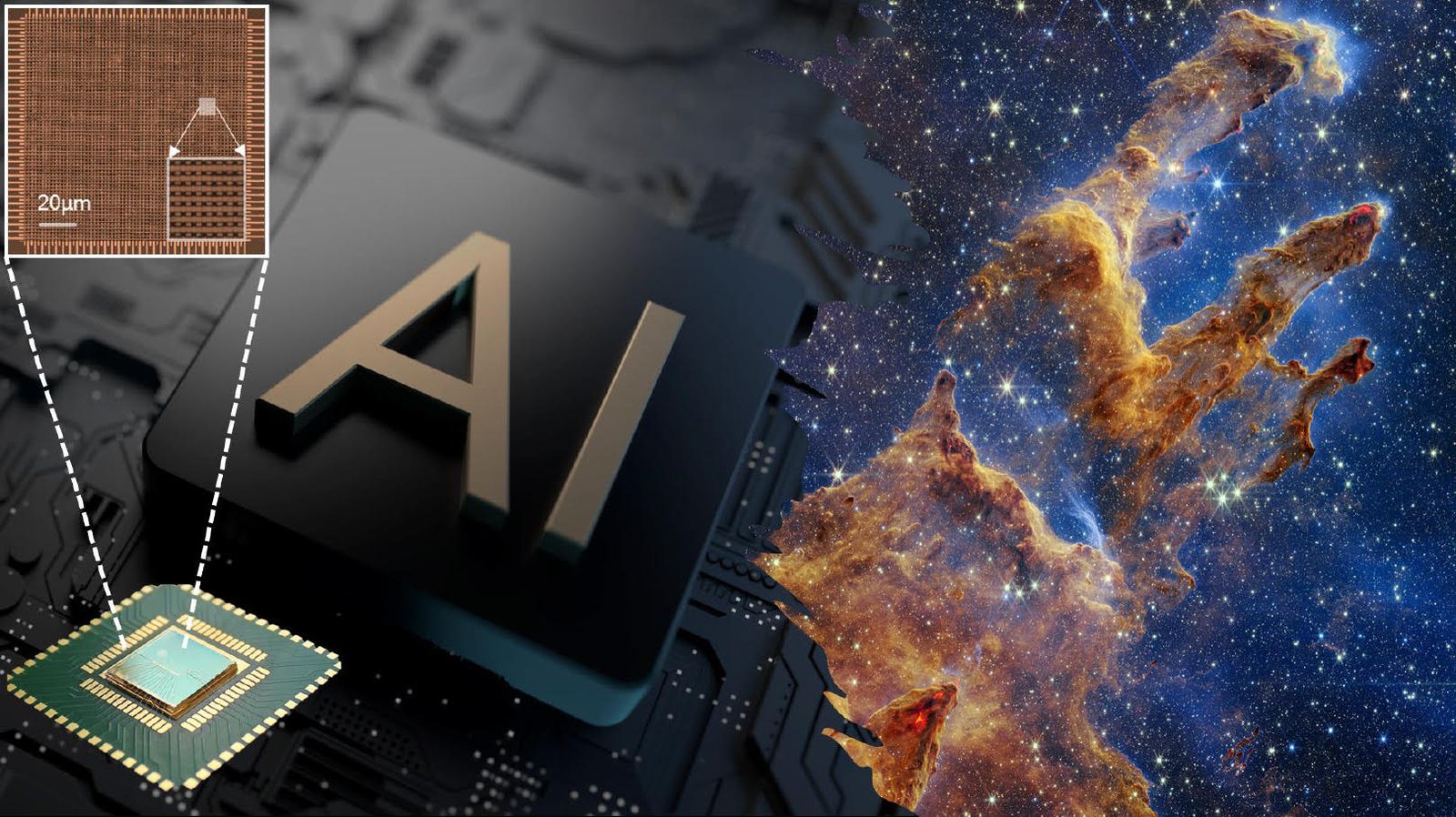
From a molecule to a machine
The numbers behind the device read like a wish list for AI hardware. The team reports 14-bit analogue resolution with linear, symmetric conductance updates, and 4.1 TOPS per watt. Goswami says the device is 220 times more energy-efficient than Nvidia’s top-tier GPUs, while retaining the power to learn and adapt. Programmed states have held steady for seven to eight months in testing, and endurance has been tested up to a billion cycles, against roughly a million for flash memory. The device scales from a micrometre down to tens of nanometres while keeping usable precision — at around 50 nanometres it still holds about 11 bits, more than enough for 8-bit inference.
The work is the product of a team of around thirty chemists, physicists and engineers at CeNSE, led by Professor Sreetosh Goswami with Professor Navakanta Bhat leading the circuit and system design. It is, Goswami says, a completely home-grown effort, from materials to circuits and systems, carried out at CeNSE’s national facilities with support from the Ministry of Electronics and Information Technology. The chip was exhibited at India’s first Nano Electronics Roadshow at IISc in March 2026, and the work is now scaling to a dedicated eight-inch wafer pilot line at the institute.
More Read

The lab becomes a company
The technology born in the lab is being taken to market by MBrain AI, a company co-founded by Goswami with IISc colleagues and semiconductor industry veterans. The company is building the software stack and development kits that let everyday applications run on molecular accelerators, and is working towards its first fully packaged chips for customers over the next couple of years.
The chip under development is designed as an AI inference accelerator that plugs into a host such as a laptop or desktop, running workloads such as image classification, object detection and voice interfaces. The design is in the RTL phase, built with tools from Synopsys, Cadence and Siemens, with workload validation in PyTorch and TensorFlow. The team says a minimum viable product will be ready within a year, with a planned tape-out on a 22-nanometre TSMC process, and the technology is protected by multiple patents at the material, architecture and system levels, which the startup will license from IISc. The group is also working with the Defence Research and Development Organisation on specific applications.
What MBrain AI is building points at a different future for AI: not bigger data centres drinking more power and water, but intelligence that lives where it is used — in a laptop, a phone, a device at the edge — because the hardware finally sips energy the way a brain does. The molecule was the hard part. The company is now turning it into a chip the world can buy.
Keep reading: A 110-Kilogram Spinning Drum at 12,000 RPM: Inside Sarkhel, the Pune Battle Bot That Finished Fourth in the World · The Hands That Teach Robots: Inside Humyn Labs, the Bengaluru Startup Turning Real Work Into Robot Training Data · More Industrial Automation & Technology stories
Like stories like this? Add Exceptional Technology as a preferred source on Google to see more of our reporting in your search results and Discover feed.