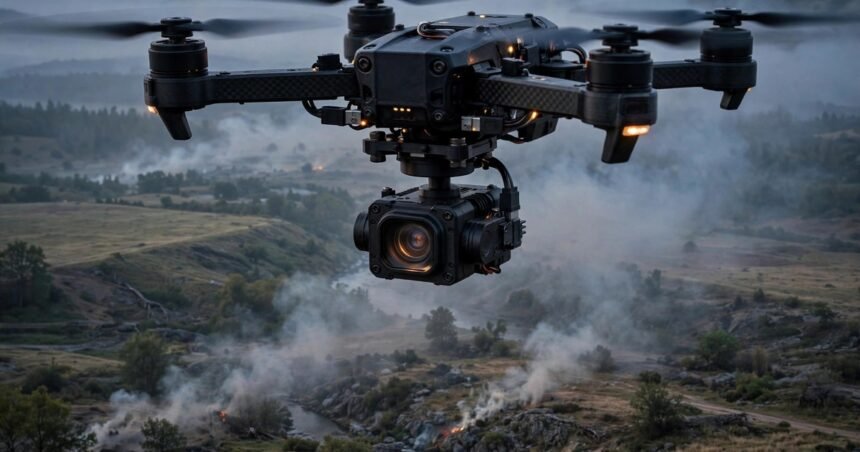
Picture a drone flying into a wall of smoke. Its ordinary camera sees nothing but grey. The people on the ground, the fire line, the stranded vehicle — all of it is hidden behind the haze. Now picture the same drone seeing straight through it, every shape crisp and clear, as if the smoke was never there. That is the power of short-wave infrared vision, and a brand-new Bengaluru startup is building the chip that could put it on every Indian drone.
Nova Spectral AI, founded in 2026 by IIT Kanpur alumni Dr Anish Priyadarshi and Sanjeev Kumar, is developing an indigenous short-wave infrared (SWIR) image sensor chip. SWIR light sits just beyond what the human eye can see, and it has a remarkable talent: it passes through smoke, haze, dust and light fog, and it keeps working in low light. Cameras built on it can see when ordinary cameras go blind.
The sensor India has always had to import
Today, SWIR cameras mostly rely on indium gallium arsenide, known as InGaAs. The company says those sensors cost thousands of dollars each and are largely imported, which keeps SWIR vision confined to high-end defence, space and industrial equipment — and has even kept InGaAs-based long-range lidar out of affordable cars. For India’s armed forces and drone makers, that dependence means the eye of the machine comes from somewhere else.
Nova Spectral AI’s answer is a change of material. Instead of InGaAs, the startup is building its sensor from lead-free indium arsenide colloidal quantum dots — tiny semiconductor crystals — deposited on standard silicon CMOS, the same manufacturing platform the world’s chip industry already runs on. Because the process is CMOS-compatible, the company says the sensors can be made at scale, using existing chip fabrication — and it is targeting sensor costs up to 100 times lower than conventional InGaAs technology.
From thousands of dollars to a sensor on every drone
That cost shift is the whole story. At today’s prices, SWIR is a luxury for a handful of high-end systems. At a hundredth of the price, it becomes something that can ride on every surveillance drone, every border patrol aircraft, every robot and autonomous vehicle that needs to see through difficult conditions. The company says its chip is designed for defence intelligence, surveillance and reconnaissance platforms and tactical drones first, and the same affordable chip could later open SWIR vision to smartphones, wearables, robots and cars.
More Read

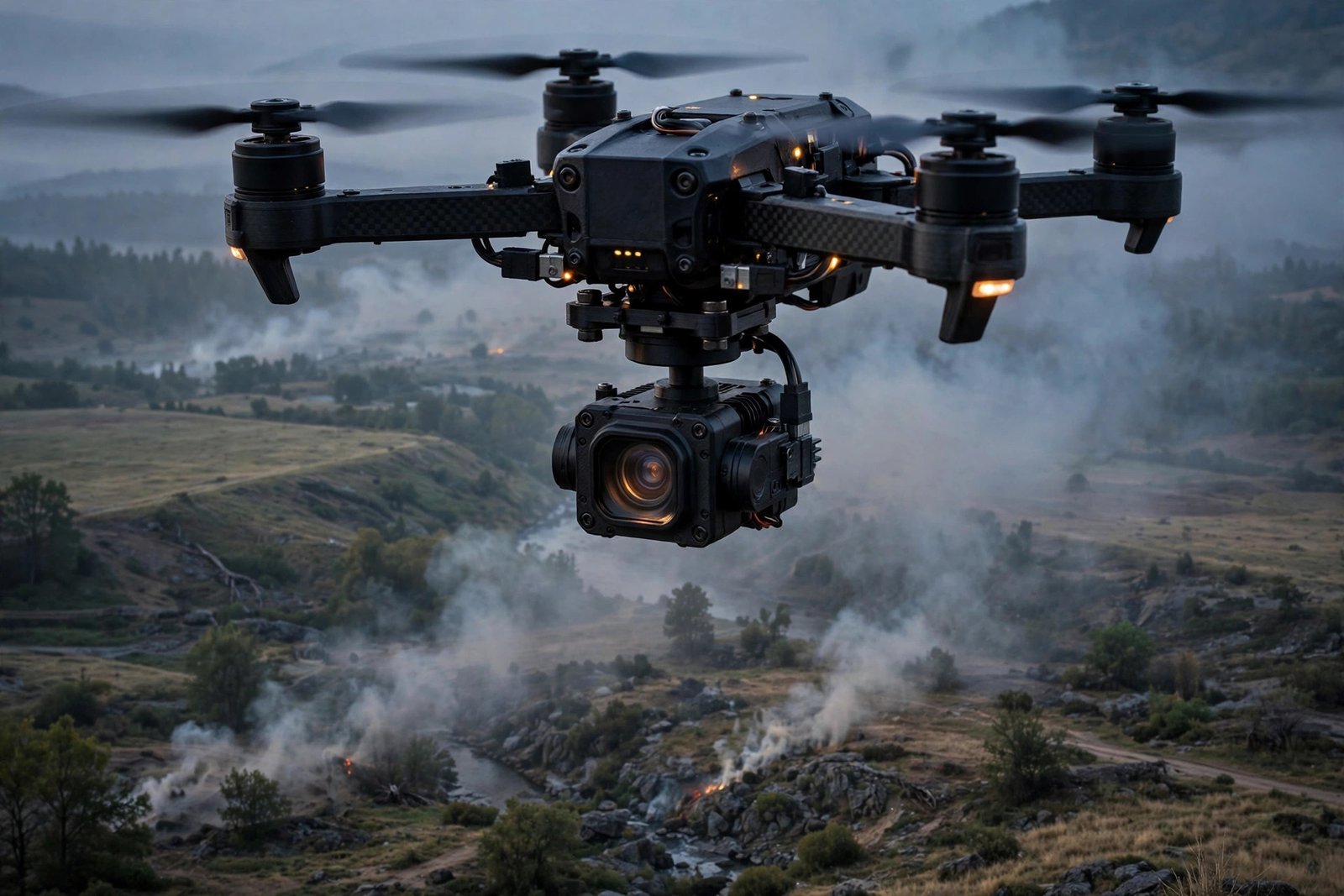
A drone-mounted infrared camera seeing through haze — the capability Nova Spectral AI’s chip is designed to deliver at a fraction of today’s sensor cost.
Built in Bengaluru, from the material up
The startup is building its team at IISc Bengaluru, where the company says it has an in-principle go-ahead to incubate. Its roadmap runs deeper than assembling a sensor: the company plans to make the quantum dot materials and the readout chip in India too, so the whole eye — material, chip and camera — is Indian. “India’s armed forces should not have to rely on an imported sensor to see at night or through smoke,” says Dr Anish Priyadarshi, co-founder and CEO. “We design and build our chip in India.”
The backing has arrived fast. Nova Spectral AI has raised Rs 21.15 crore (about $2.25 million) in a seed round led by Shastra VC, with participation from Equirus InnovateX Fund and angel investors. The company says the funding will build the team and deliver a field-ready prototype within 18 months — the first step toward giving Indian machines an affordable eye that never blinks, whatever the weather.
As India pushes to build its own defence electronics and semiconductors, the timing could hardly be better. Drones are getting cheaper and flying in ever greater numbers, and the sensors that give them sight have to keep pace. Nova Spectral AI is betting that the winning sensor will be Indian, affordable, and able to see through anything — and it is building that sensor now.
Keep reading: The Light That Carries the Internet: Inside Velmenni, the Delhi Startup Sending Data at 10 Gigabits on a Beam of Light · No Driver, No Tracks, No Downtime: Inside Robonetics, the Chennai Company Teaching Forklifts to Drive Themselves · More Industrial Automation & Technology stories
Like stories like this? Add Exceptional Technology as a preferred source on Google to see more of our reporting in your search results and Discover feed.