


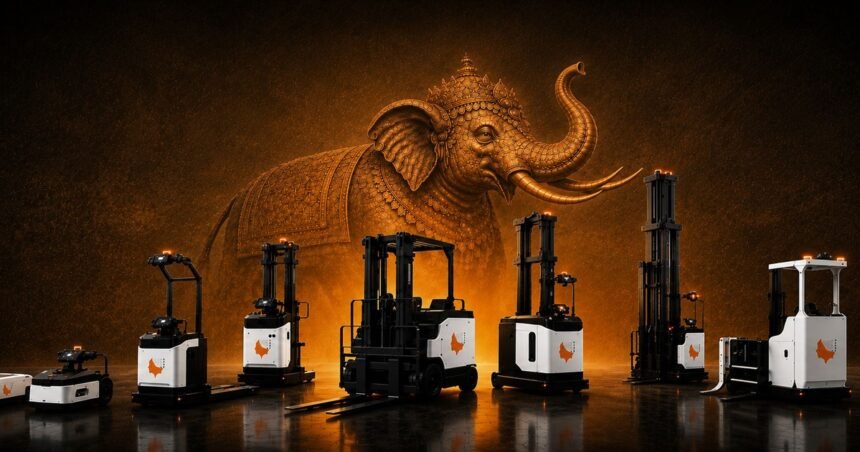
Every factory runs on a job nobody applauds: moving things. Pallets of raw material in, finished goods out, and a thousand small trips in between — the forklift ballet that keeps production lines fed and dispatch docks clear. In most Indian factories that work still depends on a human driver, a diesel or battery truck, and a shift roster. A Chennai company called Robonetics thinks the forklift itself should do the driving — and it has built a whole family of machines that already do.
Robonetics Automation Solutions, based in Chennai, builds driverless forklifts and mobile robots under its AIRA range — machines that pick up pallets, carry them across a plant, lift them into racks and set them down again, all without a driver, without magnetic tracks on the floor and without shutting the line down to install anything. The company describes AIRA as India’s first autonomous forklift, and its machines are built for the exact places where Indian manufacturing is growing fastest: automotive and tyre plants, FMCG and pharmaceutical lines, e-commerce warehouses, semiconductor and solar factories, cold stores and third-party logistics parks.
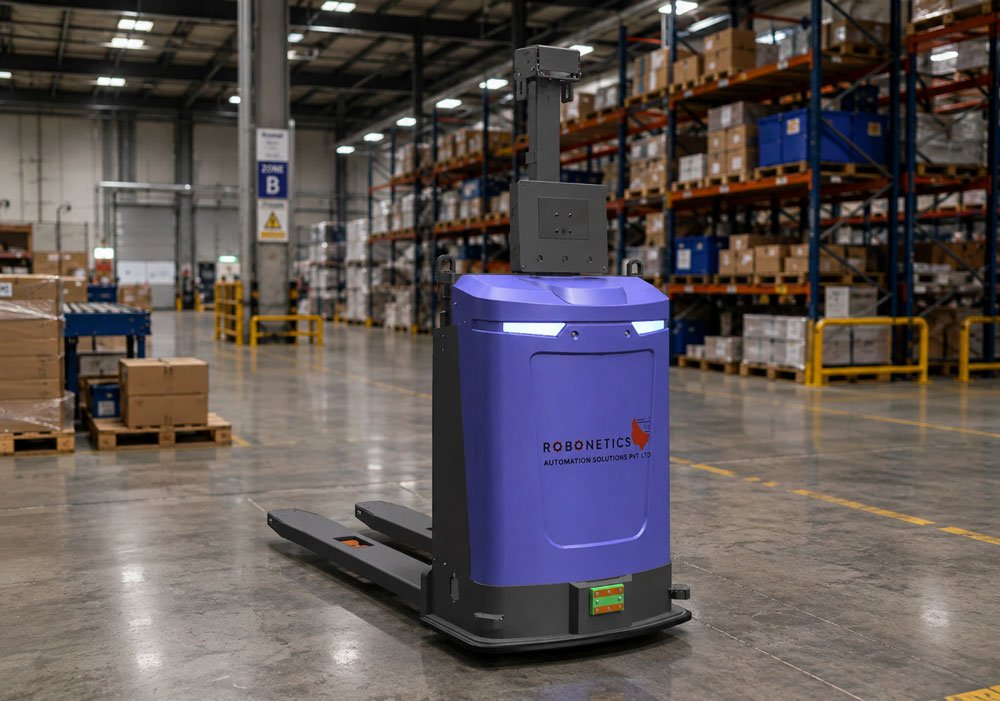
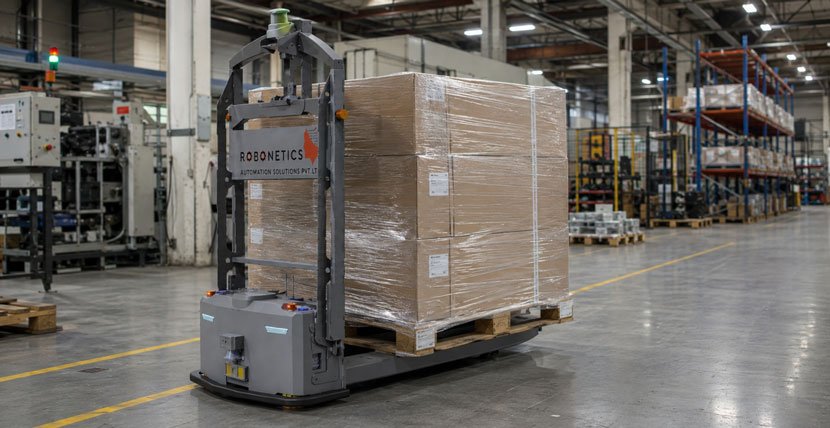
The range covers every shape of the pallet-moving job. The AIRA Mover is an AI-powered autonomous mobile robot that slides its forks under a pallet, lifts it and carries it between storage, production and dispatch — navigating with SLAM laser mapping rather than magnetic tapes or floor reflectors, so it works in an existing factory exactly as it is. The company says the Mover places pallets with ±10 mm precision, runs around the clock, and talks to the plant over Wi-Fi or 5G, taking its orders straight from ERP, MES, warehouse-management or fleet software. Its sibling, the AIRA Pallet Stacker, adds the vertical dimension: rated loads from 500 kg to 3 tonnes, a top speed of 1.5 metres per second and lifting to 5 metres, so it can feed tall racking as easily as it crosses the floor. A fork reach truck for narrow aisles and high racks, a counter-balance machine and very-narrow-aisle variants complete a lineup designed so that a factory can automate one aisle or its entire intralogistics flow.
Safety is built into the machines rather than bolted on afterwards. The company says its robots use 3D safety sensing, LiDAR navigation, obstacle detection and intelligent traffic management, so they share the floor with people, manual forklifts and shifting stock — slowing, stopping and rerouting in real time instead of demanding a fenced-off robot zone. That is what makes the machines practical for brownfield Indian plants: they drive in the aisles that already exist, beside the workforce that already works there.
Robonetics did not start as a product company. It was founded in 2018 by Prasanna Venkataramanan and Chandrasekar V, two robotics engineers with more than 15 years of experience integrating robots into factories. The company says they began in a two-bedroom apartment, first as system integrators buying robots from Germany and Japan and installing them for Indian customers — learning, job by job, what Indian factory floors actually need. That service work became the product: when they could not find machines built for Indian conditions at Indian prices, they designed their own, and now build them at their plant at Singaperumal Koil on Chennai’s southern edge. The company says its robots are also exported to customers in the USA, South Africa and Israel.
The business model is as deliberately practical as the machines. Factories can buy the robots outright, or take them through the company’s Robotics-as-a-Service and leasing programmes, which turn a large capital purchase into a running cost — a crucial difference for the small and mid-sized manufacturers who make up so much of Indian industry. The company says its automation can cut a customer’s operational costs by up to 40 per cent, by trimming manual handling, forklift traffic and idle time from the material flow.
More Read
Robonetics found a national stage in 2026 on Startup Singam, the Tamil Nadu startup reality show, where its Season 2 pitch won an ₹11 crore investment commitment — reported as the highest amount raised by a startup on an Indian reality show. The company says ₹9.5 crore of that commitment had been received by July 2026, from investors including Kumar Vembu, Rajagopal Subramanian and Shyam Sekhar, and that the funds are going into sales and expansion, with a goal of taking its automation to more than 100 companies over the next five years. The founders’ longer vision is what they call the Cognitive Factory: plants that can think, make decisions and keep evolving on their own.
That is the quiet revolution Robonetics is building: not a humanoid showpiece, but the unglamorous, essential work of moving things — done by machines that never tire, never lose concentration and never need a shift change. India’s factories are scaling up fast, and the companies that win will be the ones whose floors flow without friction. With AIRA, a Chennai team that learned its craft one installation at a time is giving Indian manufacturing the driverless workhorses to do exactly that.
Keep reading: Built for the Love of Games: Inside ARC’s X1, India’s Own Gaming Handheld · Steering Radar Beams With Silicon: Inside FermionIC Design, the Bengaluru Startup Putting India’s Radar Chips Into Production · More Industrial Automation & Technology stories
Like stories like this? Add Exceptional Technology as a preferred source on Google to see more of our reporting in your search results and Discover feed.







