More than 12 million people around the world are waiting for a corneal transplant. In India alone, the company says, 1.2 million people live with blindness in both eyes from corneal disease, another five to six million in one eye, and 30,000 new cases arrive every year. And even when a donor cornea is available, more than half of donated corneas do not meet transplant standards. The maths of sight, in other words, does not add up — there will never be enough donor corneas for everyone who needs one.
In Bengaluru, a biotechnology company has spent fifteen years working on a different answer: if there are not enough corneas to go around, grow the cornea where it is needed. That answer is a clear liquid called Kuragenx — and the company behind it is Pandorum Technologies.
A decade of printing living tissue
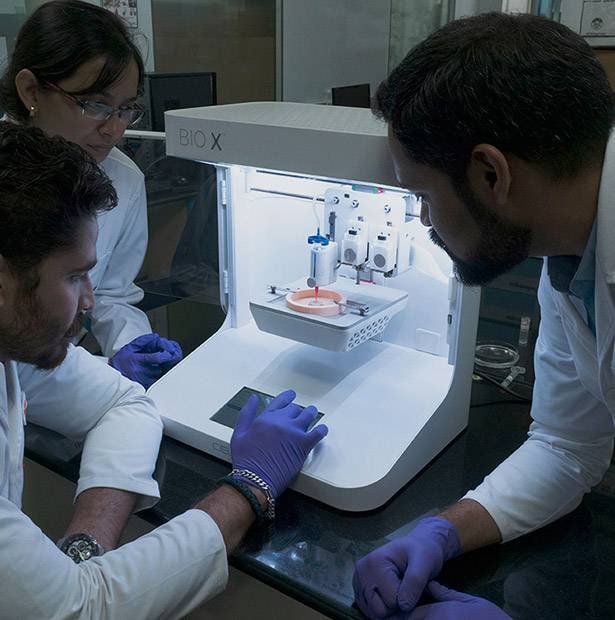
Pandorum began in 2011, founded by Arun Chandru and Dr Tuhin Bhowmick, two graduates of the Indian Institute of Science who had been dreaming about on-demand human organs since 2009. Their first landmark came in December 2015, when the company created India’s first 3D-bioprinted artificial human liver tissue — a 5-millimetre mini-liver built from 10 million human liver cells, arranged in three-dimensional architecture inside a hydrogel bio-ink, that stayed alive for weeks outside the body and behaved like real liver tissue.
The mini-liver was never meant for transplant. It was a test platform: a tiny, living piece of human liver on which new drugs could be tried for safety and efficacy before they ever reached a patient. It proved the core idea that has driven Pandorum ever since — that living cells and biomaterials can be printed, layer by layer, into functional human tissue.
A cornea you inject, not transplant
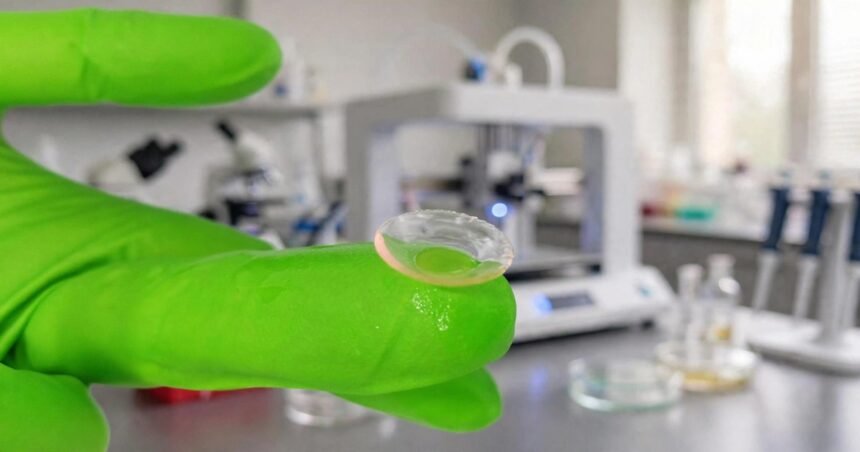
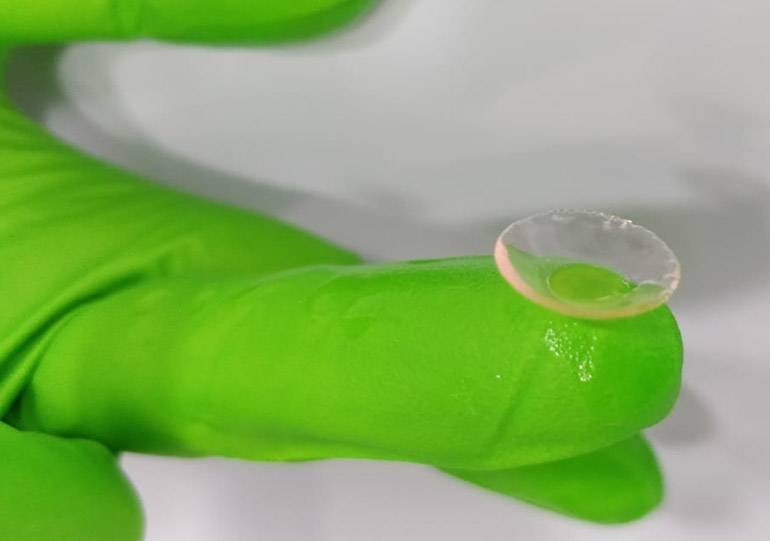
The cornea turned out to be the perfect first test of that idea. It is small, relatively simple, and the treatment is local — and the need is enormous. Kuragenx, the company’s lead programme, is what Pandorum calls a “liquid cornea”: a transparent liquid made of a hydrogel mixed with cornea cells. It is injected directly into the eye and solidified with visible light and a cell-friendly photoinitiator, regenerating the damaged cornea in place.
The company says the approach needs no donor cornea, no surgery and no sutures, with faster recovery than a transplant. In animal studies, the liquid cornea has supported the transparent, scarless regeneration of corneal tissue — the kind of healing that restores vision rather than merely patching it. In 2023, the US Food and Drug Administration granted Kuragenx Orphan Drug Designation for neurotrophic keratitis, a form of ulcerative corneal blindness that is currently untreatable, and the company has completed its pre-IND meeting with the FDA on the road to clinical studies.
More Read

Four technologies, one platform
Behind Kuragenx sits a platform Pandorum has built across four disciplines. Its bio-materials work produced a cornea-specific bio-ink with native-like transparency and mechanical properties. Its cellular engineering scales up mesenchymal stem cells — the feedstock for both cells and exosomes. Its exosome and nanotherapy work turns stem-cell-derived exosomes, tiny vesicles that carry regenerative signals between cells, into what the company calls regenerative cell modulators. And its bio-fabrication arm runs the proprietary 3D bioprinting that assembles living cells and bio-inks into complex tissue.
The same platform reaches beyond the eye. The mini-liver continues as a drug-discovery model, and the company is developing exosome therapies for lung regeneration, aimed at the inflammation and fibrosis left behind by severe lung injury. It is one technology base, pointed at every tissue it can learn to rebuild.
From the lab toward the clinic
The last two years have turned Pandorum from a research story into a clinical one. An $11 million pre-Series B round in March 2024 was followed by an $18 million Series B in February 2026, led by Protons Corporate, to advance Kuragenx through clinical development and scale up manufacturing. The company has partnered with AGC Biologics for the clinical manufacturing of Kuragenx, and is preparing first-in-human studies in India, the US and Japan with clinical partners including LV Prasad Eye Institute, the Medical University of South Carolina, Dr Shroff’s Charity Eye Hospital in New Delhi and Kyoto Prefectural University of Medicine.
Closer to home, the momentum continued in October 2026, when Nucelion Therapeutics — the gene-therapy arm of Bharat Biotech — partnered with Pandorum on two ophthalmology programmes, for advanced keratopathy and wet age-related macular degeneration, with a combined outlay of about ₹17 crore, including up to ₹8 crore in funding under the Centre’s PRIP scheme. It is Indian manufacturing and Indian science, joining forces on therapies the world has not had before.
Why it matters
Pandorum’s work matters because it attacks the cruelest part of corneal blindness: not the disease, but the waiting. A transplant list is a queue for someone else’s tragedy, and for millions of people the queue never moves. A cornea that can be grown, carried in a vial and set with light breaks that queue entirely — sight restored not by a donor, but by engineering.
It is also a glimpse of where Indian biotechnology is headed. Fifteen years ago, two IISc graduates set out to print human organs on demand. Today their company holds an FDA designation, a global manufacturing partnership and a pipeline that runs from corneas to livers to lungs. The mini-liver proved India could print living tissue. The liquid cornea may prove it can heal with it. That is the kind of alchemy Indian engineering does best.
Keep reading: The Tomato That Became Leather: Inside Bioleather, the Indian Material Turning Farm Waste Into Fashion · Five Tests in One Handheld: Inside Yostra’s NEURO TOUCH, the Bengaluru Device Catching Diabetic Nerve Damage Early · More Chemicals, Materials & Life Sciences stories
Like stories like this? Add Exceptional Technology as a preferred source on Google to see more of our reporting in your search results and Discover feed.