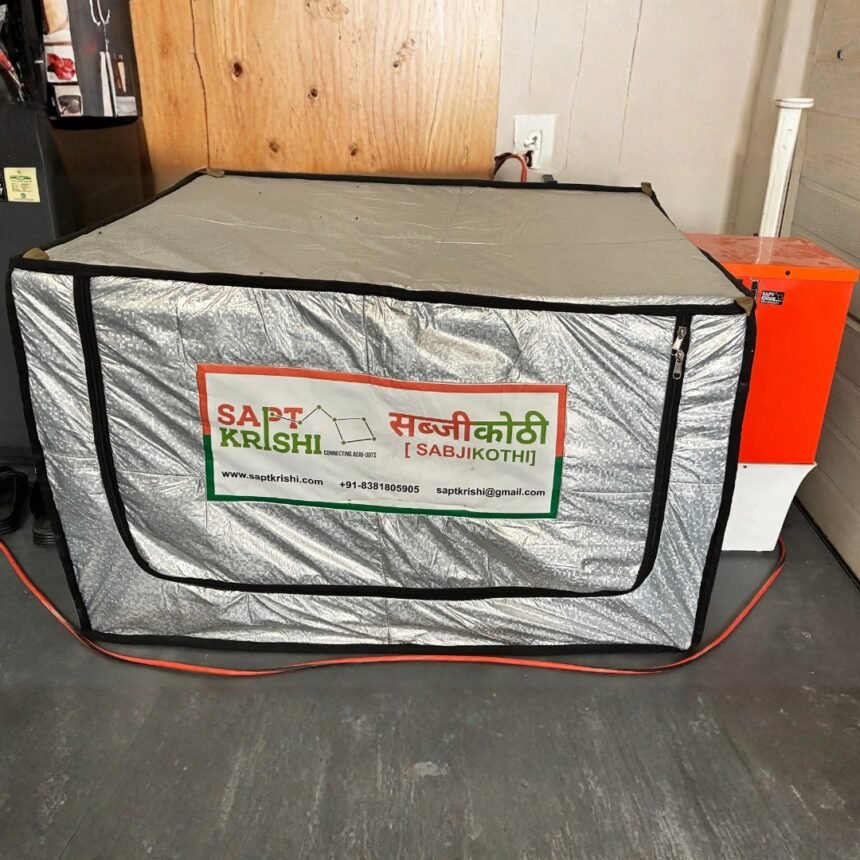
India grows more fruit and vegetables than almost any country on Earth, yet nearly a third of the harvest never reaches a plate. It wilts on the way to the mandi, rots for want of a cold room, or gets sold for a pittance because there is nowhere to keep it fresh. In a village in Bihar’s Bhagalpur district, a brother and sister decided that was a problem you could engineer away. Their answer is Sabjikothi — a box that keeps vegetables fresh for up to 30 days, with no fridge, no chemicals, and about as much electricity as a phone charger uses.
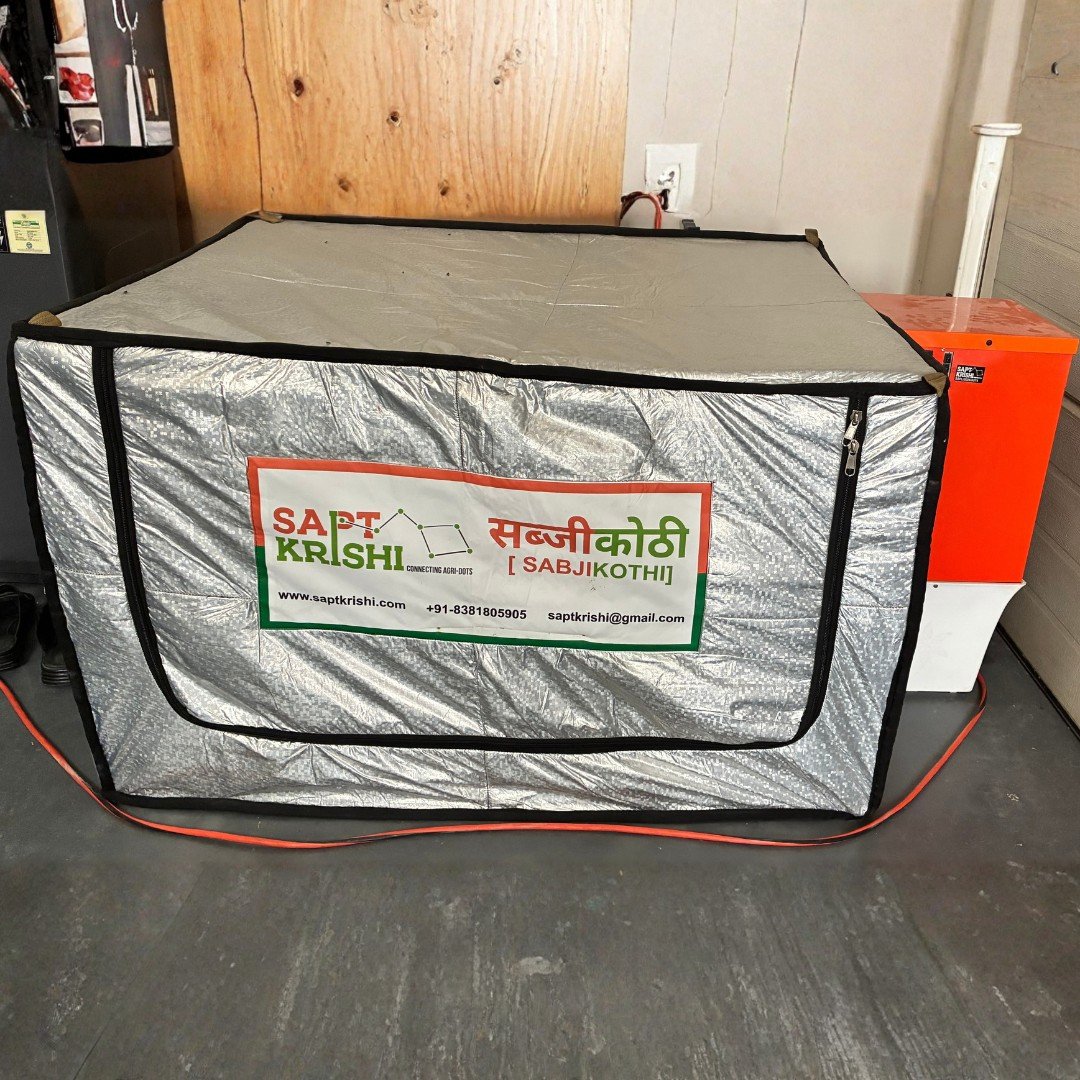
The Sabjikothi Electric unit — the insulated chamber and control box that hold the microclimate steady. (Image: Saptkrishi)
The idea began with Nikky Kumar Jha’s master’s dissertation at Nalanda University. Growing up in Naya Tola Dudhela, he had watched farmers in his village lose nearly a third of their horticulture produce to the simple absence of storage and reliable electricity. With his younger sister Rashmi, a biotechnologist, he turned that dissertation into a company: Saptkrishi, founded in 2019, incubated at IIT Patna and accelerated at IIT Kanpur. The first commercial Sabjikothi launched in 2023, and the company says thousands of farmers now use it.
A fridge that isn’t a fridge
Sabjikothi works by changing the air around the produce rather than chilling it. Inside an insulated chamber, the system builds a humid, near-sterile microclimate and oxidises ethylene — the gas that makes fruit and vegetables ripen and rot — into harmless hydrogen, carbon dioxide and water vapour. The company says the microclimate slows ripening and browning and keeps the produce’s natural freshness, stretching shelf life to between three and 30 days depending on the crop, or three to four times longer than leaving it in the open.
What makes it remarkable is how little it asks for. The company says a unit runs on around 20 watts of power and about a litre of water a day, and works on grid electricity, solar or battery backup — so it keeps working in villages where the power does not. There are no chemicals involved and nothing to refrigerate, and the units are wheel-mountable, so they can ride on e-rickshaws, mini-trucks and hand carts from the field to the market.
More Read

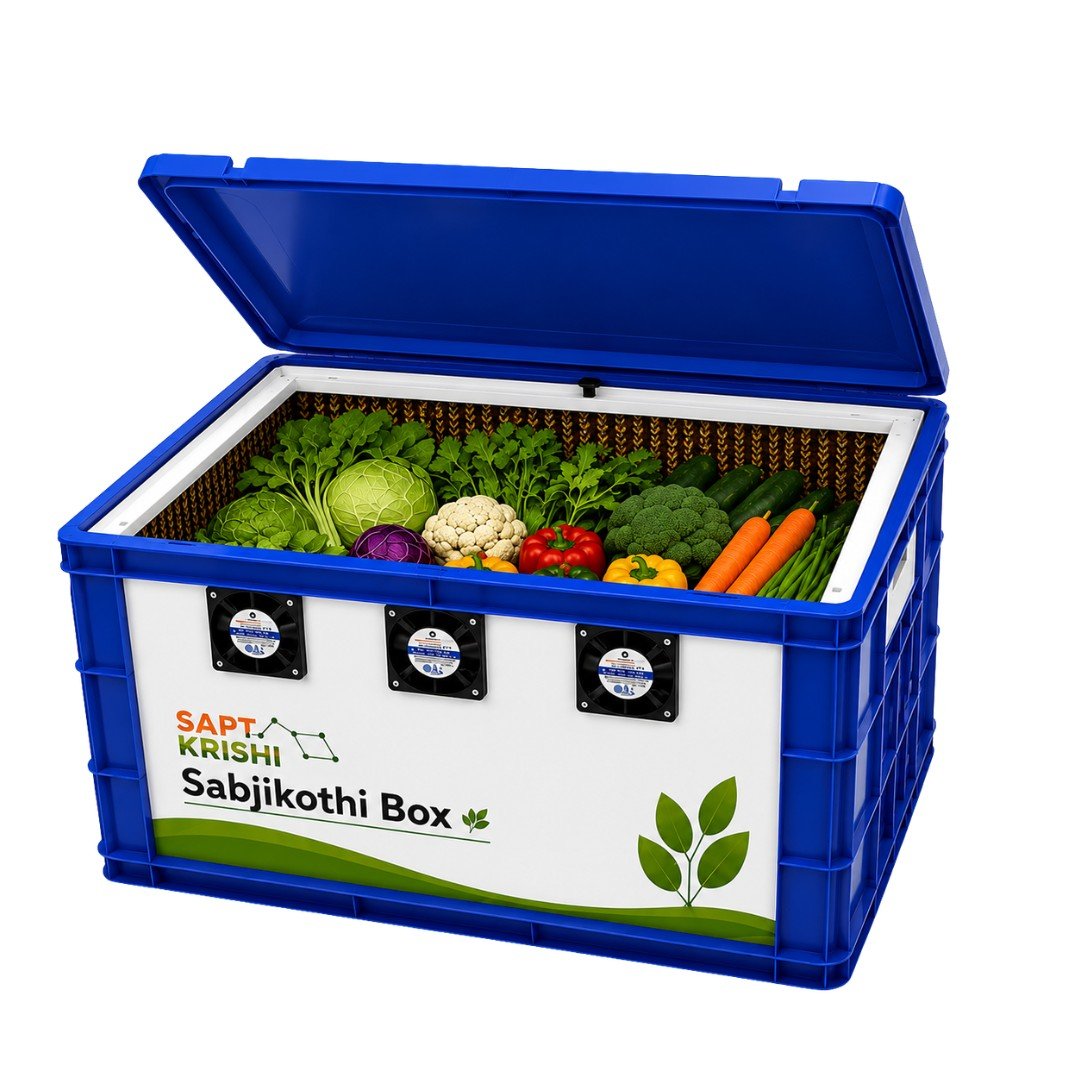
The Sabjikothi Box — the smallest unit in the range, built for vendors and small farmers. (Image: Saptkrishi)
From a tent in Bhagalpur to a product line
What began as a single tent-like chamber is now a full range. The company’s shop lists the Sabjikothi Box at ₹3,900, the Electric unit at ₹16,250 and the Solar unit at ₹29,250, rising through wheeled carts and a solar e-cart called the Annapurna Rath to a container-scale Jumbo unit. A network of farmgate micro-entrepreneurs in Bhagalpur, Patna and Kanpur buys produce from farmers through the company’s app and sells it on to consumers, so the storage reaches the farmer instead of the farmer having to reach a cold chain.
The work has picked up recognition along the way: the company was a 2023 MIT Solve Solv[ED] Youth Innovation Challenge winner, made the top eight of the UNCDF Nepal Innovation Challenge for agritech, was shortlisted under the Rashtriya Krishi Vikas Yojana with validation from SKUAST-Jammu, and was featured on Shark Tank India. The company says Sabjikothi cuts post-harvest losses by more than 40% and lifts farmers’ and vendors’ incomes by more than 30%.
Why it matters
India’s cold-chain capacity falls short by 126 lakh tonnes, according to the National Centre for Cold Chain Development — and a cold room, however good, is no use to a farmer who cannot afford the trip to it. Sabjikothi flips that logic: instead of bringing the harvest to the cold chain, it brings a little pocket of the cold chain to the harvest, at a price a small farmer can actually pay. For the family growing tomatoes in Bhagalpur, that is the difference between selling today at whatever price the mandi offers and selling next week at the price the crop deserves. A box, a litre of water, twenty watts — and vegetables that stay fresh long enough to be worth something.
Keep reading: Cleared for Takeoff Over Indian Fields: Inside Kothari’s KOAIR-10L, the DGCA-Certified Farm Drone · The Ponds That Breathe on Their Own: Inside Bariflo, the Odisha Startup Giving Fish Farms a Nervous System · More Food Processing & Agri-Tech stories
Like stories like this? Add Exceptional Technology as a preferred source on Google to see more of our reporting in your search results and Discover feed.